Ch.
3:
Strategic Management
The
External Environment
Chapter
3 questions:
1. What
is an industry?
2. What
is the Porter Model, and what use does it serve?
3. What are the stages of an industry’s
evolution?
4. WHAT specific factors should I study in
learning about a firm’s environment?
5. What TOOLS may I use to analyze a firm’s
environment?
What
is an INDUSTRY?
A group of companies offering products or
services that are close substitutes for each other.
Close substitutes are products or services that satisfy the same basic need.
What
is the Porter Model, and what use does it serve?
ANSWER:
It
is used to analyze a firm’s industry, and the firm’s position in it.
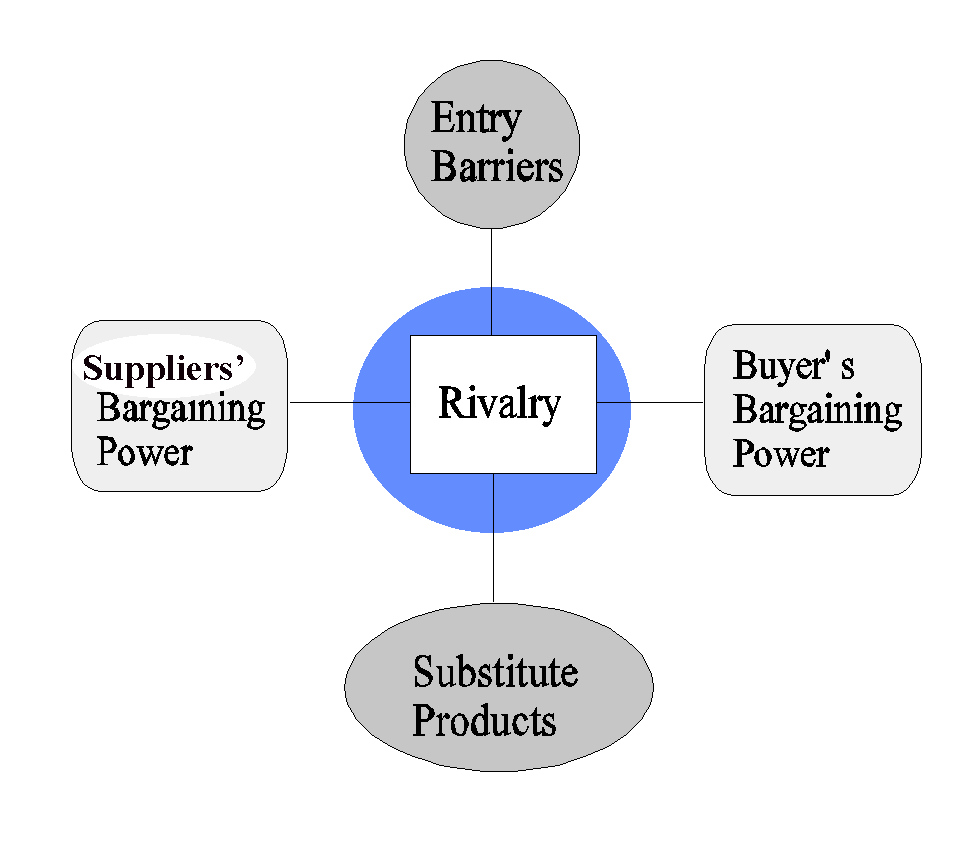
Two Questions Porter's Model seeks to Answer:
1.
Why are some industries structured for profitability?
2.
What is my company's position within its industry?
How
is my company doing?
Force
#1:
Entry Barriers = Risk of Entry.
Refers
to risk of competitors coming into your industry.
Impact of New Entry:
Expands supply,
Depresses prices, profit
High
risk of entry = Threat
Low
risk of entry allows established companies to raise prices.
Liklihood
that firms will enter industry a function of two factors:
–
Barriers to entry,
–
Retaliation from current industry participants
Characteristics
of Industries with HIGH entry barriers:
1. Brand loyalty and
high switching costs
2. Absolute
cost advantage over potential entrants.
3. Cost economies of
established Companies, and matching Capital Equipment
4. Access to distribution
channels
Force
#2: Rivalry among established
companies.
Strong
rivalry is a threat to established companies.
Weak rivalry provides opportunity to raise prices to earn more.
Rivalry
depends on:
1.
Industry competitive structure (fragmented or consolidated)
2.
Demand conditions
Characteristics
of Rivalrous Industry:
Many
firms ... OR ...
A
few firms of equal size and power
Slow
industry growth -- SOM fights
High
fixed costs or storage costs
excess capacity and low prices to
dump
Low
switching costs
High
exit barriers
These
tend to create HIGH exit barriers:
Investments
in specialized assets,
High
fixed exit costs, e.g. severance ($)
Emotional
attachments to an industry
Strategic
relationships between business units
Dependence
on an industry
Low entry barriers
Commodity-type
products hard to differentiate
When entry barriers are Low...New entrants
will flood to cash in on boom.
Excess
Capacity will be created, companies
will lower prices to be rid of excess capacity. (AOL Example)
This
cycle will continue until capacity is in line with demand (via bankruptcies), at
which point prices will stabilize again.
Force #3:
Bargaining Power of Buyers
Buyers can force down prices or demand higher quality, thus may be threats
E.g. Prescription drug buyers' demand
for generic drugs.
Characteristics
of powerful buyer groups:
Purchase
large portion of industry’s output
Product
being purchased from industry accounts for significant portion of buyers’
total costs
Buyer
can switch to another product at any time
Industry’s
products are NOT differentiated, buyer COULD vertically integrate backward.
Force
#4
Bargaining Power of Suppliers
Characteristics
of Powerful Suppliers:
Few
suppliers in industry
Substitute
products are NOT available to buying industry firms
Customers
of supplying firms buy in small quantities, and are therefore NOT powerful.
Goods
are CRITICAL to industry success
Suppliers
may integrate FORWARD
Force
#5 Substitute
products
Substitute
products limit price companies in industries can charge without losing customers
to makers of substitutes.
Closer
the substitute, greater the threat.
Studying
company's competitive position in industry:
1. Analysis
of Industries should be the start of any strategic process.
2. All
industries differ with regard to which force is most significant
3.
Companies have to be on the constant lookout for change.
4.
Companies have the power to shape their industry.
Studying
company's competitive position in industry:
5.
Companies have the power to DESTROY their industry -- make the five
forces worse.
6.
Impact of government is best viewed by looking at how government action
effects each of five forces.
STRATEGIC
Groups:
A group of companies within an industry that are pursuing the same basic
strategy.
Consumers
tend to view all products in group as substitutes for one another.
Mobility
barriers inhibit movement between groups...
Similar to entry barriers in industries.
U.S.
Restaurant Chain Industry Groups:
Mobility
Barriers
Prevent
movement between strategic groups.
Analogous
to entry barriers
Brand
loyalty, cost advantages, economies of scale
Role
of Innovation:
Alters
industry conditions across 5 forces
Industry
will be PUNCTUATED by dramatic, rapid change
= Punctuated Equilibrium
Hypercompetition
Many
industries are characterized by permanent and ongoing innovation
Constant
change
How
does this complicate our use of Porter’s model?
What
are the stages of an industry’s evolution?
Embryonic
Industry
Just
beginning to develop
Slow
growth
Poor
distribution
High
prices
Barriers
to entry based on technological know-how
Growth
Industry
First-time
demand expands rapidly
Demand
takes off
Little
rivalry
Why? Companies can expand
revenues without taking away business from competitors
Industry
Shakeout
Rate
of industry growth slows down
Demand
approaches saturation
Most
of demand limited to replacement
What is replacement demand?
Rivalry
between companies is intense
Mature
Industry
Market
is totally saturated
Demand
totally limited to replacement
Growth
is low, or is zero
Growth
that does exist is via population growth
Competition
for share can lower prices
Most
industries have consolidated, become oligopolies.
Companies
recognize interdependence, avoid price wars.
Declining
Industry
Growth
is negative (shrinking business) due to:
Technological substitution, social changes, demographics, international
competition
Falling
demand leads to excess capacity, leads to price wars
WHAT
should I study in learning about a firm’s environment?
Factor
conditions = a bundle of internal,external factors
General
environment factors
Industry
environment
Internal
factors (next chapter) =
resources, capabilities,
core competencies
What
are factor conditions?
Cost
and quality of factors of production.
Vary
from country to country
BASIC
factors:
Land, labor, capital, raw materials
ADVANCED
FACTORS:
Technological know-how, managerial sophistication, physical
infrastructure
General
Environmental Factors:
Demographics
Economics
political/legal
issues
sociocultural
issues
technological
issues
global
issues
What
TOOLS may I use to analyze a firm’s environment?
Porter
Framework
SWOPT
The
Process Model of External analysis
Industry
environment:
Analyze using Porter Framework:
Entry
barriers
Threat
of Substitutes
Bargaining
power of suppliers
Bargaining
power of buyers
Rivalry
Another tool for logging key
environmental factors, and then prioritizing
them:
SWOPT
analysis
SWOPT
Strengths
Weaknesses
= internal to firm
Opportunities
Problems
= involve externalities
Threats
= may occur in future
The
Process Model of External Analysis
FOUR
STEPS:
Scanning
=
What early warning signals do I see?
e.g., corrugated cardboard sales, housing sales.
Monitoring
= Are any trends emerging?
Forecasting
=
From above 2 steps, what might happen in future, and how quickly?
Assessing
=
How will above affect our strategies?