Week 2:
A. Reality and Assessment,
B. Teambuilding Ingredients
Agenda
Review
Discuss ONE of readings… what do managers do?
Talk about assessment instruments you’re going to take
Talk about your first learning log
Suggestions for format
Create a table, then discuss it
Introductions
Refresher from last week’s lecture/s:
Managers get things done through other people.
Managers’ jobs involve:
Functions
Roles
Behaviors
A.
Reality and Assessment
What REALLY happens when you begin your FIRST NEW management job?
How well equipped are YOU?
How do new, first-time managers view their jobs? What are they hired to do?
? What have we learned?
Becoming a Manager:
Linda Hill (HBP, 1992)
New managers think of their jobs as being TASK oriented
Focus on budget
Focus on revenues
Focus on getting the job done by working hard THEMSELVES, as individuals.
It all goes back to their PRIOR experiences, and motivations.
Managers were stars -- INDIVIDUALS.
Sought out management jobs to gain MORE authority, power.
Wanted to have the same perq’s (perquisites) as their bosses.
Rights, Privileges
Looked at their abilities as directly translatable to new job.
What it Means to be A Manager
Summary:
They didn’t understand what getting work done through others MEANT
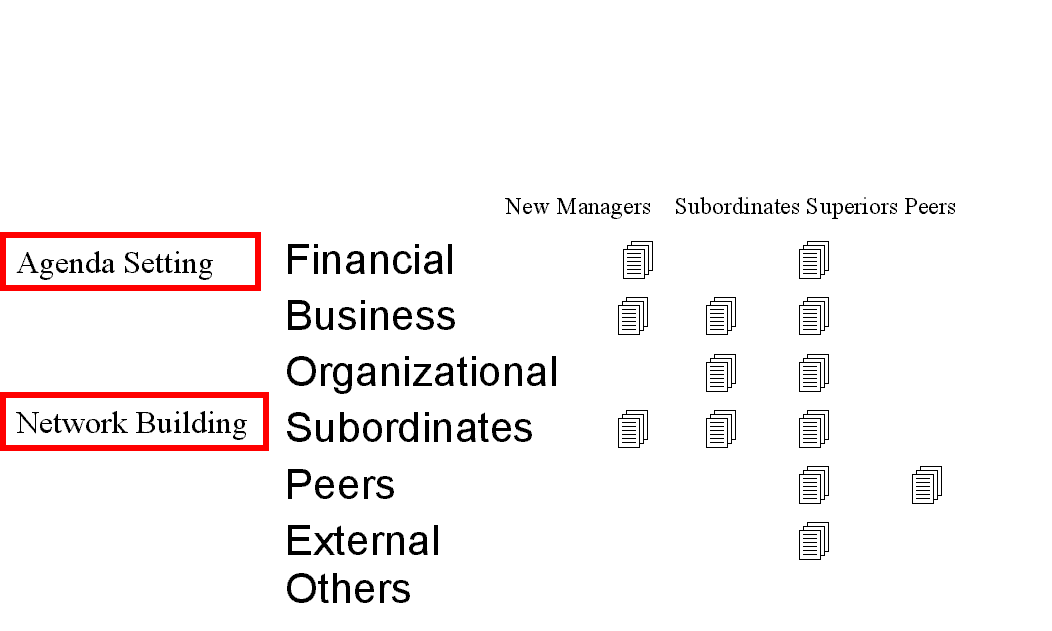
New managers tend to focus on issues related to:
Formal authority,
Agenda-setting responsibilities
Financial matters,
Business matters
Overlooked:
Network-building
A typical day:
Work on many problems simultaneously.
Constantly interrupted.
Have dozens of brief interactions with MANY people.
Read from pages: 56, 61
What’s the most COMMON mistake most new managers make?
Falling back on their previous roles as INDIVIDUALS…
Doing their subordinates’ jobs, instead of helping them develop.
Read from page 63
Where does this take us?
Many new managers "flush out" before they REACH the conclusions we’ve pointed out.
What do YOU need to do to make sure you CAN develop your staff, network with others and act as a liaison?
Network
Linda Hill on Business Education
With few exceptions, the schools emphasize functional expertise and spend little time developing interpersonal judgment and skill. Usually students must themselves connect theory and practice. And classroom learning is rarely supplemented with experiential exercises.
Until schools reconceptualize their traditional role of discovering and imparting cutting-edge knowledge to include that of helping future managers learn how to learn from experience, it is difficult to imagine how much progress they can make. (Page 275)
Self Assessment
Tolerance of Ambiguity
Locus of control
Assessing yourself: 1A
Big 5: 1B
Self monitoring: 1C
Social Mirror: 1D
Selective perception: 1E
EIQ: 1F
Assessing yourself: 2A
Johari Window: 2F
Tolerance of Ambiguity
A measure of attitude toward change
The higher the score the GREATER INTOLERANCE you possess
NOT related to intelligence
Positive correlation between tolerance of ambiguity and INTERNAL locus of control
Tolerance of Ambiguity Subscales
Novelty = tolerance of unfamiliar information
Complexity = extent to which you are tolerant of multiple, distinctive, unrelated information
Insolubility = extent to which you are tolerant of problems that are very difficult to solve
e.g., many alternative solutions, unavailable information, unrelated problem components
What does a high tolerance mean?
You pay attention to more information, interpret more cues.
Better transmitters of information
More sensitive to internal (non-superficial) characteristics of others when evaluating their performance at work.
More behaviorally adaptive and flexible under ambiguous and overloaded conditions.
Locus of Control
Internal = LOW SCORE
I was the cause of the success or failure of the change.
External = HIGH SCORE
Something or someone else cause the success or failure.
What does having an INTERNAL locus of control mean?
Less alienated from work, more satisfied in jobs, experience less job strain
Are more mobile
More likely to be leaders, more effective leading groups, and perform better in chaotic situations
Engage in more entrepreneurial activity
More active in managing own careers.
Use persuasion &expertise NOT coercion
Bad news about internals:
Less likely to follow directions
Less accurate processing feedback about successes and failures
Locus can SHIFT over time.
Assessing yourself: 1A
Focuses on current and preferred ways of understanding self in relation to others
Why is self awareness such a big deal?
"Know thyself," Socrates
Knowing your strengths and weaknesses is part of being a good leader
Daniel Goleman, "What makes a Leader" Harvard Business Review 1998
What is self awareness?
Knowing your motivations, preferences, personality
How these influence judgment, decisions, interactions with other people
Starting point for effectiveness at work.
Benefits of self awareness:
Understanding yourself, relative to others
Developing and implementing a sound self-improvement program
Setting appropriate life and career goals
Developing relationships with others
Managing others effectively
Increasing productivity
Increasing your overall ability to contribute to organizations, community, family
How to gain self awareness:
Analyzing your own:
Behavior
Personality
Attitudes
Perceptions
Big 5: 1B
What is personality?
Describes relatively stable set of characteristics, tendencies, temperaments that have been formed by inheritance, and by social, cultural, and environmental factors.
Big 5 model
Extroversion
Agreeableness
Friendliness, reserved, cooperative, guarded, flexible/inflexible, trusting, etc.
Emotional stability
React impulsively? Weigh options before acting?
Conscientiousness
Dependable, consistent, can be counted on
Openness to experience
Interest in broadening horizon
Self Monitoring: 1C
Self monitoring at work
Avoid extremes
Don’t want to be high self-monitor solely concerned with what others thing
Don’t want to be a low self monitor not at all interested in what others thing.
Social Mirror: 1D
Stephen Covey
How do others view us?
How are we shaped by others’ opinions of us?
We adopt a view of ourselves based on OTHERS’ views of us.
Learning to accurately read how others view us enhances our "self maps."
Selective perception: 1E
We are bombarded with information
Internet, tv, radio, word of mouth
We constantly FILTER information out
Absorbing and processing only those inputs we think we can handle, or want to handle
Can HINDER communication with others
Keep an open mind, stay "tuned in."
EIQ: 1F
Aristotle
Anyone can become angry – that is easy. But to be angry with the right person, to the right degree, at the right time, for the right purpose, and in the right way – this is not easy.
More on EIQ
Having and expressing emotions is a GOOD thing. But… expressing emotions requires an innate sense of what’s appropriate to say, when, where, and with whom.. EQ is developing an awareness of your feelings and emotions and using them in appropriate ways.
Six fundamentals for EQ
Self awareness
Self regulation
Motivation
Empathy
Social Skills
Group work skills
Assessing yourself: 2A
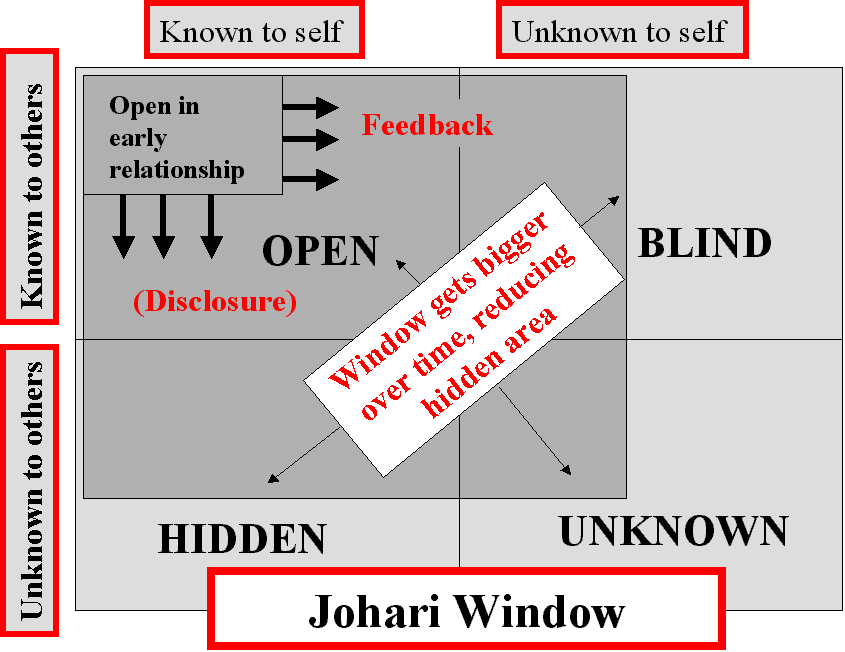
Focuses on preferred methods of self disclosure
Johari window: 2F
4 grids
Premise: More open you are, better quality relationships you’ll have
Assessment:
Based on your reading & enhanced knowledge of what managers do WRONG when they they about their jobs…
How well equipped are YOU for the job of a manager?
What do YOU need to work on.
Summarize findings for 5 minutes, then discuss in team.