
Drunken
Boxing
A little info on my favorite style drunken boxing
Elements of Chinese martial arts originated more than six
thousand years ago as the first cavemen learned simple
blocking and striking techniques to protect themselves. The
first documented form of Chinese martial arts, classical
Chinese wrestling, is noted in the texts written by and
about the legendary Yellow Emperor, Huang Ti, in the first
half of the third millennium B.C. Over the ensuing years,
other forms of Chinese martial arts evolved.
In about 525 A.D., a holy man named Bodhidharma left his
monastery in Southern India to spread the Buddhist faith to
China, later called Ch'an Buddhism. (Ch'an is the Chinese
translation for the Sanskrit word "dhyana" meaning yogic
concentration. Also known as Zen.). After traveling
hundreds of miles to reach Northern China and crossing the
Himalyan mountains, he crossed the Yangtze River and headed
North to Loyang, the capital of Honan Province.
In a neighboring forest, he found the Shaolin Ssu (Young
Forest Temple). The temple had been built by Emperor Hsiao
Wen of the Northern Wei dynasty (386-534 A.D.) and was
famous for scholarly translations of Buddhist scripture
into Chinese. Bodhidharma located a nearby cave, where he
sat in meditation facing a stone wall for most of the next
nine years. Various stories have arisen regarding his
meditation practices - it was said that he could hear the
screeching of ants crawling along the rock face. Another
time, he supposedly fell asleep while meditating and cut
off his eyelids to prevent that from happening again. At
the end of nine years, Bodhidharma's deep blue piercing
eyes had apparently drilled a gaping hole in the cliff wall
and Fang Chang could no longer refuse him entry into the
temple.
Bodhidharma became the first Tsu (patriarch, literally,
ancestor) of the Ch'an sect in China. He saw that the monks
were weak and could not perform his rigorous meditations so
he incorporated some calisthenics into the monks' training.
These in-place exercises were transcribed by later monks as
(1) "The Muscle Change Classic" or "The Change of the
Sinews," (2) "The Marrow Washing" and (3) "The Eighteen
Hand Movements of the Enlightened One" (The Eighteen Lo Han
Shou) and marked the beginning of Shaolin Temple boxing.
Bodhidharma later devised some self-defense movements based
on his knowledge of Indian fighting systems. His emphasis
on "Chi" (intrinsic energy which can be cultivated with
breathing exercises and meditation) is still an essential
foundation of Shaolin Kung Fu.
Bodhidharma's teachings were further enriched and refined
by succeeding Shaolin masters to become the powerful and
graceful Shaolin Temple boxing (also known as Shaolin
Ch'uan [Shaolin Fist] or Shaolin Ch'uan Fa [Way of the
Shaolin Fist] ).
Since bandits frequently attacked the temple, the Shaolin
hired kung fu masters to teach the monks to defend
themselves. Eventually, the Shaolin fought off the
attacking bandits and became reknown for their martial arts
prowess.
Then, in 1644 A.D., the Manchus came to power (Ch'ing
Dynasty 1644 -1911 A.D.). Many of the officials from the
previous M'ing dynasty sought refuge in the Shaolin temple
and the Manchus destroyed the temple. Only five masters
escaped - those who went north taught the taller
Northern/Mongolian people accustomed to a cold and rigorous
climate, while those who went south taught the shorter
Southern people accustomed to a warmer climate.
The first Shaolin Ssu has long since been destroyed, but
several branches of Shaolin Kung Fu stemming from the first
temple have spread out throughout China and the world.
Today, the two most well-known branches are Northern
Shaolin and Southern Shaolin.
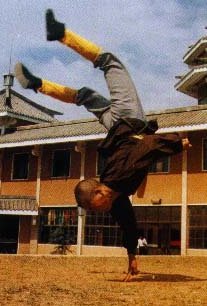
"Have you ever seeen a BBoy do this?"
In the colder Northern regions of China the ground was
hard, allowing more stability when kicking and stepping.
Therefore, Northern Shaolin styles emphasize kicking,
long-range, acrobatic, and ground-fighting techniques. Many of the fancier kicks are acrobatic and graceful as well as
powerful, but the basic kicks can be effectively applied by any well-trained student.
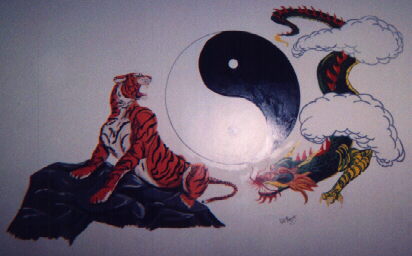
In the warmer Southern regions of China, the ground was
softer and often muddy, making kicking and stepping more
difficult. As a result, Southern Shaolin emphasizes higher
stances and hand techniques. The practitioner of Southern
Shaolin will patiently wait for an attack, then quickly
block and counter as the opponent strikes, catching the
opponent off guard.
copyright 1999 drunkmonk ent.