Housing
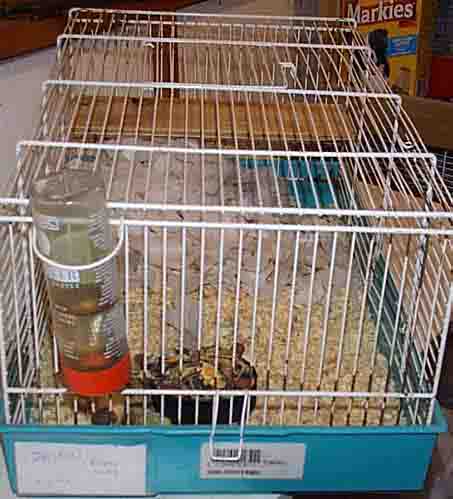
Choosing a cage
The following guidelines are designed to help you
choose a suitable cage. Most pet shops will stock a number of cages that meet all
these criteria. In this case the decision is then up to your personal
preference. Remember also that a hamster's enclosure does not have to be literally a
cage; old aquaria can make excellent hamster homes, provided that they are fitted with a
tight fitting, ventilated lid.
Guidelines
- The cage must be escape proof,
as hamsters are expert escape artists. They can also squeeze through unbelievably
small spaces, (less than 1" square for Syrian hamsters, 0.5" square for other
species).
- If the cage is mainly plastic
it must not have any edges that the hamster might chew.
Your hamster has sharp, gnawing teeth and may create its own escape route if the cage is
insecure!
- There should be plenty of space for
exercise, so the cage floor must be no smaller than 15" by
10". Some cages have shelves, which increase the floor area
- The cage should have a detachable tray/
base to make cleaning out easier.
- The door should give
easy access to all parts of the hamster's living
space. This will help enormously when you handle your hamster.
- It is a big plus if the cage has barred
sides and/ or top, since many hamsters will use the bars as a climbing
frame.
- For preference there should be a solid
exercise wheel. Some hamsters love them, others ignore them and most
are somewhere in between. If a wheel is there then the animal can choose whether or
not to use it. While on the subject of wheels, avoid "slatted" ones.
These have metal rungs, like a ladder. Many hamsters have damaged their legs
when feet have slipped between the rungs of the wheel.
Siting the cage
Having bought your cage, the next thing to consider
is where to put it. Hamsters are desert animals but, in spite of this, cope with
low temperatures much better than burning heat. They also particularly dislike changes
in temperature. Putting the cage in an unheated spare bedroom, where the temperature
is cool but relatively constant, is better than siting it in a living room which is warm
by day and chilly at night. In the same way, avoid placing the cage near radiators
or windows, both of which cause changes in temperature.
Return to Home Page