| What
is Statics?
|
The study of statics is directed
toward the description of forces that act on bodies in equilibrium.
Equilibrium means that the sum of all the external forces is equal to zero.
So statics deals with bodies that are either at rest or moving with constant
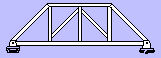
velocity. Statics is very important when analyzing such things as
structures of bridges, trusses (see picture to the left), buildings, etc. |
| |
|
|
Important
Definitions:
|
 FORCE FORCE |
 |
PARTICLE |
|
NEWTON'S
FIRST LAW OF MOTION |
|
NEWTON'S
SECOND LAW OF MOTION |
|
NEWTON'S
THIRD LAW OF MOTION |
 |
SCALAR |
|
VECTOR |
|
POSITION
VECTOR |
|
UNIT
VECTOR |
|
MOMENT |
| |
FORCE
Is the interaction between one body and
another that can be considered as a "push" or "pull". For more on forces
visit: http://eta.physics.uoguelph.ca
PARTICLE
A particle has mass but it has a size
that can be neglected.
NEWTON'S FIRST LAW OF MOTION
A particle that is at rest or moving
in a straight line with constant velocity, will remain at rest or in constant
velocity if it is not subjected to an unbalanced force.
NEWTON'S SECOND LAW OF MOTION
The net force on a particle is equal
to the product of the particle's mass and the acceleration of the particle.
NEWTON'S THIRD LAW
When two particles interact, the forces
that the bodies exert on each other are always equal in magnitude and opposite
in direction.
SCALAR
Is a quantity that is characterized by
a positive or negative number. For example, time, mass, density,
etc. are scalar quantities.
VECTOR
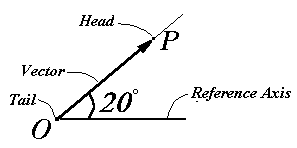
Is a quantity that has both magnitude
and a direction. For example, force, position, flux, etc. are vector
quantities. Vectors are often represented by arrows. A vector's
magnitude is the length of the arrow, and the direction of the vector is
indicated by the angle between a reference axis and the arrow. The
sense is indicated by an arrowhead. For
more visit: http://www.physics.uoguelph.ca
POSITION VECTOR
The position vector is a vector which
locates a point in space relative to another point.
UNIT VECTOR
Is a vector whose magnitude is equal
to one. This vector is obtained by taking each coordinate of the vector
and dividing it by the magnitude of the vector.
MOMENT
The moment of a force about a point or
axis is the measure of the tendency of the force to cause a body to rotate
about the point or axis. The moment of a force is also called torque.
|
|
|
TIPS
FOR STUDYING
 |
-
Review the concepts until you understand them completely,
then work problems until you have an understanding of how to apply each
concept. Challenge yourself with the hard problems.
-
Read the
problem carefully, draw free-body diagram(s) (if necessary), keep
track of units and make sure units correspond with each other , and organize
the given information. Also include the equations needed for solving
the problem.
-
Remember just because you can work the easy problems
does not mean you understand the concept fully, try some hard problems.
Rework these or similar problems before the test.
|