Ludovic E. J. Siouffi March 12, 2001
Batteries, what exactly are they? What’s inside that little metal cylinder which most of us use on a daily basis? How does the chemical compound inside form this wireless electricity for which we use for granted? Which battery is the best to buy? Well, all of these questions shall be answered in the paragraphs to follow.
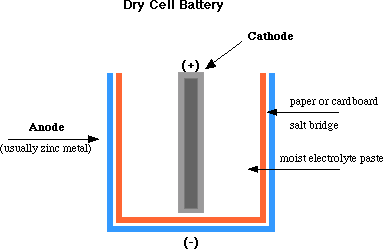 Whether it’s a wristwatch, flashlight, automobile, or even your own calculator, all of them contain batteries. There are many different sizes of batteries that can be found, from large car batteries, to small wristwatch batteries. There are also different types of batteries, rechargeable, alkaline and dry cell batteries. Taken from the dictionary, a battery is "a number of electric cells joined together". What exactly does this mean? Whether the battery is a dry cell or and alkaline, they pretty much work on the same principles. Shown here on the bottom is a simple diagram of a dry cell battery, which I will use to explain. In this case the anode is a thin zinc cylinder which will be our anode. Once a battery is put to work, or you turn on whichever device you must use it for, the electrons must have a circuit to have a flow of electricity. Then in the process of oxidation the zinc releases two electrons and the rest of the zinc ions are left there.
Zn (s) ---------------> Zn+2 + 2e-
Then once the electrons have been used up they are sent back to the battery, but this time to the cathode. Once inside the cathode they go into the reduction reaction. This is where they react with ammonium chloride and manganese dioxide.
2 NH4+ + 2 MnO2 + 2e- ------> Mn2O3 + 2 NH3 + H2O
Now we must figure out a way to carry the electrons back to the anode in order for us to have oxidation and reduction. This is where the electrolyte comes in as the last piece to completing a circuit. Then what is left reacts with water and the leftover zinc ions from the beginning react. Then all of this forms some hydroxide ions, which completes the circuit. All of this is covered with cardboard or paper to absorb the H2O produced. Now don’t forget that all of this is the inside of the battery itself, on top of it all there are other layers to seal it tight, such as steel. The steel is there to maintain the reaction inside the battery. Then, over the steel cylinder is a metallic ribbon.
Now that we know the principles of a battery, let us have a look at the different types of batteries. We have seen how a dry cell battery works, let’s now have a look at alkaline batteries. In the alkaline battery, the major difference is, instead of having ammonium chloride it is NaOH. The alkaline battery also lasts longer due to the fact that it takes longer for the anode to corrode. Now for rechargeable batteries, whenever a battery is plugged back into the wall to be recharged, it is given back more electrons, which it has lost in the process.
Batteries can also be combined to be more powerful or last longer. If batteries are to be piled one on top of the other, as if the were following each other this makes them more powerful, creating a series circuit. Then if instead you place them in your graphics calculator for instance, side by side, it will create a parallel circuit and will make the batteries last longer.
Now which battery is the best buy? Well from the research that I have conducted, I came to this conclusion. There isn’t really a better battery than another, I believe from what I have seen that the only difference is the popularity, advertisement and price of a specific battery that really affect consumers to buy one battery from another. Chemically, the three most advanced and with better performance are Energizer, Duracell, and Rayovac. But are also the three most expensive.
In conclusion, I am now glad to know what exactly I am using just about every single day of my life! Learning what a cathode, anode and electrode are and much more. It has in a way changed me I now look at a battery in a more sophisticated way, and not just as a battery.