
"
Chemistry, branch of science concerned with the properties, composition, and structure of substances and the changes they undergo when they combine or react under specified conditions."Molecules, rates and reactants, temperatures and gas laws are only a few of the many branches that derive from the broad world of chemistry however, the focus here will be on Atmospheric Pressure.
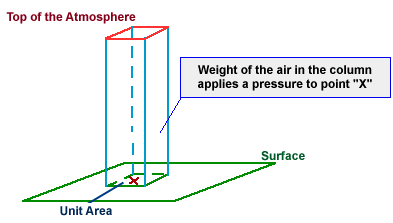
By definition, atmospheric pressure is the force per unit area exerted by the weight of the air above us. Without doubt, the air above us is held on the earth by gravity. An invisible yet strong force pulls the air downwards giving air molecules weight this force is known as gravity. This weight then exerts a force upon earth. This force is called atmospheric pressure. The higher one gets into the atmosphere, the fewer air molecules press down on them. The further one gets from the atmosphere, more weight presses down on them resulting from a longer column of air. This concludes that atmospheric pressure increases with decreasing altitudes. When the air from above reaches the ground, it continues to be compressed. For this, the density of the air on the ground in normal cases is normally greater than the air in the atmosphere. Now days, we use a barometer to measure atmospheric pressure. This instrument consists of mercury filled glass, which is closed at one end and is inverted in a cup of mercury. Atmospheric pressure is a major part of everything around us. Not only are there atmospheric pressure but also the pressure that allows us to use our vacuum cleaner, gravity and many more. There are many things around us that we tend to forget but the absence of pressure would cause disruption to many if not all of our lives.
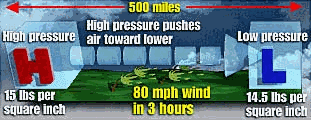
 Highs and lows of pressure
Tia Nicholls