PROTEASE INHIBITORS
In 1876, Wilhelm Kuhne found a substance in pancreatic juice that degraded other biological substances. Kuhne was the first scientist to find an enzyme that degraded proteins. Kuhne’s findings was the first crucial step in the development of a drugs used to fight HIV. In the 1980’s, most people who contracted HIV, could expect an inexorable destruction of their immune system. Today in most western nations, the fate of people who are HIV positive, are very different thanks to a group of drugs called PROTEASE INHIBITORS. PROTEASE INHIBITORS are drugs that slow down the spread of HIV-the virus that causes AIDS, inside the body. To make new copies of itself inside cells, HIV depends on several enzymes that it brings into the cell or makes inside the cell. All of these enzymes have specific jobs in the HIV replication. PROTEASE INHIBITORS are drugs that resemble pieces of the protein chain that protease normally cuts. PROTEASE INHIBITORS prevent protease from cutting long chains of proteins and enzymes into the shorter pieces that HIV needs to make new copies of itself. The more copies of itself are made, the more quickly the HIV virus will be absorbed into the blood stream. PROTEASE INHIBITORS are able to slow down this process enough to make the virus infectious. Many studies on these inhibitors show that these drugs are more powerful than the first drugs used to treat this virus. These were called THE REVERSE TRANSCRIPTASE INHIBITORS.
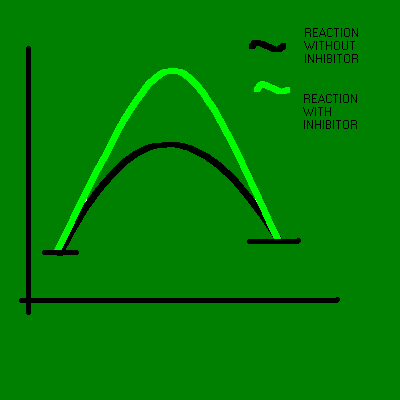
This diagram shows how the inhibitor plays a major role in the amount of energy required to replicate HIV. The activation energy is much higher for the PROTEASE INHIBITORS
The role of the PROTEASE INHIBITORS is to bind to the enzyme of the protease. If it gets into the enzyme then it can work from there. Scientists try to design inhibitors that have an even bigger similarity for the active site, then does the natural substrate, so that the inhibitor will win the fight to bind to the enzyme properly.
There are three PROTEASE INHIBITORS that have been approved for use in the United States. One is now in the final stages of testing in people with HIV.
1.Indinavir (Crixivan)
2.Ritonavir (Norvir)
3. Saquinavir (Invirase)
4. under way… Nelfinavir (Viracept)
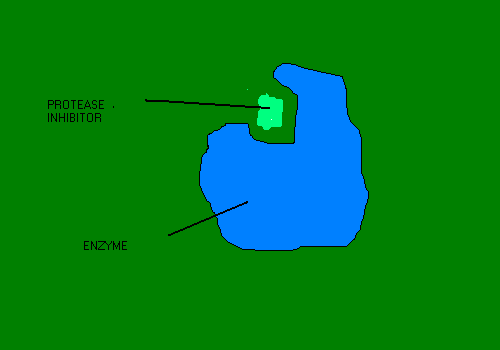
Diagram of the enzyme/substrate starting to bind.
Stats
Certain PROTEASE INHIBITORS can reduce the amount of virus in a HIV positive person by as much as 99%.
Between ’96 and ’98, the number of deaths linked to HIV infection dropped more than 70%
Some down falls of these inhibitors
PROTEASE INHIBITORS should only be taken with the other anti-HIV drugs REVERSE TRANSCRIPTASE INHIBITORS.
Since HIV tends to mutate easily and rapidly, populations of drug-resistant virus will appear sooner or later during the treatment.
Eventhough PROTEASE INHIBITORS can greatly reduce the number of new infectious copies of HIV, alone it is not a cue for the HIV virus. There remain many questions to be answered.
Scientists who attributed something to the discovery of the PROTEASE INHIBITORS: John H. Northrop
Moses Kunitz
Frederick Sanger
John Kendrew
Max Perutz
Christian Anfinsen
David W. Cushman
Miguel A. Ondetti
Robert Gallo
Luc Montagnier