The Ten Oxherding Pictures
by
Kaku-an
I
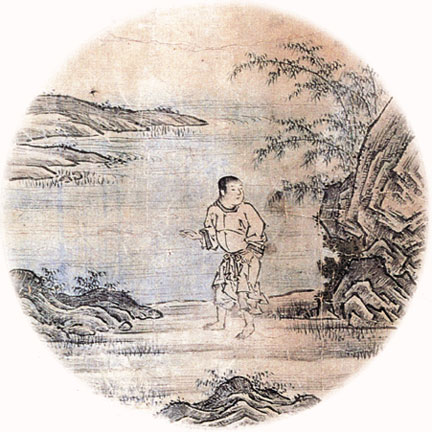
Searching for the Ox
 The beast has never
gone astray, and what is the use of searching for him? The reason why the oxherd
is not on intimate terms with him is because the beast is lost, for the oxherd
has himself been led out of the way through his deluding senses. His home is
receding farther away from him, and byways and crossways are ever confused.
Desire for gain and fear of loss burn like fire; ideas of right and wrong shoot
up like a phalanx.
The beast has never
gone astray, and what is the use of searching for him? The reason why the oxherd
is not on intimate terms with him is because the beast is lost, for the oxherd
has himself been led out of the way through his deluding senses. His home is
receding farther away from him, and byways and crossways are ever confused.
Desire for gain and fear of loss burn like fire; ideas of right and wrong shoot
up like a phalanx.
Alone in the wilderness,
lost in the jungle, the boy is searching, searching!
The swelling waters, the far-away
mountains, and the unending path;
Exhausted and in despair, he knows
not where to go,
He only hears the evening cicadas
singing in the maple-woods.
II
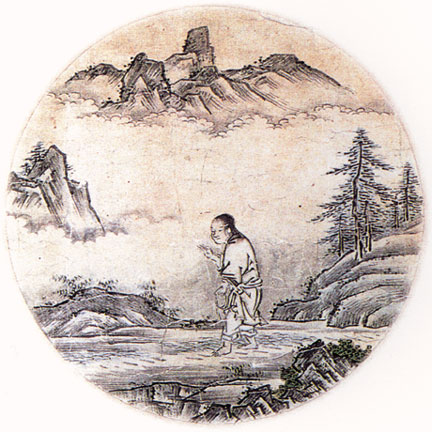
Seeing the Traces
By the aid of the sutras and by
inquiring into the doctrines, he has come to understand something, he has found
the traces. He now knows that vessels, however varied, are all of gold, and
that the objective world is a reflection of the Self. Yet, he is unable to distinguish
what is good from what is not, his mind is still confused as to truth and falsehood.
As he has not yet entered the gate, he is provisionally said to have noticed
the traces.
By the stream and
under the trees, scattered are the traces of the lost;
The sweet-scented grasses are growing
thick-did he find the way?
However remote over the hills and
far away the beast may wander,
His nose reaches the heavens and
none can conceal it.
III
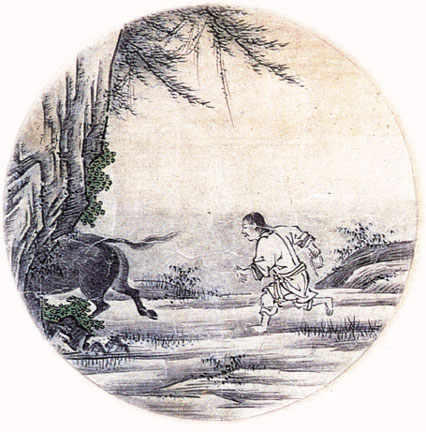
Seeing the Ox
The boy finds the way by the sound
he hears; he sees thereby into the origin of things, and all his senses are
in harmonious order. In all his activities, it is manifestly present. It is
like the salt in water and the glue in colour. (It is there though not distinguishable
as an individual entity.) When the eye is properly directed, he will find that
it is no other than himself.
On a yonder branch
perches a nightingale cheerfully singing;
The sun is warm, and a soothing
breeze blows, on the bank the willows are green;
The ox is there all by himself,
nowhere is he to hide himself;
The splendid head decorated with
stately horns-what painter can reproduce him?
IV
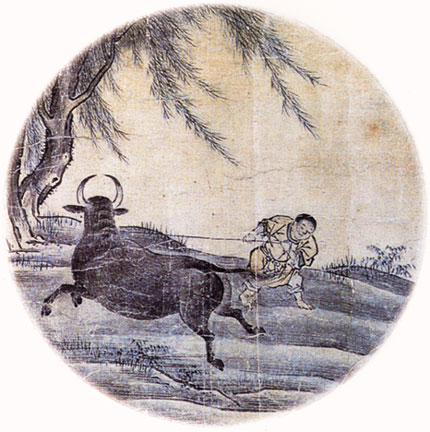
Catching the Ox
Long lost in the wilderness, the
boy has at last found the ox and his hands are on him. But, owing to the overwhelming
pressure of the outside world, the ox is hard to keep under control. He constantly
longs for the old sweet-scented field. The wild nature is still unruly, and
altogether refuses to be broken. If the oxherd wishes to see the ox completely
in harmony with himself, he has surely to use the whip freely.
With the energy of
his whole being, the boy has at last taken hold of the ox:
But how wild his will, how ungovernable
his power!
At times he struts up a plateau,
When lo! he is lost again in a
misty unpenetrable mountain-pass.
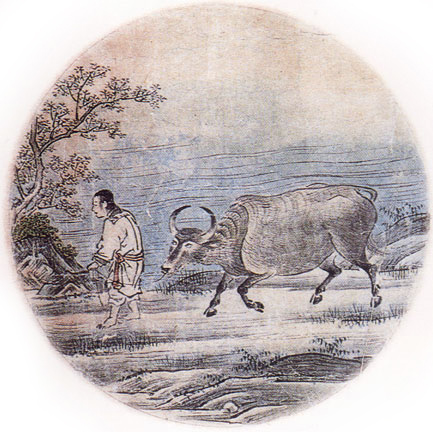
V
Herding the Ox
When a thought moves,
another follows, and then another-and endless train of thoughts is thus awakened.
Through enlightenment all this turns into truth; but falsehood asserts itself
when confusion prevails. Things oppress us not because of an objective world,
but because of a self-deceiving mind. Do not let the nose-string loose, hold
is tight, and allow no vacillation.
The boy is not to
separate himself with his whip and tether,
Lest the animal should wander away
into a world of defilements;
When the ox is properly tended
to, he will grow pure and docile;
Without a chain, nothing binding,
he will by himself follow the oxherd.
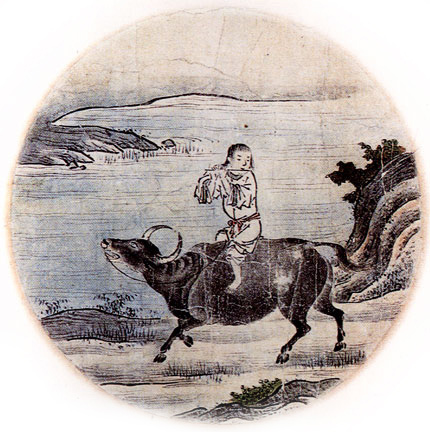
VI
Climbing Home on the Ox's back
The struggle is over;
the man is no more concerned with gain and loss. He hums a rustic tune of the
woodman, he sings simple songs of the village-boy. Saddling himself on the ox's
back, his eyes are fixed on things not of the earth, earthy. Even if he is called,
he will not turn his head; however enticed he will no be kept back.
Riding on the animal,
he leisurely wends his way home:
Enveloped in the evening mist,
how tunefully the flute vanishes away!
Singing a ditty, beating time,
his heart is filled with a joy indescribable!
That he is now one of those who
know, need it be told?
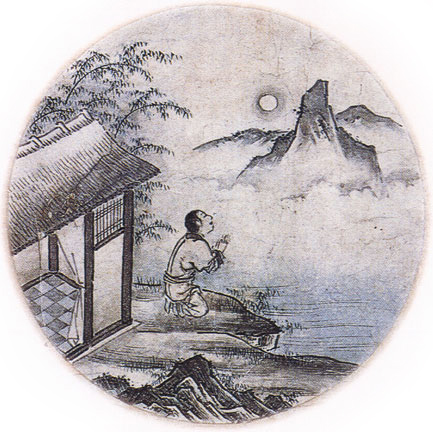
VII
The Ox Forgotten, Leaving the Man Alone
The dharmas are one
and the ox is symbolic. When you know that what you need is not the snare or
set-net but the hare or fish, it is out of the clouds. The one ray of light
serene and penetrating shines even before days of creation.
Riding on the animal,
he is at last back in his home,
Where lo! the ox is no more; the
man alone sits serenely.
Though the red sun is high up in
the sky, he is still quietly dreaming,
Under a straw-thatched roof are
his whip and rope idly lying.
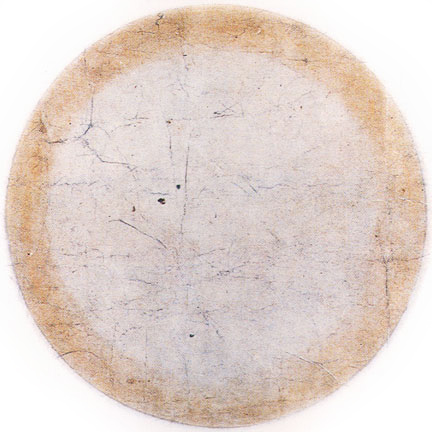
VIII
The Ox and Man Both Gone out of Sight
All confusion is
set aside, and serenity alone prevails; even the idea of holiness does not obtain.
He does not linger about where the Buddha is, and as to where there is no Buddha
he speedily passes by. When there exists no form of dualism, even a thousand-eyed
one fails to detect a loop-hole. A holiness before which birds offer flowers
is but a farce.
All is empty-the
whip, the rope, the man, and ox:
Who can ever survey the vastness
of heaven?
Over the furnace burning ablaze,
not a flake of snow can fall:
When this state of things obtains,
manifest is the spirit of the ancient master.
IX
Returning to the Origin, Back to the Source
From the very beginning,
pure and immaculate, the man has never been affected by defilement. He watches
the growth of things, while himself abiding in the immovable serenity of non-assertion.
He does not identify himself with the maya-like transformations (that are going
on about him), nor has he any use of himself (which is artificiality). The waters
are blue, the mountains are green; sitting alone, he observes things undergoing
changes.
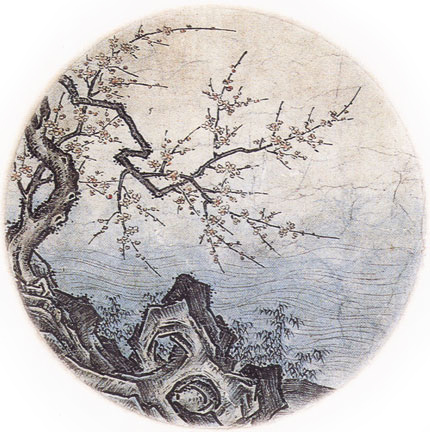
To return to the
Origin, to be back at the Source-already a false step this!
Far better is to stay at home,
blind and deaf, and without much ado;
Sitting in the hut, he takes no
cognisance of things outside,
Behold the streams flowing-whither
nobody knows; and the flowers vividly red-for whom are they?
X
Entering the City with Bliss-bestowing Hands
His thatched cottage
gate is closed, and even the wisest know him not. No glimpses of his inner life
are to be caught; for he goes on his own way without following the steps of
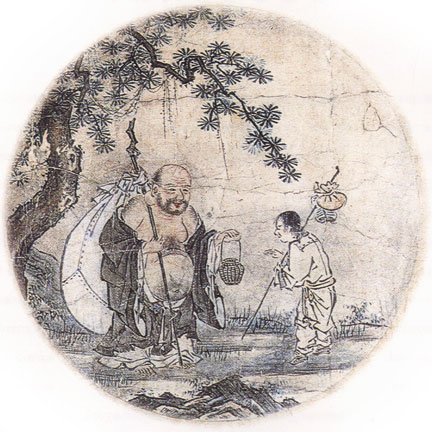
the ancient sages. Carrying a gourd he goes out into the market, leaning against
a staff he comes home. He is found in company with wine-bibbers and butchers,
he and they are all converted into Buddhas.
Bare-chested and
bare-footed, he comes out into the market-place;
Daubed with mud and ashes, how
broadly he smiles!
There is no need for the miraculous
power of the gods,
For he touches, and lo! the dead
trees are in full bloom.
Notes
VIII
The Ox and Man
Both Gone out of SightIt will
be interesting to note what a mystic philosopher has to say about this: "A
man shall become truly poor and as free from his creature will as he was when
he was born. And I say to you, by the eternal truth, that as long as ye desire
to fulfil the will of God, and have any desire after eternity and God; so long
are ye not truly poor. He alone hath true spiritual poverty who wills nothing,
knows nothing, desires nothing."-(From Eckhart as quoted by Inge in Light,
Life, and Love.)
X
gourdSymbol
of emptiness (sunyata).
leaning against a staffNo
extra property he has, for he knows that the desire to possess is the curse
of human life.