| Early Summer joined the ARC '90 to cross the Atlantic. The following is a letter I wrote to Victoria Yachts, which they published in the October 1991 issue of their newsletter "WATERLINES" |
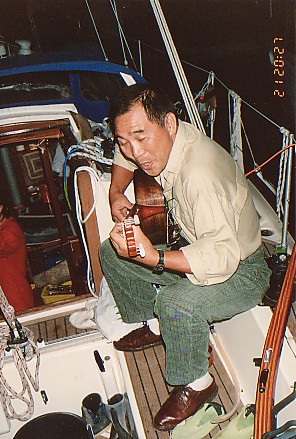 [Photo: A Japanese businessman in Grand Canary
finds an audience on aboard Early Summer.
Without him, it would have taken much longer
to get all the necessary provision for the
crossing.] [Photo: A Japanese businessman in Grand Canary
finds an audience on aboard Early Summer.
Without him, it would have taken much longer
to get all the necessary provision for the
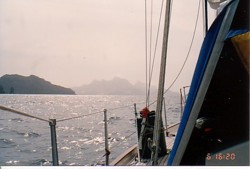
crossing.]I am happy to say this to you from this side of the Atlantic: Early Summer sailed beautifully. It was really a lot of fun to hold the tiller and feel her steer herself especially in rather high seas. If allowed to find her own course she usually points her stern at the right angle to waves over 4 meters of height and begins to surf if the wave is higher than 5 meters. I was truly amazed at her performance in the choppy sea we encountered about 200 miles off St. Lucia, where the sea was full of waves over 4meters high and 10 meters wide. When I stood on the stern end with my left arm around the back stay to take the sun sight, she began surfing down the waves that had lifted her stern. It was only the beginning. As she coasted down the slope, she began turning towards the wind slightly, as if to prolong the time of surfing. She kept on doing this one wave after another. I felt as if I were trapezing out on a planing dinghy. I gave up taking sun sights and returned to the cockpit to replace the Plastimo Navik which I was afraid was a bit underpowered for the situation. However, as Mike (Sharples) had pointed out long ago, Early Summer is very “light” when she is moving at more than 5 knots, and it was really easy to counter the tendency to head into the wind. No wonder Eruzaburo (Navik’s name) had been doing such a wonderful job. The results of the ARC ’90, therefore, do not reflect the true performance of Early Summer. If we could have carried more diesel ( we carried 80 liters in addition to the main tank under the cockpit) or if we had one more crew on board we should have finished much earlier. As you probably know, this year’s ARC, like last year’s, suffered from the lack of trade winds. During the first 9 days, except for the 20 knots of wind that blew for 2 hours on the first day, the strongest wind we had was about 9 knots true. Those that finished “early” were the ones that could carry enough fuel to burn all the way across the ocean. [Photo: Mindero, Cabo Verde]
The trades did come but it didn't last long. Two weeks after the rally started 15 to 10 knots of wind began to blow. But it lasted only 10 days. Because we “wasted” three days sightseeing in the Cape Verdes we had only 7 days of good winds. Early Summer covered 854 miles over the land during the 7 days. Well, this figure does sound average and in fact most of the “slow fleet” attained much the same. But you must take into account the fact that Early Summer was the smallest of the entire fleet and also that unlike other boats, we did not, or could not, use either the chute or No. 1 Genoa. We used the poled out yankysail and double-reefed main all the time during the seven days. After the Cape Verdes Midori became seasick, and standing watch for 4 hours a day to let me sleep was all she could manage to help me. Therefore, I was always very reluctant to sue my No. 1 Genoa, which is made of rather light material and should not be used in winds over 20 knots. It is a piece of cake to change sails on
the furling gear when the wind is less
than
10 knots. But it is a nightmare when
it’s
blowing more than 15 knots. I lost my best pair of glasses while struggling
with the genoa. so I decided early that I would be content
with the yankysail and the double reefed
main, which combination balanced just
as
beautifully as the genoa and the full
main. In a tropical depression, I found out, the winds were either more than 35 knots, gusting 50, or less than 1 knot, gusting 2. When the wind was heavy, the sea soon became very high unless it was raining cats and dogs. When the wind was heavy and torrential rain was falling, the sea was prevented from getting high by the rain but the raindrops came with the force of bullets. When the wind was light, the air was literally charged with electricity. If I was lucky I saw many ships of line firing at one another in the distance. If I was not so lucky, I was floating between the two ships of line exchanging broadsides; only the firing ships were invisible. When I was in the middle of the battle, I noticed to my dismay the mast top antenna glowed light-green and the mast began to hum to the beat of the inaudible thunders. Early Summer sailed under the depression for 2 nights and 2 days, during which time I was unable to sleep. After the depression, Early Summer seemed to be moving along a front and enjoyed visits of tropical squalls every 3 hours or so. Each squall was preceded by a period of lull, in which wind speed dropped to zero, and then came a period of strong wind ( 35-53) and the rain which may last 1 or 2 hours. As a result, since the day we encountered the tropical depression I could not sleep more than 1 hour at a time. So on Christmas Day, when the wind got up over 45 knots, I decided I was too tired to go on and I let Early Summer lie to and drank a glass of Famous Grouse and went to bed. [Picture was drawn by Midori :①A wave ②this way③collapses.] 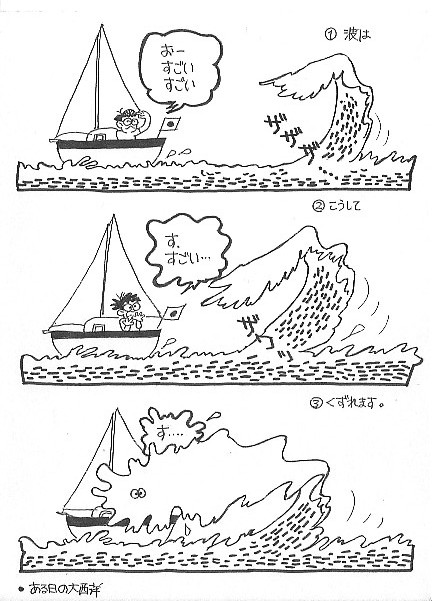 When I woke up one hour later, it was still
blowing over 40 knots. But I felt refreshed and took the tiller
and sailed down the wind. Sometime later, I thought I heard someone
tearing a long piece of silk cloth
behind
me and looked back. All I saw was a light blue wall whose top
was glittering white-green. A moment later the peak of the wall began
collapsing into white foams and then
tons
of water came into the cockpit. When I woke up one hour later, it was still
blowing over 40 knots. But I felt refreshed and took the tiller
and sailed down the wind. Sometime later, I thought I heard someone
tearing a long piece of silk cloth
behind
me and looked back. All I saw was a light blue wall whose top
was glittering white-green. A moment later the peak of the wall began
collapsing into white foams and then
tons
of water came into the cockpit.
The next moment I was floating in the tub of the cockpit with my head under the metal fitting on the base of the tiller. On getting up, I found the sliding door over the companion way open and the shower curtain I had hung over the washboards to prevent the spray and rain from getting into the cabin was torn into two pieces and floating on the floor. But luckily, the settee berths were more or less dry. The curtain must have weakened the force of the water. Though I did not notice it until the next day, the forward end of the sprayhood was “derailed”. Half of the front end which was encased in the plastic rail was out of the rail. I began pumping out the bilge water but the pump did not work. So I got to the back-up bilge pump I had fitted in Spain and used it. I don’t know how long it took to get the water out of the cabin, but I was praising myself for not losing the presence of mind in this crisis, when I realized that Early Summer had been left on her own in the very rough sea all that while. I had not switched on the self steering gear, nor had I lashed the tiller. I had done nothing about steering. But she had brought herself to an attitude that may be called “lying-to”. She was not pointing to the wind as high as when the jib sheet was properly pulled in, but she was pointing high enough to ride the 7-8 meter high waves that came with the 40 knots ( and over ) winds, and that with the stability that had let me work on the bilge pump and believe that I had not panicked at all. Captain Eagle St. Lucia
|
 In fact many went into Cape Verde to buy
more fuel.
In fact many went into Cape Verde to buy
more fuel.