MONEY: A financial asset that makes the economy
function
smoothly by
serving as:
1. A medium of exchange
2. A unit of account
3. A store of wealth
FUNCTIONS OF MONEY EXPANDED:
Medium
of
Exchange
Lubricates exchange (vs. barter)
Accepted as payment for debt
Faith => fiat money, by decree -- not backed by gold
Optimum Scarcity
too much -- goods sell fast => prices rise
too little -- barter, goods sell slow => prices fall
limited supply
hard to counterfeit
Unit
of
Account
If money is stable it is accepted as deferred payment
problematic w/ hyperinflation => if pay back is in cheap
money (reference lost)
Provides relative price information
cigarettes during WWII & jail
Store
of
Wealth
A bond that pays no interest
Coffee cans & mattresses
Liquid debt
w/ gp people spend $ quickly
w/out gp people spend $ slower
DEFINITIONS OF MONEY: based on liquidity
Liquidity: the ability to turn an asset into cash quickly w/out losing
value. Cash is the ultimate liquid asset.
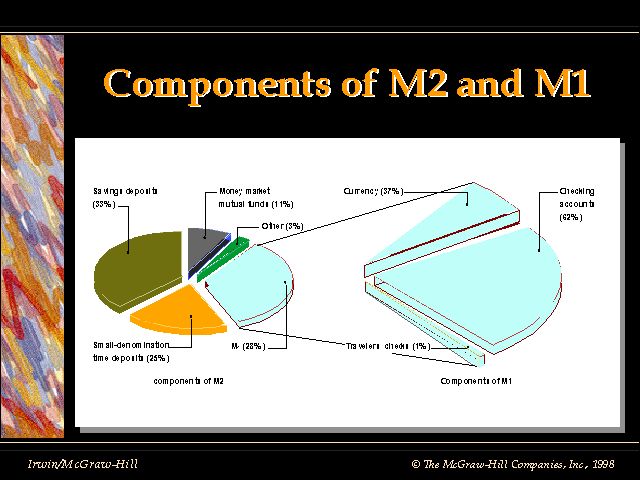
M1 = currency (nonbank), demand deposits
(checking
accounts) &
travelers' checks
M2 = M1 + savings deposits, small time deposits,
money
market mutual
fund shares, money market deposit accounts, overnight repurchase
agreements, overnight eurodollars
M3 = M2 + large time deposits (negotiable, Jumbo
CDs),
money market
mutual fund shares (institutions only) & term repurchase
agreements
L = M3 + short-term Treasury securities,
commercial
paper, term
eurodollars, savings bonds & bankers acceptances (buyer's IOU
may not be accepted by seller, but the buyer's bank gives its IOU)
****************************************************************
Credit Cards -- why aren't they counted?
Credit
is savings
made available to be borrowed => already counted
Asset Management -- banks handling of loans & other assets
Liability management -- how a bank attracts
deposits
& what it
pays for them
HISTORY OF BANKING => short course
Marco
Polo
- Kubla Khan
Goldsmiths
- Modern Banking (fractional reserve baanking)
HOW BANKS CREATE MONEY:
Remember: Financial assets can be created as long as an offsetting financial liability is simultaneously created.
Reserve
Requirement = r (or rr, this is set
by the Fed)
(required
reserves)
r not counted as money
England has no r
Legal Reserves = Required Reserves + Excess
Reserves
*Out of legal reserves banks
can lend out excess reserves
****************************************************************
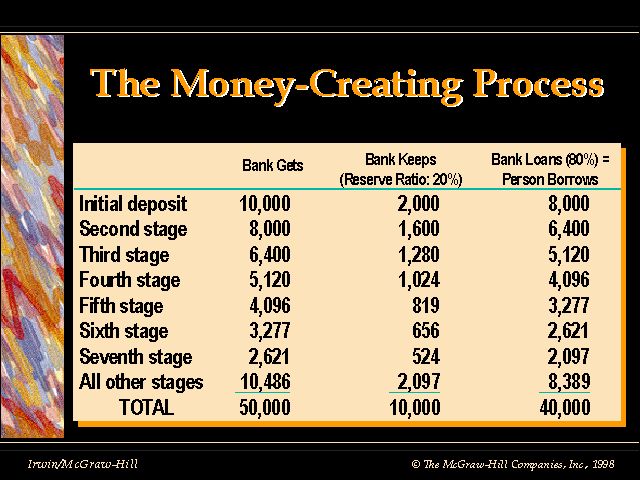
Example: T-Account w/ a deposit of $1,000 & r=.2
Assumptions: banks are profit seekers & are
fully
loaned out
there are no excess reserves
bank requires borrowers to open dd by the amount of loan
the intial deposit is new money into the system
ASSETS
LIABILITIES
$1,000 demand deposit/Bill
r=$200
$800 loan/Mary
$800 demand deposit/Mary
r=$160
$640 loan/Kim
$640 demand deposit/Kim
r=$128
$512 loan/Herb
*This process continues until the total reserve requirement (r) equals the initial injection of $1,000. Notice that including the original deposit a total of $2,440 in demand deposits has been created after just a few steps.
A simpler way of finding how much money will be created by this process is to multiply the simple money multiplier (m) times the initial injection.
m = 1/r => (m) x
(initial
injection) = money created
(5) x ($1,000) = $5,000
m = 1/r = 1/.2 = 5
initial injection = $1,000
WHAT ABOUT A WITHDRAWAL OF $1,000 OUT OF THE SYSTEM?
Let's say Bill withdraws the original $1,000 & takes it completely out of the system:
The only thing left to cover
the
withdrawal is r = $1,000, therefore there
is no r to cover the other demand
deposits of $4,000 and the bank must
call in its loans. The
demand
deposits go to zero. $5,000 in money has
been destroyed.
(m) x (withdrawal) = money destroyed
(5) x (-$1,000) = -$5,000
m = 1/r => what happens when r changes?
when r
falls m increases & when r increases m falls
****************************************************************
Complex m = 1/r+c, where c = ratio of cash to
deposits
Example:
$100 => $20 cash/$80 deposits = .25
r = .20
complex
m = 1/r+c = 1/(.20+.25) = 1/.45 = 2.1
*in reality complex m is much smaller
Your checking account is the liability of the
bank
secured by their assets
(loans). These loans are the financial
liability
of the borrower -- promises
to pay. Banks borrow short & lend long.
Runs on the bank -- FEAR -- FDIC & FSLIC
Failed S&Ls in the late 80s.
THE FEDERAL RESERVE SYSTEM
Central Bank
=>
The Bankers' Bank
*Conducts
monetary policy & supervises the financial system
European Central Bank
=>
Bundesbank
The Bank of Japan
Bank of England
Monetary
Policy:
Fed policy that influences the economy through
changes in the $ supply & available credit
THE FED
Quasi
government
organization: the government makes the major
personnel
appointments, but the Fed is privately owned by its
member banks
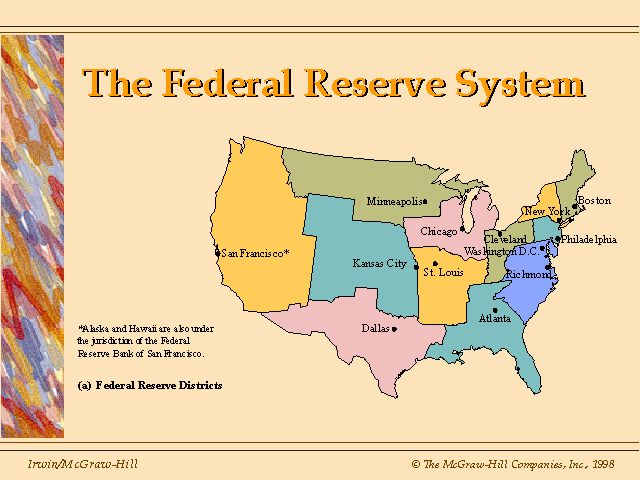
12 Regional Banks of the Fed
Board of Governors
=>
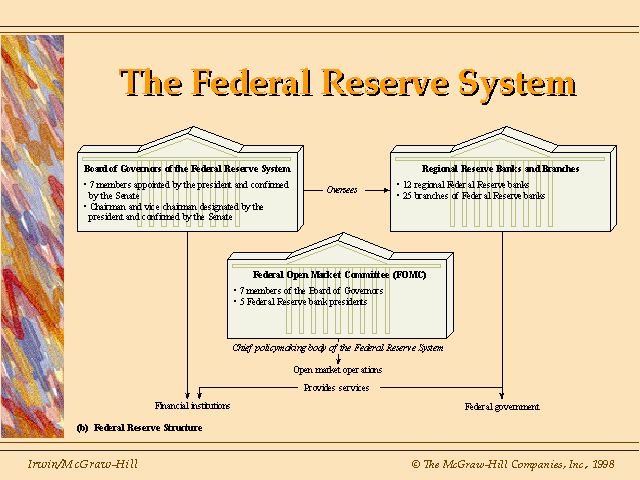
7 members
Appointed by the President
Approved by the Senate
Headed by
the Chairman (Alan Greenspan)
*all governors have 14 year
terms, except for the chairman who has a
4 year term
Policy
Making Body of the Fed
Federal Open Market Committee (FOMC)
Members of the FOMC:
Board of Governors (including the chair)
The President of the NY Fed
Four other Regional Bank Presidents (on a rotating basis)
FUNCTIONS OF THE FED:
1. Monetary Policy
(expansionary/contractionary)
2. Supervision &
Regulation
of Financial Institutions
3. Lender of Last Resort
4. Provides Banking
Services
to the Government
5. Issues Coin &
Currency
6. Financial Services
to Commercial Banks
TOOLS OF MONETARY POLICY:
1. Sets Reserve Requirement
2. Sets Discount Rate
3. Open Market Operations
*fighting recessions &
gp
M up
=> i
down => I up => Y up
M down
=>
i
up => I down => Y down
Keynesians target i
Classicals MV=PQ
(Rules)
SR effects on real output
LR => increasing M causes gp (affects only the price level)
Nominal vs. Real Interest Rates
Five Problems of
Monetary
Policy
1. Knowing what policy to use (correct Yp)
2. Understanding the policy you're using
the fed only controls vault cash & reserves @ the fed
called the monetary base
m influenced by cash people hold (moving target)
3. Lags in monetary policy
4. Political pressure
5. Conflicting international goals
Central Bank
=>
The Bankers' Bank
*Conducts
monetary policy & supervises the financial system
European Central Bank
=>
Bundesbank
The Bank of Japan
Bank of England
Monetary
Policy:
Fed policy that influences the economy through
changes in the $ supply & available credit
THE FED
Quasi
government
organization: the government makes the major
personnel
appointments, but the Fed is privately owned by its
member banks
12 Regional Banks of the Fed
Board of Governors
=>
7 members
Appointed by the President
Approved by the Senate
Headed by
the Chairman (Alan Greenspan)
*all governors have 14 year
terms, except for the chairman who has a
4 year term
Policy Making Body of the Fed
Federal Open Market Committee (FOMC)
Members of the FOMC:
Board of Governors (including the chair)
The President of the NY Fed
Four other Regional Bank Presidents (on a rotating basis)
FUNCTIONS OF THE FED:
1. Monetary Policy
(expansionary/contractionary)
2. Supervision &
Regulation
of Financial Institutions
3. Lender of Last Resort
4. Provides Banking
Services
to the Government
5. Issues Coin &
Currency
6. Financial Services
to Commercial Banks
TOOLS OF MONETARY POLICY:
1. Sets Reserve Requirement
2. Sets Discount Rate
3. Open Market Operations
*fighting recessions &
gp
M up
=> i
down => I up => Y up
M down
=>
i
up => I down => Y down
Keynesians target i
Classicals MV=PQ
(Rules)
SR effects on real output
LR => increasing M causes gp (affects only the price level)
Nominal vs. Real Interest Rates
Five Problems of
Monetary
Policy
1. Knowing what policy to use (correct Yp)
2. Understanding the policy you're using
the fed only controls vault cash & reserves @ the fed
called the monetary base
m influenced by cash people hold (moving target)
3. Lags in monetary policy
4. Political pressure
5. Conflicting international goals