|
|
...
|

|
...
|
 n
the 1930s women fashion returned to a more genteel, ladylike
appearance. Budding rounded busts and waistline curves were
seen and hair became softer and prettier as hair perms
improved. Foreheads which had been hidden by cloche hats
were revealed and adorned with small plate shaped hats.
Clothes were feminine, sweet and tidy by day with a return
to real glamour at night. n
the 1930s women fashion returned to a more genteel, ladylike
appearance. Budding rounded busts and waistline curves were
seen and hair became softer and prettier as hair perms
improved. Foreheads which had been hidden by cloche hats
were revealed and adorned with small plate shaped hats.
Clothes were feminine, sweet and tidy by day with a return
to real glamour at night.
Skirts
were frequently longer at the back than the front. Below the
knee pleats and godets fell from panels so gave fullness at
the hemline. The hemlines reached the bottom of the calf
within a year. Some of the clothes were so stylish that they
could be worn today.
More
luxurious gowns were kept for evening. Part of their appeal
was the draping fabric that was further enhanced by cutting
fabrics on the true cross or the bias grain also quite
fashionable at the start of the new millennium. New fabrics
like metallic lame were very popular at night and were made
to shimmer even more richly by adding plastic sequins and
glass beads.
The
new improved fabrics like rayon had several finishes and
gave various effects exploited by designers eager to work
with new materials. Cotton was also used by Chanel and
suddenly it was considered more than a cheap fabric for work
clothes. But nothing cut and looked like pure silk and it
was still the best fabric to capture the folds and drapes of
thirties couture. Fine wool crepes also moulded to the body
and fell into beautiful godets and pleats.
Rayon
dyed well and looked similar to and felt like silk. Often it
was used to make lingerie for the cheaper end of the
market.
In
1927 Dr. Wallace Carothers began to research new polymers
and eventually discovered polyamide. By 1938 the Du Pont
company was producing commercial nylon and by 1939 making
knitted hosiery. Later it was given the commercial name
Nylon. Nylons were eventually available in 15 denier and
these were very sought after particularly in the
War.
Nylon
hosiery transformed women lives. No more bagging and sagging
of stockings and a sheer allure which enhanced their legs.
The women of the era must have felt much the same as women
of the sixties did later when tights gave a new
freedom.
The
French designer Madeleine Vionnet opened her own fashion
house in 1912. She devised methods of bias cross cutting
during the 1920s using a miniature model. She made popular
the halter neck and the cowl neck.The bias method has often
been used to add a flirtatious and elegant quality to
clothes. To make a piece of fabric hang and drape in sinuous
folds and stretch over the round contours of the body,
fabric pattern pieces can be cut not on the straight grain,
but at an angle of 45 degrees.
It
is sometimes said that Vionnet invented bias cutting, but
historical evidence suggests that close fitting gowns and
veils of the medieval period were made with cross cut
fabrics. The Edwardians also made skirts that swayed to the
back by joining a bias edge to a straight grain edge and the
result was a pull to the back that formed the trained skirt.
She did really popularise it and the resulting clothes are
styles we forever associate with movie goddesses and
dancers.
Using
her technique designers were able to produce magnificent
gowns in satins, crepe-de-chines, silks, crepes and chiffons
by cross cutting the fabric, creating a flare and fluidity
of drapery that other methods could not achieve. Many of the
gowns could be slipped over the head and came alive when put
on the human form. Some evening garments made women look
like Grecian goddesses whilst others made them look like
seductresses of the silver screen.
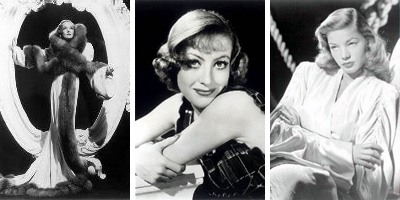
In
fact the entertainment industry continued to exert a strong
influence over fashion througout the period. Movies were one
of the few escapes from the harsh reality of the Depression.
Movie star endorsements of styles and accessories became
common, especially with evening wear. A popular formal look
was the empire-waisted gown, with ties at the back. The
dress might boast butterfly or large, puffy sleeves.
Hemlines fell at the ankle and trains added a further formal
touch. Fabric flowers might be placed at the neckline, on
one shoulder, or at the center waist or center neckline.
Bows were another popular accent. The peplum made its debut
in the late thirties evening wear.
To
show off the styles of the times a slim figure was essential
and that was getting easier for women using full length
backless evening dresses cut on the true cross or bias and
which moulded to the body. Certain of these gowns still look
quite contemporary today.
Until
the 1930s wealthy women had not really needed to wear
practical day clothes. Although styles had been designated
day styles if they were impractical it had not really
mattered as long as maids took care of chores. Now women had
more productive and busier lives and simpler pared down
clothes gave a freedom of movement women relished in daily
life.
As
far as men's clothing, it was during this decade that
promoting clothing for its 'snob appeal' was begun. Clothing
manufacturers have always known that if changes are
continuously made to clothing so that it goes out of fashion
quickly, more sales will be made as women rush out to
refurbish their closets. This has not been applied to men's
clothing though. Until the 1930s. Warm shirts in large
plaids, and early in the 30s the single breasted jacket was
the male look. Later in the decade, double breasted jackets
became popular yet again and the front of the man's jacket
was higher.
Health
and fitness was an important aspect of thirties lifestyle.
As
sun worshipping became a common leisure pursuit fashion
answered the needs of sun seekers by making chic outfits for
the beach and its surrounds. Beach wraps, hold alls, soft
hats and knitted bathing suits were all given the designer
touch.
Swimwear
was getting briefer and the back was scooped out so that
women could develop tanned backs to show off at night in the
backless and low backed dresses. The colours of the beach
holiday were navy, white, cream, grey, black and buff
with touches of red.
Pyjamas
introduced as informal dinner dress or nightwear for
sleeping died quickly as fashions. However the third use of
them as a practical beach outfit caught on and every woman
made them an essential garment to pack. They were soon
regarded as correct seaside wear. The trousers were sailor
style, widely flared and flat fronted with buttons. They
were made up in draping heavy crepe-de-chine. Blue and white
tops or short jackets finished the holiday look.

In
1930 Prunella Stack started the Women's League Of Health And
Beauty in Britain. The motto was 'Movement Is Life' and the
League promoted the ideal of a healthy mind and a healthy
body.
The
League had thousands of members who put on huge displays in
parks and other venues.
Physical
fitness was seen as important and in various forms was
popular across Europe especially in Germany and Austria.
This resulted in the adoption of Tyrolean styles as forms of
sportswear fashion which began to be more practical and
actually allowed for movement. Skating skirts became shorter
than ever before and in 1933 the Tennis star Alice Marble
wore shorts at the Wimbledon season.
The
era had begun with an economic depression which had lifted
by 1936 for many. At the same time the rumble of war in
Europe became more evident. Designers began to adjust the
mood of their collections to more military inspired square
shouldered clothing teamed with low heels as if sensing a
need for more functional wear.
By
1939 European designers had shown simple clothes, trousers
and sweaters and classic shirt waisters designed to stay in
fashion.
This
was a pivotal time for the fashion industry and lessons
learnt developing methods of mass producing uniforms carried
over into the ready to wear industry. In the future it
enabled manufacturers to produce quality goods speedily,
moderately priced, and within acceptable profit
margins.

|