

|
Robert Edward Lee was born to General Henry "Light Horse Harry" Lee and Ann Hill Carter on January 19, 1807. The Lee and Carter families were two of the most distinguished families of early America. Robert was the last Lee born at Stratford in Westmoreland County, Virginia. It has been said that Robert inherited the best qualities of the previous generations with none of the flaws. For financial reasons, Robert was appointed to West Point Military Academy in New York in 1825. Upon admission, Robert demonstrated the qualities of leadership and command that would characterize his long service as a soldier. In four years, he was the first cadet ever to receive no demerits. He graduated cadet corp adjutant, head of his class in tactics and artillery and second in general standing with honors. 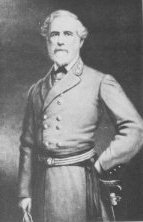 By the time of his commissioning, Robert developed traits of character that would distinguish him from his contemporaries and make him a legend after his death. Of these traits, moderation, self control, duty, sincerity, consideration of others, courage, special regard for ladies, courtesy, honor and deep religious conviction, he believed duty and honor to be especially important. He once stated, "There is true glory and true honor, the glory of duty done and the honor of integrity and principles." He also wrote, "Duty is the sublimest word in the language. You cannot do more than your duty; you never wish to do less."
Robert married Mary Ann Randolf Custis of Arlington while serving as Second Lieutenant of Engineers at Fort Monroe, Virginia on June 30, 1831. Mary was the only daughter of George Washington Parke Custis, the grandson of Martha Washington and the adopted grandson of George Washington. The couple moved to Arlington and lived in the Custis house across the Potomac from Washington, D.C. For the next thirty years Arlington was Robert's beloved home, which is now known as Arlington National Cemetery. Robert had three sons and four daughters. While in the Corps of Engineers, Robert assisted in a variety of projects and construction of military bases and ports. In 1846, Robert was ordered to Mexico as a supervisor of road construction during the Mexican-American War. It was in Mexico that he learned the battlefield tactics that would serve him so well in the coming years. Promotion came slowly for Robert, his assignments were lonely and difficult and the fact that he was separated from his family was hard. In 1838, he was promoted to captain. He was promoted to major after the war. In 1852, Robert was a superintendent at West Point for three years until after an Indian attack in 1855, when he was promoted to lieutenant colonel of the Second Cavalry. He was also in charge of the detachment of marines that was sent to retake the US Arsenal at Harper's Ferry, Maryland from John Brown. On the eve of the Civil War, President Abraham Lincoln, through Secretary Francis Blair, offered Robert command of the Union Army. Robert was opposed to secession and considered slavery evil. His views on the United States were "no north, no south, no east, no west." After a long night of consideration for Blair's offer, on April 20, 1861 Robert turned in his letter of recognition after 32 years in the service. He had decided that he could not lift his hand against his own people. In 1861, President Jefferson Davis of the Confederate States of America made Robert commander of forces. This was a desk job. On June 1, 1862, Robert took control of the Army of Northern Virginia in the Confederate capital of Richmond. He was again commanding men in the field. Later in June of 1862, Lee drove the Union army away from the Richmond area in the famous "Seven Days' Battle." He then drove the northern army back into Washington, D.C. With many large accomplishments such as these, it was not till February 1865 that he was named Commander in Chief of all Confederate forces. His skill as a strategist and his capacity to rapidly analyze a combat situation combined with his ability to arouse intense devotion within troops, helped to further the Confederate cause. His brilliance as a commander is legendary. Military colleges around the world study his many campaigns as models of the science of war. Lee and the South faced overwhelming numerical superiority, production capability and unlimited supply sources. Robert's command of the Confederate forces came to an end at Appomattox, Virginia on April 9, 1865. The end of the War brought dramatic change to Robert's life, the Custis-Lee fortune was greatly reduced and Arlington was lost. Despite this, Robert's superb dignity, courage, and noble character in the difficult post-war years intensified admiration for him, earning high respect of even his former enemies. It has been said that in defeat, Lee achieved his highest level of greatness. In the summer of 1865, Lee accepted the presidency of Washington College in Lexington, Virginia after the Board of Trustees had unanimously voted to offer it to him. Word of Lee heading the institution caused enrollment to triple within the first year. Robert strove to equip his students with the character and knowledge he knew would be necessary to restore the war-ravaged South. One of Lee's most noted statements to his students was, "We have but one rule here and that is that every student must be a gentleman." |