
 | Full Name : Wong Choon Hann Date of Birth :17 February 1977 Place of Birth :Kuala Lumpur Height,Weight :183cm,71kg Left/Right handed :Left-handed |
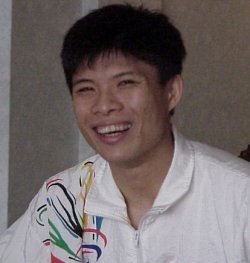
So, how did it all begin?
When I was 11 I joined the school team, and at that stage I was always second best which wasn't so bad - there wasn't as much pressure on me then as there is now! I knew I was good - a lot of people complimented me on my potential, and when people do that it makes you want to try harder to please them.
When I first started out, it was quite difficult for me and my family. They were not as well off as they are now, so it was not easy for them to support me in badminton. Maybe that's the reason I made success of playing badminton - I appreciate how my parents supported me when it wasn't easy for them, so I want good results for them, so they know that I am grateful for what they have done for me.
In my early teens, I never had any spare time - I used to have to travel to the BAM camp to train, which was exhausting. I had to travel right across Kuala Lumpur to get to the camp - I even tried hitch-hiking a few times! Financially, my family and I had to be very careful.
Looking over your past results, you seem to have a lot of "near misses" in the quarter finals of major events. This must have been really frustrating for you....
1997 was a really frustrating year for me - I would get so annoyed when players who were not as good as me still got through to the next round in competitions. When I started out, I didn't really notice this, but the I started wondering why I hadn't made any progress in the last year.
What improvements do you think you need to make to your game?
Secondly, I need to improve my analysis of other people's games and tactics, and thirdly, I need better pace. I have to be very, very fast at the time when I need it most - I've always known that. I understand that being able to change the pace of the game is the most important thing.
The World Championships in Copenhagen were a real eye-opener for me. I had such high expectations, but they didn't come to anything. I was so into the game, I forgot what was most important.
I couldn't believe I had lost to Fung Permadi. I wanted to see how come I had lost to such an old man! I was so fit, what had I done to make me lose?
That's when I learnt the importance of controlling the pace of the game. Young players, like me, try to make the game fast all the time, and that's what I have to change about myself. It's not that I'm not good, but that's one of Fung's strengths that I see I need.
Badminton is such a big thing in Malaysia, it would be great if I could win. Many people say that badminton is the only way for Malaysia to win Olympic Gold. "The upcoming Thomas Cup is also really important in my country, especially as we're the hosts this time. It's been 25 years since we won the Thomas Cup, so we could be heroes once more.
There's such pressure from the Malaysian people - when they see that we've won the Thomas Cup before, they have higher expectations of us, and won't settle for anything less than champions. There's a lot of pressure to succeed, but they don't know me as well as I know myself. You need time to prepare and progress, but they don't give you time. It's the same with the newspapers - once you have shown you are capable of reaching a certain standard, they won't accept anything lower.
What about away from the badminton court? What do you enjoy doing in your spare time?
I think now all my hard work is beginning to pay off, but that still doesn't leave very much time for anything else in my life. I spend about 80% of my time involved with badminton, but it's not too bad. There are plenty of opportunities to make friends within the game.
You can't always stick to badminton, though - you need other things. I train for 5-and-a-half intense hours every day, but when I'm not playing I like to go to the movies, or to pubs or restaurants with friends. I love REALLY spicy foods!
What does the future hold for you after badminton? When do you think you'll pack up your rackets for good?
What about the game itself - where do you see that going?
I don't like tennis - I think it's boring, but their marketing strategy is very good, and they've got strong financial support, which always helps. I think maybe the games in badminton are too long - there's no tension until too long in the game. Shorter games would mean there's more excitement earlier on, and it would also keep the TV people happy by giving them more breaktime for commercials.
I guess it all started out as a but of fun with some friends at school. I was quite young at the time - only about 10 years old.
I think 1994 was when I first travelled abroad to play badminton, for the Dutch and German Junior Championships. These were very exciting times for me. I didn't think I had much of chance - I thought it would just be a good opportunity to learn. I was actually the runner-up in Holland! It really gave me a boost and made me want to train harder. All the long hours I had put in seemed more worthwhile.
I've always tried very, very hard and played as well as I could, but I'd never seem to do as well as I'd hoped. I always anticipate more, but sometimes, you just have to take things on step at a time.  You're now among the top five in the world - how did you overcome this lack of progress?
I needed more analysis of my game. I knew that my badminton was going in the wrong direction, so now I keep a training journal and write down my training and progress each day. Now, if I find something's not going well, I have a chat with my coaches explain the problem. They will then watch me train, say if I'm right or wrong, and then we'll change. If the results come in, we keep going, if not, we change again!
At the moment, I'm aware of three main changes I need to make to my game. Firstly, I need to give just that little bit extra in training. My mental preparation and quality of training needs to be more intense.
My ambition has to be the Olympic Gold, but unfortunately it's also going to be the hardest one to achieve, as it's the one that everyone wants. Even if you're the favourite, there's a big chance you won't be the one taking the gold medal home. But who knows? Winning the Commonwealth Games has helped to put me up there with the big named players, so I may well be in with a chance!  It sounds like there's an awful lot of pressure on you to perform. Is that the worst thing about being a world-class badminton player?
Partly - the worst thing, I think, is being in the public eye. I don't mind being recognised by people, it's nice, but sometimes you have to have peace of mind and privacy. It can be hard work to get it!
What about the best thing?
The best thing about badminton is the self-satisfaction - the pride you get from self improvement. Money is only the second priority. You have to be able to earn a living, but what players want is success and to win the tournaments.
Do you think your success within the sport has changed you in any way?
Maybe a little, although I don't really see many changes from my point of view. Other people see changes and are very excited. They expect me to deliver good results all the time. Some people don't really have faith in me, so I'm always having to prove myself - I really have to work hard to prove myself!
There are no women in tow at the moment! I don't have time! I don't have anything against relationship things, but I'll just take it as it comes. My coaches are always saying it's better not to have girlfriends - they say they're like a timebomb!
I guess that depends, really. Your shelf-life depends on how well you're playing - as long as you are playing good badminton, there's no reason not to carry on.
I think other countries are put off from playing badminton because the Asian players are so strong. But the truth is, there are no guarantees that you will succeed in this game, even if you put in all the effort you can, regardless of your country.
 |

 Back to other players