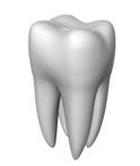
Your teeth Most people know that the teeth are the hardest and strongest part of the body. There's more than meets the eye, though. Teeth are actually a living part of your body that has blood vessels and nerves. If you used to judge your teeth like a book by its cover, then you're in for one big surprise. Teeth anatomy is a lot more complicated than you ever thought. The visible part of a tooth, otherwise known as the crown, is only a small portion of the living system. The crown is made up of enamel, the hardest substance found within the body. It is bone that has been enriched with large percentages of calcium. That's why people who drink lots of milk or take calcium supplements have strong bones and teeth. The enamel is thickest at the crown, and thinnest near the roots of the teeth. New developments include the implantation of artificial teeth or binding posts into the gums or jawbone; antibiotic fiber for periodontal disease; root canal surgery, a procedure that ameliorates pain while permitting teeth to remain in place; and nearly painless lasers to repair dental cavities, usually making local anesthesia unnecessary.
Learning more about dental implants Tooth loss is something no one looks forward to. If you lose one or more teeth, you have a number of options, one of which is dental implants. You owe it to yourself to be informed as possible about these options. With this in mind, we've created this section on dental implants. Begin learning more about dental implants for tooth replacement exacltly now! Implants are great for replacing missing teeth. It is important that you have enough bone in the area of the missing teeth for the implants to be attached to. Implants are not only used to replace one tooth, but rather people missing most, if not all, of their teeth benefit greatly as well. Implants are increasingly being used to replace certain types of bridges and removable partial dentures. The implant procedure is a surgical placement of the implant or implants in your jaw bone which requires a three to six month healing period before the implant restoration to replace the missing tooth or teeth. During this healing time, the bone grows in and around the titanium implant creating a very strong support. Dental implants can be rejected. Usually they are replaced with another implant of a slightly larger size. The rejection or "failure" rate is minimal, only 1 to 2% of all implant procedures. You must go without wearing your dentures for one day to two weeks after an implant placement. After the implant has "taken" and you have sufficiently healed, a very natural crown is placed on the implant.
Teeth dentures procedure There are two main types of dentures. Both Complete Dentures and Partial Dentures are finely crafted, custom-fitted. If you properly maintain your dentures they will appear natural and provide a perfect smile. Additionally, dentures help strengthen muscles controlling your expressions that require the support of your teeth, rid you of pronunciation problems caused by missing teeth and aid with chewing. If you've lost, or are losing, all of your teeth a Complete Denture is something to discuss with your cosmetic dentist. If some of your teeth remain and are healthy, a partial denture may be your way to a great smile. The main component of dentures is acrylic resin molded over the top of various combinations and paterns of metal. In oreder to use dentures all of the teeth in the top or bottom or both top and bottom of the mouth are removed. It is recomended that after the removal of the necessary teeth that the patient wait at least a month to have the dentures fit to the mouth. The waiting period allows for proper healing in the mouth to take place.
Cosmetic dental bonding Bonding is a composite resin filling placed in the back teeth as well as the front teeth. Composites are the solution for restoring decayed teeth, making cosmetic improvements and even changing the color of your teeth or the reshaping of teeth. Bonding will lighten any stains you may have, close up minor gaps and can be used to correct crooked teeth. The resin comes in many shades so that we can match it to your natural teeth. Due to the layers involved, this procedure will take slightly longer than traditional silver fillings because multiple layers of the bonding material are applied. Typically bonding takes an hour to two hours depending on your particular case.
Dental crowns Grinding your teeth, an improper bite, age, fillings and tooth decay can all be contributing factors in the wearing down, cracking or breakage of your teeth. Dental crowns cover the entire visible surface of your affected tooth and add strength, durability and tooth stability. Your cosmetic dentist will usually be able to spot problem areas in your mouth that might lead to tooth damage and a need for crowns. Chewing patterns play a big role as well. By selectively grinding the tips of your middle and back teeth (called cusps) will alter your bite to reduce the stress on at-risk teeth. Be sure to discuss with your cosmetic dentist that the cement color used for your permanent crown will be the same as used for your temporary crown. A try in paste is used for this purpose. The color of the cement does affect the overall color of a porcelain crown, so this needs to be discussed long before your temporary crown is placed. In some cases your cosmetic dentist may choose to use a Flipper instead of a temporary crown. A Flipper is a false tooth to temporarily take the place of a missing tooth before the permanent crown is placed. A Flipper can be attached via either a wire or a plastic piece that fits in the roof of your mouth. Flippers are meant to be a temporary solution while awaiting the permanent crown.
Teeth straightening Teeth straightening is accomplished with a number of different procedures and is usually done on children and adolescents when their permanent teeth begin growing in. Crooked teeth, crowded teeth, and even overbites and underbites can be treated with various teeth straightening techniques. While considered a cosmetic procedure, some people require teeth straightening in order for their teeth to be aligned in such a way that chewing is possible. Severe overbites and underbites can result in serious consequences over time, and even overly crowded teeth can mean health problems for the mouth. Invisalign is one of the newest methods of teeth straightening and is extremely popular with adults. Consisting of a clear mold that is nearly invisible when worn, Invisalign uses a series of molds that gradually push the teeth into the desired shape. Invisalign does not cost significantly more than standard orthodontic braces, but cannot correct an overbite or underbite and is only a good choice for minor straightening. Invisalign is not as effective on major problems, which may require standard braces.
Terms on this pageDental fillings
- Dental fillings are inserted as restorations in the treatment of dental cavities, after drilling out the cavities.
Dental implants
- Dental implants are surgically fixed substitutes for roots of missing teeth. Embedded in the jawbone, they act as anchors for a replacement tooth, also known as a crown, or a full set of replacement teeth.
Dentures
- Removable complete dentures are full-mouth false teeth, which are used when a patient has no teeth left on either the mandibular arch, the maxillary arch, or both.
Veneer
- A layer of tooth-colored material, usually porcelain or acrylic resin, attached to and covering the surface of a metal crown or natural tooth structure.
Anesthesia
- Total or partial loss of sensation, especially tactile sensibility, induced by disease, injury, acupuncture, or an anesthetic, such as chloroform or nitrous oxide.
- Local or general insensibility to pain with or without the loss of consciousness, induced by an anesthetic.
- A drug, administered for medical or surgical purposes, that induces partial or total loss of sensation and may be topical, local, regional, or general, depending on the method of administration and area of the body affected.
Bridge
- A dental bridge is a prosthesis used in place of missing teeth and may be removable or permanently attached.
Dental cavities
- The formation of cavities in the teeth by the action of bacteria; tooth decay.
- Also known colloquially as tooth decay.
Dental crown
- Full-coverage restoration (sometimes incorrectly called a cap) is a prosthetic tooth designed by a dentist and usually created by a lab technician.
Porcelain
- A hard, white, translucent ceramic made by firing a pure clay and then glazing it with variously colored fusible materials.
Stomatology
- The medical study of the mouth and its diseases.
Tooth bleaching
- Also known as tooth whitening.
|


