
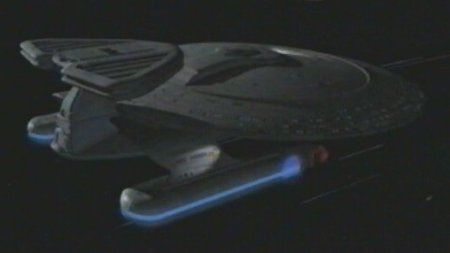
Information is by Daystrom Institution
Commissioned 2355 - present
Dimensions Length : 452 m
Beam : 560 m
Height : 145 m
Decks : 42 (including pod)
Mass 4,500,000 tons
Crew 780 including family members
Armament:
8 x Type X Phaser arrays
3 x Type 3 burst fire photon torpedo tubes + 180 torpedoes
Antimatter spread emitter Defence Systems
High capacity shield system
Standard Duranium/Tritanium double hull plus 9.0 cm High Density armour.
Standard level Structural Integrity Field Warp Speeds (TNG Scale)
Normal Cruise : Warp Factor 6
Maximum Cruise : Warp Factor 9
Maximum Rated : Warp Factor 9.9 for twelve hours
Strength Indices (Galaxy class = 1,000)
Beam Firepower : 1,000 Without
Weapon Pod : Beam Firepower : 1000
Torpedo Firepower : 2,000
Without Weapon Pod : Torpedo Firepower : 1,000
Weapon Range and Accuracy : 1,200
Without Weapon Pod : Range : 1,000
Shield Strength : 950
Hull Armour : 1,000
Speed : 1,601
Combat Manoeurvability : 1,500
Overall Strength Index 1,325 Without
Weapon Pod : 1,113
Diplomatic Capability Grade 7
Expected Hull Life 100 years
Refit Cycle Minor : 1 year
Standard : 5 years
Major : 20 years
Notes : As part of Starfleets war effort many of its ships have been upgraded
to increase their combat capabilities. The
uprated Nebula design has a maximum warp speed of Warp 9.9 and incorporates improvements
to the weapons and
targeting systems, a high level structural integrity field, and various other
classified changes. All Nebulas now being produced
are of the uprated model, and all of these are launched with the enhanced weapons
pod as standard.
The Nebula class was fielded in the 2350's to provide a smaller, more numerous
counterpart to the Galaxy class then
under construction. The design was intended to parallel that of the Galaxy class
as closely as possible in order to allow for
many identical systems to be installed in both classes; this has resulted in significant
improvements in the design and
construction processes for the Nebula class and thus allowed comparatively high
numbers to be fielded. Compared to
the Galaxy class the Nebula has a more compact shape - the engineering hull is
mounted directly to the underside of the
saucer section, a measure which saves some 200 metres in length. The major difference
in capability is the addition of a
prominent housing aft of the saucer section of the Nebula class. This enables
the vessel to carry any one of a variety of
special equipment pods - current models include a high capacity sensor pod, an
enhanced weapons pod, a colony
transport pod, an emergency field hospital unit, or a science laboratory pod.
Although the basic Nebula design has
approximately 80% of the capability of a Galaxy class vessel in most areas, the
addition of the mission pod brings that
figure up to 95% or more in that specific area. This flexibility actually allows
the Nebula design to accomplish almost
identical missions despite its smaller size. In service the Nebula class has proved
highly satisfactory, and in many ways
these ships form the backbone of Starfleets exploratory and scientific programmes.
Like the Galaxy class they have
received regular upgrades to their systems, most notably a new Warp Core design.
With the advent of the threats from
the Romulan, Dominion and Borg, Starfleet invested in the new enhanced weapon
pods for the Nebula class; most of the
vessels now carry this as a standard item. the pod carries eight standard torpedo
tubes and a stock of 300 casings,
approximately doubling the ships overall rate of fire.
 Back to Main