
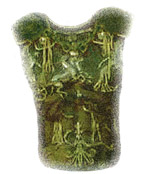
Caius Livius Varus Germanicus is of mixed Roman/ Alemanni birth; his mother being the daughter of an Alemanni King Gunderic. His birthplace is Aquae Sulis, Brittania in the year 377AD. His father Marcus Livius Maximus, being of the Ordo Equitata Romanus began as a auxiliary cavalry Praefect serving in Gaul and Britannia adding a second cognomen: Germanicus and eventually rising to the rank of Legate Commander of Legio XX Valeria Victrix in Eboracum.
Caius Livius Varus is the first generation born in Britannia. Raised in the Glevum area he joined the Legions at age 16 with a simple letter of introduction from a family friend and hiding his mixed barbarian/ equestrian heritage.
Determined to attain greatness on his own terms, Caius Livius Varus enlisted in the Legions as a common soldier, serving five years in Britain and Germania with distinction and eventually taking on the honorary cognomen of Germanicus, and rising to the rank of Centurio of the 3rd Cohort, Legio II Augusta upon his return home in Britannia.
Unwanted political interference guaranteed Caius Livius Germanicus transfer and sudden promotion to Tribune. As Praefectus Cohortis of the Cohors Sextae Thracia Equitata (an Auxila Cohort which soon became largely comprised of Alemmani volunteers and conscripts) Caius was stationed with Legio XX Valeria Victrix along the Rhenus in Germania Superior when Regent Stilicho relocated the Legio there to reinforce the Frontier Army in the Provincia. The Auxila Cohort soon became enveloped into another Frontier Ala and Caius Livius Germanicus was reassigned to General Stilicho’s personal Cohortes Palatinae serving as Magister Equitata. In the freezing winter of 406 AD the Frontier Army was crushed by invading tribes of Vandals, Alemanni, Franks and other Germanic tribes. Caius’ father, General Maximus and the Twentieth legion were lost while the Goths under Radagasius were pushed back by the Field Armies of Stilicho in Illyricum.
Later the remainder of the legions left Britannia in 409. Stilicho, less skilled in politics than his contemporaries, was claimed a traitor and executed along with many of his staff. Caius Livius Germanicus and several of Stilicho’s remaining staff fled home, several going to Britannia. Alaric, finally unopposed by Stilicho crossed the Alps and sacked Rome. The Western Roman Empire was changed forever.
Now at the age of 35, Caius Germanicus is developing a Colonia near Glevum, gathering Romans and Britons from the surrounding area and developing a unit of mixed Infantry and Cavalry based upon the 6th Thracian Cohort named Cohors Tertae Britannorum Equitata.