|
|
|
 |
|

| WEB PROFORUM TUTORIALS PRINCIPAL
SPONSORS |
 |
 |

| |
 |
Cellular
Communications |
1. Mobile
Communications Principles
Each mobile uses a separate, temporary radio channel to talk to
the cell site. The cell site talks to many mobiles at once, using
one channel per mobile. Channels use a pair of frequencies for
communication—one frequency (the forward link) for transmitting from
the cell site and one frequency (the reverse link) for the cell site
to receive calls from the users. Radio energy dissipates over
distance, so mobiles must stay near the base station to maintain
communications. The basic structure of mobile networks includes
telephone systems and radio services. Where mobile radio service
operates in a closed network and has no access to the telephone
system, mobile telephone service allows interconnection to the
telephone network (see Figure 1).
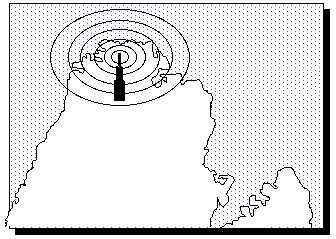
Early Mobile Telephone System Architecture
Traditional mobile service was structured in a fashion similar to
television broadcasting: One very powerful transmitter located at
the highest spot in an area would broadcast in a radius of up to 50
kilometers. The cellular concept structured the mobile telephone
network in a different way. Instead of using one powerful
transmitter, many low-power transmitters were placed throughout a
coverage area. For example, by dividing a metropolitan region into
one hundred different areas (cells) with low-power transmitters
using 12 conversations (channels) each, the system capacity
theoretically could be increased from 12 conversations—or voice
channels using one powerful transmitter—to 1,200 conversations
(channels) using one hundred low-power transmitters. Figure
2 shows a metropolitan area configured as a traditional
mobile telephone network with one high-power transmitter.
|