Paul Eddleston's Cycle Training Manual
Very under construction
Position 5
Stretching 35
This manual is intended to be used by riders enrolled in Paul Eddleston's Coaching Program and will complement the practical work done during the program.
The manual consists of enhanced articles that have previously appeared in the Queen City Wheel's newsletter along articles and information unique to this manual.
Additions and modifications will be offered from time to time so please be sure to choose a flexible binding system to accommodate future insertions.
One day I may even finish it.
Position
Adopting a good position on the bicycle is one of the fundamental aspects of effective cycling. Once the optimum position is adopted everything else, the training, cornering, correct pedalling, all fall into place. It is almost a spiritual symbiosis.
how to define position
Position is basically the shape you adopt on the bicycle and is determined by the relationship of the three points of contact you have with your machine. When you talk about your position on the bike you are really concerned with the relationships between the pedals, seat and handle bars.
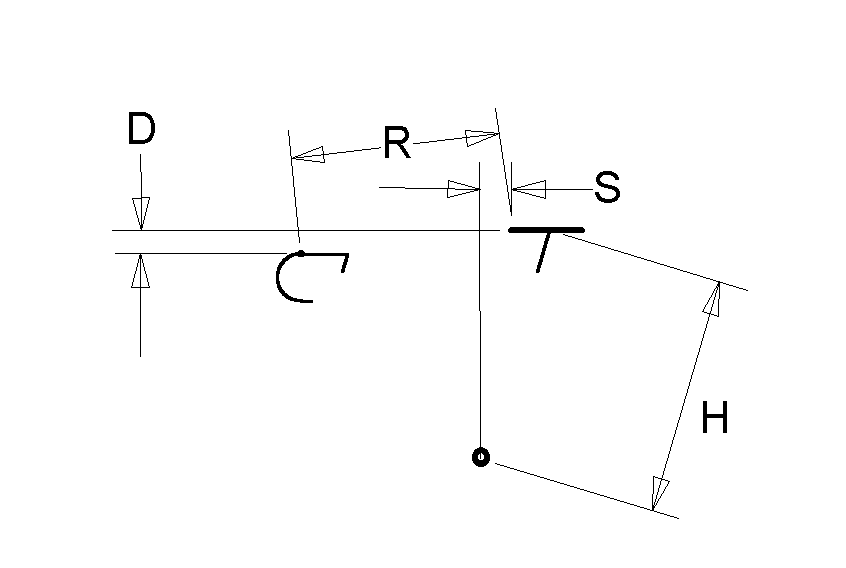
fig. 1. The Dimensions of Position
Fig. 1. shows the four dimensions of position. Note that the diagram does not include a frame. This is because position is not dependent upon the frame at all; it is purely the relationship between the three points of contact. For example, the dimension for seat height is not measured along the seat tube as is commonly done but between the centre of bottom bracket and the lowest part of the saddle as stated earlier. The fact that it closely follows the position of the seat tube is purely coincidental.
Because the pedals rotate around the bottom bracket it is more convenient to measure from the centre of the bottom bracket to the seat when measuring the seat height (H). It is very important to measure to the lowest part of the seat which is usually half way along its length. The distance from the tip of the seat to the bars is called reach (R) and is taken to the nearest surface of the handlebars. The drop (D) is measured from the uppermost surface of the handlebars.
basis of optimum position
The adoption of the optimum position must take into account two requirements; aerodynamical and biomechanical. The position adopted by a rider must allow him or her to cut through the air and also make the best use of the riders fitness.
Recent research in Europe utilizing ergometers in wind tunnels, has revealed that the optimum position for road racing related disciplines consists of having the rider seated high and well back with a flat back parallel to the ground. The adoption of this position is now almost universal in European pro ranks but sadly, the USA is lagging behind.
how to determine optimum position
The problem of achieving the optimum position can be defined simply as calculating the four dimensions of position for each individual rider. If you study these four dimensions it is possible to relate each one to various parts of the human anatomy. For example, it is fairly easy to imagine how the seat height might be related to the length of the legs. By the same token, it is possible to see that the set-back (S) of the seat might be related to the length of the thigh, the reach related to the length of the trunk and forearms and the drop related to the length of the upper arm.
If we accept this hypothesis one can see that in order to come up with four dimensions of position for any one rider we are going to need to know the sizes of the various body parts involved.
All the measurements shown below are performed with the rider seated with the back pushed up against the wall and shoeless. The trunk is measured from the top of the shoulder to the seat. or from the top of the Sturnum to the seat. Holding a bike pump or similar object the forearm is measured from the back of the elbow to the nearest edge of the pump and the arm, from the wall to the pump with the arm held straight out but not stretched. Measure the thigh from the wall to the front of the kneecap and the calf from the floor to the top of the kneecap. to measure the inseam it is easiest to push a wide book up against the crotch bone and measure it,s height from the floor after marking it.

Fig. 2. Body Measurements for calculating Position
From the measurements shown in fig. 2. it is possible to determine the various proportions of the rider. For example, the average ratio of the thigh to the calf is 1.11 in males, 1.14 in females indicating that the thigh is slightly longer than the calf.. Therefore, if we were to divide the measurement for the thigh by the one for the calf will get a ratio which will be similar to "1.11" for males and "1.14" for females. If the ratio is larger than this average we know that this particular rider has long thighs. If the figure is smaller then he or she has short thighs.
This kind of analysis can be applied to the other measurements using the following average relationships:
trunk/inseam = 0.76
arm/forearm = 0.87
forearm/inseam = 0.4
Once we know a riders peculiarities, i.e. long thigh, short trunk, long forearms etc. we have some indication as to their ultimate position. We can apply this information to determine the position dimensions by using the following table of typical values.
_______________________________________________________________________________
75-78cm 4-6cm 47-51cm 5-6cm
79-82cm 5-7cm 50-54cm 6-7cm
83-86cm 6-8cm 53-57cm 7-8cm
87-90cm 7-9cm 56-60cm 8-9cm
Table 1. Dimensions of Position
As mentioned above, if we consider the shape of a cyclist on a bike it is possible to see how the lengths of the various parts of the body relate to the four dimensions of position and therefore why it is important that we know the various relationships of these parts. For instance, it is quite clear that the height of the seat is related to the inseam. In fact, it is determined by multiplying the inseam by 0.885. The set back is related to the length of relative length of the thigh, the reach to the trunk and fore arm and the drop to the upper arm. Therefore, a high ratio for any of these parts will mean choosing dimensions from the higher end of the range in the table above and visa-versa.
how to modify your position. i.e. slowly
While it is nice to have a position that is defined down to the nearest millimeter it is not practical from a anatomical point of view to simply accept this as absolutely accurate. The numbers must act as a guide first and trial and error and experimentation will prove the best approach later.
Having said that, it is important to move towards this new position in a cautious manner in order to give the body time to adjust. The calculations, if done correctly may seem to produce a position which might, at first, seem a little extreme but this is quite normal. Adjustments must be made a few millimeters at a time over quite a few months or injury and frustration will be the result. It is an exercise worth persevering with as the resulting satisfaction and feeling of oneness with the bike will be well rewarded.
how to adapt an existing bike
It should be possible to apply the position resulting from this method to your existing bike however, you may experience a few problems. For those with long thighs it may not be possible to push the seat back far enough because of an overly steep seat tube angle. Don't compromise by using a longer stem, try different combinations of seats and seat posts to overcome this. Also, you may have difficulty getting the bars low enough if your current frame is too large. Don't compromise by putting the seat up. Try instead, looking for a sloping stem.
If you still can't achieve the optimum position with your existing bike you are going to have to find a more suitable frame or have one built to suit. Don't despair at this thought though as remember, you are going to move towards this new position very slowly anyway so your old frame will probably do for now.
Riding In A Group
During my career as a racing cyclist I was frequently being reminded of the lack of skill among riders when it comes to riding in a group, even among those who have been riding a while.
Riding in a group is one of the elementary and fundamental aspects of not only road racing, but of any part of the cycling world, even cycle touring. Whenever you ride with more than yourself you are riding in a group so it is important to know how to do it properly.
There have developed, over the years, various techniques, unwritten rules and protocols which the cycling community uses to negotiate it's way around the planet. Learn these, and you will be able to compete or ride any where in the world but ignore them and you will only serve to irritate your fellow cyclists and other road users and alienate yourself from their number. Good group riding technique is the key to unlocking the door of acceptability in the world of cycling.
Racing
Nothing can be more frustrating or irritating than a strong and powerful rider in a bunch or break who doesn't know how to conduct him or herself. In fact, the stronger they are the more frustrating the situation can be. When riding in a bunch be alert and pay attention at all times. Ride smoothly in a straight line and try not to do any thing suddenly or unexpectedly. Try to stay near the front and be constantly looking for opportunities to move up. Remember, if your not moving up your moving back. The easiest ride is always in the first half of the race especially in a tight criterium where the back half has to almost stop to get around the corners while the front half just flies round. Unless you crash yourself, logic dictates that you will never run into a crash that happens behind you, unless it is on a very small circuit of course.
When riding in the bunch you must have the utmost respect for the other riders around you. Not so much for there ability, although that is important too, but for their well-being. Never do anything that will compromise the safety of another rider. This you can achieve by being in total control of your machine-i.e. bike handling. It is your responsibility as a cyclist to be the best bike handler you can be. Everybody else will assume you are.
Be aware of the effects of your actions. For example, not too many riders are aware that when you get up out of the saddle to accelerate or just to change position there is usually a small movement of the bike backwards. This can be avoided but in some it is exaggerated and can have disastrous consequences for those following.
There is an unwritten rule in Europe and most of the rest of the world that you never overtake on the inside of a bend in a group situation. Unfortunately this is the major cause of crashes in the USA and should be a written rule. What happens when you force your way down the inside is that the whole of the bunch has to move to the outside to accommodate you and there is usually some poor sod on the outside who gets squeezed out and crashes bringing down the following riders too. If you find yourself continually in the situation where you feel you have to overtake in this manner try getting to the front instead. If you race in Europe, you'll only ever do it once.
If you do ride near the front you'll notice that there will be some kind of formation in operation particularly if there is a large group of riders who have broken away. Those in the know will generally form themselves into two parallel lines. One line will consist of riders moving towards the front and one will consist of riders moving towards the rear.
Lets follow one particular rider in a race; he's called Fred and is half way up the line moving towards the front. He is positioned immediately behind the rider in front and just a tad to one side so he can avoid a crash should there be a problem. He is not looking at the wheel in front of him but rather over the shoulder of the rider in front. This way he can see where he is in relation to the front of the group. As the rider in front of Fred reaches the front, he pulls over to one side and eases up a little. This leaves Fred at the front of the line that is going to the front. Fred doesn't accelerate to get past the rider who has just pulled over but allows that rider to slip back at his own pace. When he has slipped back beyond Fred's rear wheel Fred moves over in front of him and also eases up slightly. This allows the rider who was behind Fred to pass him without accelerating and to pull over in front of Fred.
Fred is now in the line that is slipping back and recovering from his effort to get to the front. As he moves back, the line he was previously in continues to move past him one by one. Fred is looking for the guy whom he was previously following (who is now on Fred's wheel) to pass him. When Fred sees him he looks back then moves over and again takes up position behind him. Fred is again in the line that is moving towards the front and has successfully completed one cycle.
Things do not always work this smoothly however. Sometimes the rider Fred is following pulls really strongly when he gets to the front and Fred has to accelerate to get past him and pull over. This disrupts the flow of the group as the rider behind Fred begins to suffer and can't get past Fred and so the group breaks down and ends up going slower until it reforms itself. Fred would have been better to let a gap open in front of him allowing the over zealous rider to ride away on his own. He could have then swung over and took up position in front of the rider that the stronger one should have been in front of. This assumes, of course, that he also has allowed him to drift away and not tried to keep up with his foolish pace. This method serves to keep the group together and the average speed high. The strong rider will soon come back to the group and learn his lesson.
After struggling to pass the strong rider and drifting back down the return line Fred finds he is not yet recovered enough to move over back into the forward moving line easily. That's OK as long as he informs the rider in front of him of the situation so he can jump in next. Fred then remains at the back of this group, recovering from his earlier effort. He could have struggled up to the front again but then he would have been unable to take his pull and caused even more disruption to the flow of the group. This way they will tolerate him sitting on the back so long as he gets back into the action when he is recovered.
This kind of formation is known as a paceline or through and off or some other local colloquialism and forms the basis of all group riding. It is a very efficient way of moving a large body of cyclists quickly down the road and is the reason why a large group can usually catch a smaller one.
Once the size of the group falls below about five or six the pace line method is no longer efficient. Then you adopt a system known as bit & bit. This basically consists of the riders riding in one long line. After a short time the rider at the front swings over and eases up until he ends up at the back of the group where he rejoins until he again gets to the front. Again it is important that the lead rider doesn't accelerate or this will disrupt the flow of the group. In a criterium or circuit with a lot of corners, a good way to swing off is to go into the corner wide and then slow down. This can often be the quickest and safest way to the back and is almost automatic. The length of time each rider spends at the front will vary but is generally fairly short. In a smaller group it will be longer than a larger group and in a head wind it will be shorter.
This is the most efficient way of moving two to six riders along the road. It is basically the way a team time-trial or team-pursuit team operates. If you have ever been in a pace line consisting of three riders you will understand why. You just end up with three guys constantly at the front and nobody resting.
Training
The above methods are primarily used during competition but are frequently employed during group training rides as well, particularly the bit & bit method.
When riding in a group at a more leisurely pace a more suitable system is required. The globally recognized method adopted by cyclists riding along a highway is for them to pair up so they are effectively riding in two lines. Each pair will stay at the front for between five and fifteen minutes depending on the severity of the conditions. When it is time for them to return to the back of the group they will move apart from each other leaving enough room for the whole group to pass between them as they drift to the back.
Riders will typically be partnered with the same rider for most of the ride and will even maintain the formation when stopped at lights. They will pass through intersections as one vehicle so they never have to wait for anyone. However, for this to be successful it is crucial that they stay in tight formation.
In the event that a highway is busy or narrow the riders will merge with each other into a single line but again they will stay tight allowing no gaps to appear between them. This way they can ensure that they all stay together. As soon as the hazard is clear they reform into the pairs they were originally in.
Next time that you see a race or are in one or on a group ride, look for these techniques being employed. Join in and practice them as this is the best way to improve these vital skills.
Training Intensities
When you went on your last training ride, how hard did you go?. Did you go 20mph or did you do a time trial effort?. Did you ride at 60% of maximum effort or did you ride with a heart rate of 170?. Maybe you went hard enough to make you legs hurt. As you can see, there are lots of ways to describe how hard you go when you ride your bike.
So what methods should you use to describe how hard you go? Well, all of them are useful but, the best ones are those that imply that there are different kinds of efforts that produce different feelings and results as this is what actually happens inside our bodies.
As you increase the intensity of your effort by increasing your speed or by riding up a hill your bodies energy producing methods change to ones more suited to the kind of effort you are making. So instead of measuring intensity on a scale of 1 to 100 you actually use a scale of 1 to 6 which represent separate phases called zones
These zones are divided up according to what energy source is used and in what manner. Zone 1 is an endurance or low intensity effort. Because it burns fat for fuel this kind of effort can go on indefinitely as you have loads of fat stored around your body. Your heart rate would be between 65 and 87 percent of it's maximum which is the minimum for getting any kind of benefit from a ride. Because you are using oxygen to burn the fat we say that the system is aerobic which simply means "with oxygen". It is like riding in the bunch in a road race and feels fairly comfortable.
Zone 2 is called an intense aerobic effort. You are still using oxygen and fat but now you have to burn a little glycogen as well. Your heart rate is between 80 and 90 percent of it's maximum. It is a similar effort to a long time trial, say over 25 miles. Theoretically you could carry on till you ran out of glycogen and then you would have to run on fat. This is known as the bonk. By now you are starting to breath hard. You find it hard to talk but at least your legs aren't hurting.
Zone 3 is the upper limit of zone 2. It is known as the anaerobic threshold. Anaerobic simply means "without oxygen" and it is called a threshold because you are on edge of not having enough oxygen available. As you can't burn fat quick enough you only use glycogen. Your heart rate would be between 90 and 100 percent of maximum. You could carry on at this pace for between four and thirty minutes before you became fatigued so it is similar to doing a short time trial. You will probably feel a little uncomfortable but your legs won't be burning much.
Zone 4 is what happens when you make a hard effort to climb a short hill or close a gap. It is called a long anaerobic interval because some of the glycogen reactions take place without oxygen. This produces lactic acid in your muscles. which causes the burning sensation in your legs that you are probably familiar with. You can keep this up for about two to four minutes before the burning is too much and you have to ease off. Your heart rate would be close to maximum by the end of this effort. After this kind of effort you still have to supply lots of oxygen to nuetralise the lactic acid.
If yougo a little bit harder than the zone 4 effort, you do a pure anaerobic interval which is zone 5. There wouldn't be nearly enough oxygen to combine with the glycogen so lots of lactic acid would be produced which would stop all progress after about 25 second to 2 minutes. Your heart rate would be up to maximum. It is similar to doing a kilometer ride on the track or closing a small gap in a crit.
Zone 6 is a pure sprint. When you do a flat out sprint you use a special fuel called creatine phosphate. which burns very quickly. Because, when it burns it does not produce lactic acid, during a true sprint, your legs don't actually hurt. You can even hold your breath if you want as creatine phosphate burns without oxygen. Unfortunately this supply of super fuel only lasts about 10 to 25 seconds after which you revert to a pure anaerobic interval with all it's dire consequences.
These points are summarised in the table below.

Systematic training is training to a plan that has been devised to obtain clearly defined goals and objectives. The opposite of systematic training is Accidental training. This can be thought of as getting any training that happens to come along during the day to day riding activities of the rider.
Typical Year
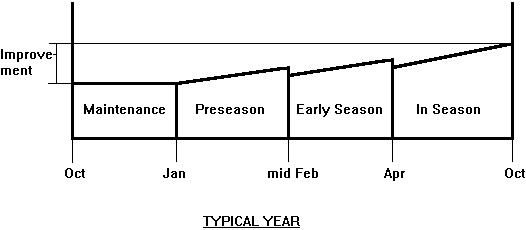
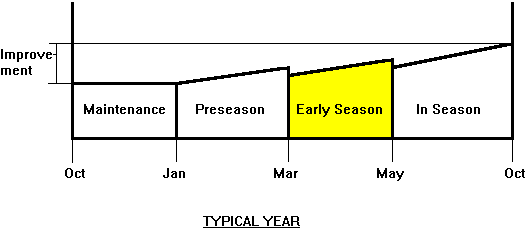
In order to form a plan to reach your cycling goals you need a time frame. Four years is usually what it takes to reach your potential. Over this period you hope to improve from where you are now to the level you want to be at in four years. This means a steady improvement over the year then training during the off season to maintain this level before improving again during the next year. At the start of the next year you aim to be as fit or slightly less fit than when you ended the last year but significantly fitter than when you started it.
Each season consists of a series of four phases defined by the kind of training activity within them and related to the racing activities of each phase. During each phase you aim for a gradual, steady improvement and then you rest for a short time to recover. You start the next phase at a level slightly below the level you ended the previous phase at but higher than you started it at.
The training year begins at the end of the racing season after a short rest. This allows you to avoid losing the valuable fitness you spent all year acquiring. After all, you are usually at your best at this time of the year; what a shame to let it go to waste. It can be thought of as the maintenance phase as you try to maintain your fitness during this period. If you consider that one week taken off the bike requires about three weeks of training to get back you will realise why plenty of riders don't progress very much.
During this phase it is important to get a mental break from competition and to a lesser extent cycling. However, activities should be choosen that stress the cardiovascular system in a similar way to cycling so that little fitness is lost. Running, swimming, cross country skiing etc all provide the correct degree of intensity to maintain a fitness level during this phase while offering a change of sport. Aim to work in zones 1 2 & 3 in these alternative activities and zone 6 (sprints) on the bike.
From January 1st up to the onset of training races can be considered as the pre-season phase of the year. The goal during this period is to build up an endurance and aerobic base on which to build the speed required later for competition. Training during this phase should be generally unstructured and gradually progress in terms of duration and intensity. Work should be carried out in zones 1, 2, 3 and 6 as before but more of it will be on the bike.
Once the preseason phase is completed you move into the early season phase. This usually extends to about the time when the important races begin which is usually around the beginning of May. Again the work is performed in zones 1, 2, 3 and 6 but towards the end of the phase we re-introduce the body to speed work in zones 4 and 5. Training is now more structured and planned. Any races ridden during this period, and there should be as many as possible, should be considered as training races. This means that the end result is not at all important. What matters is riding oneself into the ground and attempting all the moves that you are normally to timid to try during the important events later in the season.
During the actual racing season, the emphasis switches to training at the intensities you use during competition. That means that for road racing, all zones need to be given attention as they are all called into play at some time. However, the ones that need the most attention are the faster zones as these comprise the race winning speed.
Cycles
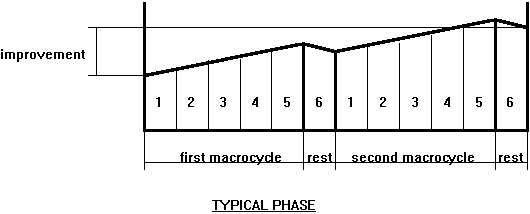
In order to assure progression each phase is derided up into 4 to 7 week periods called macrocycles. Each macrocycle is followed by a week of active rest. (This is rest on the bike at low intensity and mainly allows for a break from the structured training of the macrocycle.) During each macrocycle you build up the intensity and duration of training and then ease off for a week beginning the next macrocycle at a level just below where you left off. This allows you to focus our effort and gives you a physical and mental break before you move on.
Typical Week
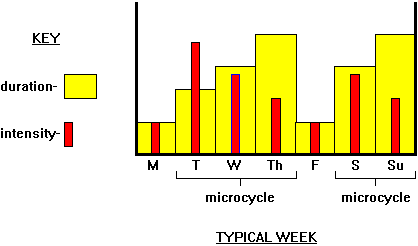
As with the rest of the periods mentioned earlier, the typical week is also broken down into cycles. These are called microcycles and are typically 2 or 3 days in length. During each microcycle you train at an intensity and duration above those of last week then rest for a day. It is important to train the higher intensity zones at the beginning of each cycle so as to be fresh for the next day of lesser intensity. If you tried to do sprints on a Thursday after a week of hard anaerobic and endurance work you probably wouldn't be able to produce your maximum effort and you would not be training at your best.
Therefore a typical week during any phase of the year would start out with Monday as a rest day. This is usually the day after a race or long group ride and it is necessary to recover before you try to improve some more. A Monday rest day can be a day off the bike all together as it is good to teach the body how not to ride sometimes. Tuesday marks the beginning of the first of the week's 2 microcycles. As you want to train the more intense zones first you do a sprint work out on
Tuesday. This could be followed by an interval training session (zone 4 and 5) if you were in the in season part of the year. In this case you would do sprints in the morning and intervals in the evening. Wednesday is usually the day for working on your anaerobic threshold, zone 2 and 3. The intervals from Tuesday could be done today but before the less intense threshold training. That would mean doing intervals in the morning and threshold work in the evening.
Thursday would bey our day for training your endurance system (zone 1). This requires a ride of between 2 and 7 hours duration depending where you are in your training plan so it is usually the only thing that is done on this day. After all that training Friday is a rest day. It should consist of 1 to 2 hrs of easy riding to loosen stiff muscles.
Saturday is the beginning of the week's second microcycle and is basically a combination of Tuesday and Wednesday depending on the time of year and upcoming events. Sunday is usually race day or if not a day of group riding possibly simulating efforts made in a race. This returns you t Monday and a well earned rest.
Each weeks training is at a level and duration slightly above last weeks in order to maintain a progression. Then at the end of the macrocycle you rest to allow yourself to recover so you can train at your best during the next one. The specific training done on any particular day depends on the phase, and cycle that you are in.
Training In The Off-season
As the season is draws to a close everybody starts to look forward to a well earned rest and then to the ensuing holiday period before the start of next season. Well the beginning of the next season should follow the end of the last; that is, if you want to go into next year season as a better cyclist than last. A goal I hope you all share.
The new training year begins at the end of the racing season after a short rest. This allows you to avoid losing the valuable fitness you spent all year acquiring. After all, we are usually at our best at this time of the year; what a shame to let it go to waste. It can be thought of as the maintenance phase as we try to maintain our fitness during this period. If we consider that one week taken off the bike requires about three weeks of training to get back we will realise why plenty of riders don't progress very much.
During this phase it is important to get a mental break from competition and to a lesser extent cycling. However, activities should be chosen that stress the cardiovascular system in a similar way to cycling so that little fitness is lost. Running, swimming, cross country skiing etc all provide the correct degree of intensity to maintain a fitness level during this phase while offering a change of sport. Aim to work in zones 1 2 & 3 in these alternative activities and zone 6 (sprints) on the bike.
The off-season phase extends from your last race to January 1st. This usually means from the beginning of October in Cincinnati but you may already have finished. Begin this period by taking a complete break from cycling for one to two weeks but no longer. It's been a long hard season and this will give you a good mental break and make you look forward to the beginning of training again.
Winter Clothing
Macrocycles
The period is split into two macrocycles each ending in a rest or easy week. The first one ends just before Thanksgiving so you don't have to worry about fitting in training around family activities. The second one ends before Christmas so it would seem that the holidays have been designed to accommodate cycling. As always, aim to improve slightly during each macrocycle before taking a short break.
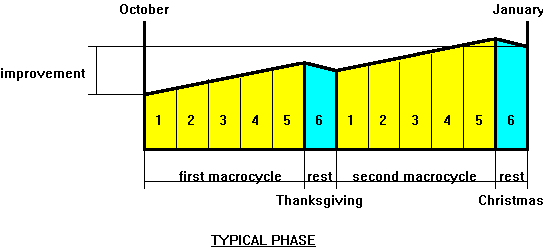
Microcycles
Each macrocycle is split into shorter periods known as microcycles. There are two per week. The first microcycle begins on Monday which is a rest day. Tuesday is the day for doing sprints. Sprints are performed all year round because they are a highly complex exercise that takes so much neurological skill to perform properly that we cannot afford to neglect them even during this phase of the year. Because of the skill factor, there is really no other way to do them other than on the bike. We do less than the rest of the year but try to build up the number you do as the macrocycle progresses.
Wednesday is usually our day for working on our aerobic power, i.e. zones 2 and 3. The off season phase is no exception however we don't have to do it on the bike. Choose between, running swimming, cross country skiing aerobics or roller riding etc. Just make sure that you work up near your anaerobic threshold and that you increase the quantity as you progress. Be very careful with these new activities. As a cyclist you are a somewhat fragile creature and prone to injury if you dive into a new activity too aggressively. Don't play football.
We still have to ride our bikes this time of year so we do it on Thursdays. We need to work in zone 1, our endurance capacity. This needs 2 to 3 hours of stimulation on the bike but if the weather is too cold, ride on the rollers instead. I don't know many people who can ride that long on rollers without turning into a vegetable but some more zone 2 training wouldn't hurt instead.
On Friday, take a rest. Do any activity you want or watch a cycling video to keep up your enthusiasm. Saturday and Sunday comprise the second of the week's microcycles. On Saturday, combine Tuesday's and Wednesday's workouts with a few hours for lunch in between and then on Sunday, take part in a group ride for between 3 to 5 hours. Choose one that maintain a good pace and is a little competitive from time to time without being crazy. You want to be slightly pressured during this ride while staying mostly in zone 1. Keep an eye on your pulse during these rides. If it consistently goes below 120 you would be better off staying at home and watching a Tour de France video; you'll learn more.
You may have noticed that so far we have not mentioned weight training. Really there is no place for weights in a road or criterium rider's training program, even in the off-season. Everything you can do with weights, you can do on the bike but more efficiently as you are also teaching your body to pedal. The nearest activity we do to weight training is sprinting as it is a high strength activity but sprinting, being the highly neurological skill activity that it is can not be duplicated with weight training unless you were to develop a special piece of apparatus designed to mimic the motion of the legs during cycling. In fact, this has already been done; it's called a bike.
If you follow this program throughout the off-season you will be able to start training proper in January at a level more or less the same as the one that you ended the last year. Then you spend the next few months improving on that instead of trying to get all your lost fitness back.
Error! No topic specified.
TRAINING PLAN FOR OFF-SEASON PHASE. ADULT RIDER.
Pre-season Training
In the last chapter I talked about the kind of training you should do during the off-season phase. This chapter will give you a training program for the next phase of the training year.
From January 1st up to the onset of training races can be considered as the Pre-season or Winter Phase of the year. The goal during this period is to develop up an endurance and aerobic base on which to build the speed required later for competition. Training during this phase should generally be unstructured and gradually progress in terms of duration and intensity. Work will be carried out in zones 1, 2, 3 and 6 as before but more of it should be on the bike.
The period is split into two macrocycles each ending in a rest or easy week. Each macrocycle should be between 5 and 7 weeks long. As always, aim to improve slightly during each macrocycle before taking a rest week. This should consist of short, easy, fun rides in zone 1.
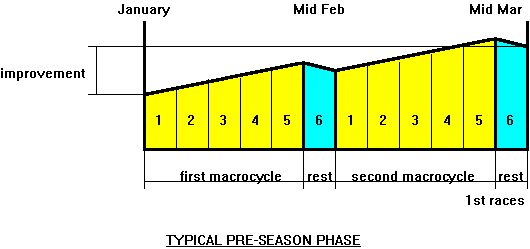
Microcycles
As usual, each macrocycle is split into shorter periods known as microcycles. There are two per week. The first microcycle begins on Monday which is a rest day and the second begins on Saturday after an easy day on Friday.
As you may remember, each microcycle starts off with high intensity, short duration and progresses through decreasing intensity and increasing duration.
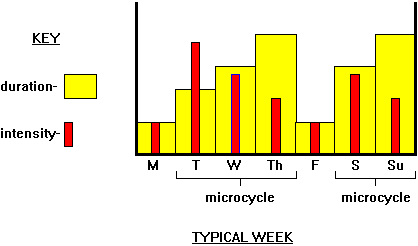
Monday
Monday is typically a rest day off the bike. In the season it is usually the day after a race so it is a good idea to get used to resting on a Mondays. You could go for a short, easy ride but it is useful for you to teach your body that it is OK not to ride.
Tuesday
Tuesday is really the beginning of the training week. As you always start with the higher intensity exercise first, Tuesday is the best day for doing sprints.
Zone 6 is a pure sprint. When you do a flat out sprint you use a special fuel, stored in the muscles, called creatine phosphate. which burns very quickly. Because, when it burns it produces no lactic acid, during a true sprint, your legs don't actually hurt. You can even hold your breath if you want as creatine phosphate burns without oxygen. Unfortunately this supply of super fuel only lasts about 10 to 25 seconds after which you revert to a pure anaerobic interval witch does produce lactic acid and consequently, burns your muscles.
Each sprint workout should be preceded by at least a 15 minute warm-up and should be conducted on an empty stomach. Your first 3 sprints should be short (7-10 sec), explosive efforts in a big gear (typically 52x13) from a near standing start. These should be done on a flat or slightly uphill section of road. This trains your explosive power and jump. It is very important to rest sufficiently between each sprint effort in order to insure that the next sprint can be performed at it's maximum. Do this by riding in a low gear at or below 125 beats per minute until you feel fresh..
After the short warm-up sprints, you need to do some pure sprints. Choose a gear slightly lower than the one for the short sprints (52x14/15) and sprint for 10-25 seconds flat out from a brisk pace (20mph). It is important not to sprint for too long as this will deplete your supply of creatine phosphate and you will no longer be doing a pure sprint (zone 6) but a short interval (zone 5). Remember, a pure sprint does not hurt your legs. It's only when you have depleted your supply of creatine phosphate and started using up glycogen reserves that lactic acid is produced making your legs burn. This is one reason that you must rest sufficiently between sprints in order for you to replenish your supply of this high energy fuel.
In this phase of the year, do between 2 and 6 pure sprints depending on your level of fitness and place in your training plan. If you are too tired to manage the number of sprints you set out to do, then stop the session. There is no point trying to sprint if your are too tired to do a 100% sprint each time. Instead, ride at an endurance pace (zone 1) for at least 1.5 hours.
Wednesday
Following the principle of decreasing intensity and increasing duration; Wednesday is the best day to train in zones 2 & 3.
Zone 2 is called an intense aerobic effort. You are still using oxygen and fat but now you have to burn a little glycogen as well. Your heart rate is between 80 and 90 percent of it's maximum. It is a similar effort to a long time trial, say over 25 miles. (Theoretically you could carry on till you ran out of glycogen and then you would have to run on fat. This is known as the "bonk"). By now you are starting to breath hard. You find it hard to talk but at least your legs aren't hurting.
Zone 3 is really the upper limit of zone 2. It is known as the anaerobic threshold. Anaerobic simply means "without oxygen" and it is called a threshold because you are on edge of not having enough oxygen available. As you can't burn fat quickly enough you use glycogen exclusively. Your heart rate would be between 90 and 100 percent of maximum. You could carry on at this pace for between four and thirty minutes before you became fatigued so it is similar to doing a short time trial. You will probably feel a little uncomfortable but your legs won't be burning much.
The best way to train these two systems this time of year is to do a hilly road ride. Ideally you are aiming to be in your target heart rate range (80-90% of max) for between 5 to 10 minutes on the climbs. Aim to climb between 2 and 5 good hills as you progress through the macrocycles. Ride steady for about 15 minutes between each climb. Don't be too rigid with these time periods though. Remember, your training should be fairly unstructured this time of the year to avoid burnout.
If the weather is bad or you can't get out during daylight, you can get a good zone 2 & 3 workout on a turbo trainer. You probably won't be able to ride for as long but you can still ride at the required level for 5 to 10 minute periods with easy bits in between. Make sure you use a fan to keep you cool; it is easy to overheat when training indoors. A hard mountain bike ride might also be suitable.
Thursday
Thursday is endurance day. After the intense training of the previous two days you should be quite tired but you should be able to ride in zone 1 quite easily.
Zone 1 is an endurance or low intensity effort. Because it burns fat for fuel this kind of effort can go on indefinitely as you have loads of fat stored around your body. Your heart rate should be between 65 and 87 percent of it's maximum (65% is the minimum for getting any kind of benefit from a ride). Because you are using oxygen to burn the fat we say that the system is aerobic which simply means "with oxygen". It is like riding in the bunch in a road race and feels fairly comfortable.
Aim to ride for between 2 & 5 hours in this phase scheduling the distances so that they gradually increase over the period of the macrocycle. Having said that, with endurance training, it doesn't hurt to do more if you feel good. Again, if you can't get out on the road try to ride as much as you can on the indoor trainer. As you won't be able to equal the duration you would do on the road try to increase the intensity a little but not to the same extent as the previous day especially if you feel tired.
Friday
Friday is a rest day but you don't want to be totally inactive. Ride for 1-2 hours at an easy pace in a low gear. This is like a massage on the bike and is known as active rest. In the season you should always rest the day before the day before a race not the actual day before. This avoids the tired, sluggish feeling that usually occurs after a rest day.
Saturday & Sunday
Saturday and Sunday comprise the second of the week's microcycles. On Saturday, combine Tuesday's and Wednesday's workouts with a few hours for lunch in between. If you want to do everything in only one session make sure that you ride easy for at least half an hour before going up any hills.
On Sunday, take part in a group ride for between 3 to 5 hours. Choose one that maintains a good pace and is a little competitive only from time to time. You want to be slightly pressured during this ride while staying mostly in zones 1 and 2. Keep an eye on your pulse during these rides. If it consistently goes below 120 you would be better off staying at home and watching a Tour de France video. Try to be disciplined enough not to get too involved with the inevitable competitiveness that usually accompanies these rides. Know what you need to do and do it. If the group goes too slow; leave them. If they go too fast; let them go and beat them in the races later in the year. If they get back too early or they want to do an epic; let them. Don't be a sheep; be in control of your training.
Summary
Whatever training program you end up fitting into your busy schedule always follow the basic principles below:-
I) Make your training progressive by training in cycles and resting in between.
II) Train the higher intensities before the lower ones.
III) Rest is as important as training.
IV) Make a plan and follow it. (It is one of the traits of successful people.)
Early Season Training
Once the preseason phase is completed we move into the early season phase. This usually extends to about the time when the important races begin which is usually around the beginning of May in this area. Again the work is performed in zones 1, 2, 3 and 6 but towards the end of the phase you re-introduce the body to speed work in zone 4. Training is now more structured and planned.
Typical Week
As with the rest of the periods discussed in previous articles, the typical week is broken down into cycles. These are called microcycles and are typically 2 or 3 days in length. During each microcycle you train at an intensity and duration above those of last week then rest for a day. It is important to train the higher intensity zones at the beginning of each cycle so as to be fresh for the next day of lesser intensity. If you tried to do sprints on a Thursday after a week of hard anaerobic and endurance work you probably wouldn't be able to produce your maximum effort and you would not be training at your best.
Therefore a typical week during any phase of the year would start out with Monday as a rest day. This is usually the day after a race or long group ride and it is necessary to recover before you try to improve some more. A Monday rest day can be a day off the bike all together as it is good to teach the body how not to ride sometimes.
Tuesday marks the beginning of the first of the week's 2 microcycles. As you want to train the more intense zones first you do a sprint work out on Tuesday.
Wednesday is usually the day for working on your anaerobic threshold, zone 2 and 3. In the previous phase you did unstructured long intervals by riding hills. In this phase you should do structured long intervals. This means riding at or near your anaerobic threshold for between 5 and 10 minutes at a time and resting for between 10 and 15 minutes. The duration of the effort and number of efforts should increase as you progress through the phase. You will need to find a fairly flat stretch of road to perform this exercise as you don't want severe changes in gradient to interfere with your efforts.
Thursday should be your day for training your endurance system (zone 1). This requires a ride of between 2 and 7 hours duration depending where you are in your training plan so it is usually the only thing that is done on this day.
After all that training Friday is a rest day. It should consist of 1 to 2 hrs of easy riding to loosen stiff muscles.
Saturday is the beginning of the week's second microcycle and is basically a combination of Tuesday and Wednesday. Sunday is usually race day or if not a day of group riding possibly simulating efforts made in a race. The duration should be the same as Thursday's. This returns us to Monday and a well earned rest.
Each weeks training is at a level and duration slightly above last weeks in order to maintain a progression. Then at the end of the macrocycle you should rest to allow your body to recover so that you can train at your best during the next one. The specific training done on any particular day depends on the phase, and cycle that you are in.
Interval Training
During the last few weeks of this early season phase you want to re-introduce your body to anaerobic intervals. This will give you the speed needed to attack during races and stay at the front during the last few laps of a criterium. This requires riding above your anaerobic threshold for 2 minutes and then resting for 8 minutes. This is a zone 4 workout. You need to perform between 3 to 6 of these intervals as you progress. They are best carried out on a gradual hill as it is difficult to push yourself this hard on the flat.
These intervals need to be slotted in between your sprints and your anaerobic threshold training. This means doing them Tuesday evening after sprinting in the morning or at lunch time, or Wednesday morning before the evenings anaerobic threshold training.
You could also do them on a Saturday afternoon instead of your anaerobic threshold training. Alternatively, you could alternate them on a weekly basis, skipping the sprints or anaerobic threshold training. Whatever you decide, remember that it is important to train in all these areas to some extent.
Training Races
Any races ridden during this period, and there should be as many as possible, should be considered as training races. This means that the end result is not at all important. What matters is that you ride yourself into the ground and attempt all the moves you are normally too timid to try during the important events later in the season.
Do not make any special concession in your training to accommodate these races. For example, if you have a training race on a Sunday, do not take it easy on Saturday to be in top form for Sunday. Don't compromise your training for a race whose result is not important. Nobody remembers who wins the training races but, come the summer, they are sure going to know who used them as training.
Another trap that you need to watch out for is to make sure that riding a training race on a weekend doesn't result in you getting only a fraction of the duration of training that you would normally expect to do this time of year. Normally, on a Sunday for example, you would expect to ride for 3 to 5 hours but if you ride a fifty mile training race you are only going to ride for perhaps two hours. Thus, racing can be counter productive.
The way round this is to make sure that you get a little bit extra in over and above the race distance. The traditional way to do this in Europe is to ride home from the race, preferably in a small group. This also gives you opportunities to discuss the details of the race with other riders.
In-season Training
Two previous chapters talked about the different energy systems and how they relate to the intensity of effort and about how the year is broken down into various components related to training. Now I want to bring these two subjects together and talk to you about what training methods and workouts you need to do during the next phase of the season, the in-season phase.
What we are going to take a look at next is a typical week during the in season phase. As you may remember, the week starts of with high intensity; short duration and progresses through decreasing intensity and increasing duration in two microcycles.
Monday
Monday is typically a rest day off the bike. It is usually the day after a race so it is a good idea to rest on a Monday. You could go for a short, easy ride but it is useful for us to teach your body that it is OK not to ride sometimes.
Tuesday
Tuesday is really the beginning of the training week. As you always start with the higher intensity exercise first , Tuesday is a sprint and interval day.
Each sprint workout should be preceded by at least a 15 minute warm-up and should be conducted on an empty stomach. Your first 3 sprints should be short (7-10 sec), explosive efforts in a big gear from almost a standing start. These should be done on a flat or slightly uphill section of road. This trains your explosive power and jump. It is very important to rest sufficiently between each sprint effort in order to insure that the next sprint can be performed at it's maximum. Do this by riding in a low gear at or below 125 beats per minute until you feel fresh..
After the short warm-up sprints, you need to do some pure sprints. Choose a gear slightly lower than the one for the short sprints and sprint for 10-25 seconds flat out from a brisk rolling start. It is important not to sprint for too long as this will deplete your supply of creatine phosphate and you will no longer be doing a pure sprint (zone 6) but a short interval (zone 5). Remember, a pure sprint does not hurt your legs. It's only when you have depleted your supply of creatine phosphate and started using up glycogen reserves that lactic acid is produced and makes your legs begin to burn. This is one reason that you must rest sufficiently between sprints in order for you to replenish your supply of this high energy fuel. Do between 2 and 10 pure sprints depending on your level of fitness and place in your training plan. If you are too tired to manage the number of sprints you set out to do, then stop the session. There is no point trying to sprint if your are too tired to do a 100% sprint each time. Instead, ride at an endurance pace (zone 1) for at least 1.5 hours.
After the sprint workout in the morning and after an afternoon rest you should do an interval workout. Interval training is any training where you ride hard then easy, hard then easy. There are many types of interval training. The type you do after a sprint workout is the short or pure interval training. This is performed in zone 5.
Again, you need a 15 minute warm-up and an empty stomach. To perform a series of pure intervals, jump hard and sustain the effort for between 25 and 45 seconds then coast and rest for 4 times as long as the effort. This is repeated as many times as your program prescribes, if possible. This may be anywhere between 2 and 8. The rest is relatively short in order to maintain high levels of lactic acid in the muscles. This helps increase lactic tolerance and gives you that last lap, race winning effort.
Wednesday
Following the principle of decreasing intensity and increasing duration; Wednesday is the day to train in zones 2, 3 and 4.
To train zone 4 you need to ride at near your maximum heart rate for about 2 minutes then rest for about 8 minutes. This is known as long interval training. Do as many as can be done until the intensity fades, gradually increasing the quantity as you progress through your macrocycle.
After the morning's long interval workout, in the evening you can train your anaerobic threshold system, zones 2 and 3. Aim to ride for periods of 10 minutes at a time just below your anaerobic threshold as many times as possible. (probably between 2 and 5) and rest 15 minutes between each effort. This can be performed on the flat or on hills, reflecting the type of race on the approaching week end.
Thursday
Thursday is endurance day. After the intense training of the previous two days you should be quite tired but you should be able to ride in zone 1 quite easily. Aim to at least equal the duration, (not the actual distance), of the upcoming race and try to schedule the distances so that they gradually increase over the period of the macrocycle. Having said that, with endurance training, it doesn't hurt to do more if you feel good.
Friday
Friday is a rest day but you don't want to be totally inactive. Ride for 1-2 hours at an easy pace in a low gear. This is like a massage on the bike and is known as active rest. Always rest the day before the day before a race not the actual day before. This avoids the tired, sluggish feeling that usually occurs after a rest day
Saturday
As Sunday is usually race day, Saturday is the day that you re-awaken your body after the rest on Friday and bring it back up to speed. You don't want to tire yourself out today but you want to ride with some intensity for a short time. Do a few sprints and spend a few minutes near your anaerobic threshold. Stay out for a duration that is inversely proportional to tomorrows race. That is, if your are riding a 100 mile road race, ride for an hour, If you have a short crit ride for between 2.5 & 2 hours.
Sunday
Sunday is usually when the races are. If you do not have a race this day do a ride that simulates the types of efforts that you would make in a race.
Adapting the schedule
The above training ideas are set forth as an ideal program to follow for a full time senior rider. Juniors should avoid the higher intensity intervals and juveniles should just ride their bikes in whatever manner they prefer. Of course, most of you don't live in an ideal world and have to compromise.
If time is not available to work in all the zones each week several steps can be taken. Concentrate your training in the areas that most closely duplicate the type of races you do or are most important to you. For example, if you ride mostly criteriums and work full time during the day you could do sprints on Tuesday night, intervals on Wednesday and anaerobic threshold on Thursday. You don't need to worry about endurance training to ride a one hour criterium so you can afford to reduce that aspect of your program to the occasional long ride. Whatever kind of intervals you did on Wednesday, do the other kind the next week and so on through your macrocycle. Always follow the principle of doing the harder exercise first.
It is also worth remembering that sprints and intervals take only a short time to do and it may therefore be possible to squeeze them into a lunch time session or even do them in the morning before breakfast or on the way to work.
If you have a race that falls on a Saturday, it is necessary to tweak the weeks schedule to suit. If you raced on Sunday, then you will be resting on Monday and as you need to rest two days before the race, you will be resting also on Thursday. This leaves only Tuesday and Wednesday to train, so do the things that are important to you for the upcoming race. Remember, always rest after a race and always warm-up the day before. If you are racing late in the day, you can maybe warm-up in the morning and rest day before.
Summary
Whatever training program you end up fitting into your busy schedule always follow the basic principles below:-
I) Make your training progressive by training in cycles and resting in between.
II) Train the higher intensities before the lower ones.
III) Rest the day before the day before the race
V) Ride the day before the race.
Stretching
What is Stretching
I think most cyclists will be aware of the concept of stretching but in case some aren't, here is a brief description.
Stretching is the act of moving a joint or joints through its full range of motion to increase the mobility of that joint. This elongates the muscles and tendons of the affected joints and results in a greater range of motion about that joint.
Why Stretch
Many top class athletes go through their entire careers without ever employing stretching routines in their training programs. On the other hand, there are many lowly athletes who do utilize stretching routines frequently yet remain at a low level.
The point here is that stretching won't make you a super fast cyclist. What it will do is help you to become a better rider than you otherwise might be. A regular stretching program will increase the range of motion at specific joints. Cycling is a sport that fixes the upper body in a predetermined position for many hours at a time so joints in this region tend to loose their flexibility. This is not a major problem until the rider is unfortunate enough to be involved in an accident resulting in a tumbling motion from the bicycle. In this kind of crash, some joints may be strained beyond their normal range of movement and injury in that area may be the result. However, if there is ample range of motion in these joints, injury may well be avoided at this point and the consequences of the accident minimised.
Another area of cycling where having a good range of motion is important is in the pursuit of the optimum riding position. Modern thinking has pushed the rider to extremes in terms of saddle height, set-back and handle bar location in order to improve aerodynamics but some, if not the majority of riders find difficulty in attaining this ideal through lack of flexibility. The problem lies in the hamstrings at the back of the thighs and to a lesser extent, in the lower back area. Unfortunately, the cycling action tends to shorten the muscles of the hamstring as the knee is rarely fully extended. The same thing applies to the muscles of the lower back and the result is that many cyclists would find it difficult to adopt their ideal position which would dictate them having to lean forward, rotating the pelvis in order to attain what is generally considered a flat back position.
Another problem related to position is the muscles own defence mechanism. As a contracting (shortening) muscle nears the end of it's range of movement it sends out a signal via the nerves to tell the opposing muscle to contract in order to slow down the movement. It's not unlike putting on the brakes. This braking mechanism is counterproductive to cycling as it slows you down so we need to make the "braking point" beyond the normal range of motion experienced during cycling so as not to trigger the defence mechanism.
When to Stretch
Although we talk about stretching muscles, if we are looking for increased range of motion in a joint it is actually the muscle tendons, the tissue that connects the muscle to the bones, that elongates over time. This tissue will only stretch when it is fully warmed up so it is very important to stretch only after exercise or a good warm up. Improvements in performance may be gained by stretching before competition but this should only be done after the initial warm up.
A regular stretching schedule should be incorporated into your daily routine, ideally after the days training ride or race. The stretching will also have therapeutic effect which helps in the recovery phase of exercise. Muscles typically exhibit less feeling of fatigue the following day after stretching.
How to Stretch
As previously discussed, it is very important to warm up before a stretching session. If stretching after training, take a shower and put on some comfortable clothing but don't take in any large quantities of food before stretching
All the exercises described below should be performed up to the point of "comfortable tension". They really shouldn't be painful. To get to this point it is crucial that you stretch very slowly. Any ballistic effort will trigger the defence mechanism and you wont get any benefit from the exercise; in fact, you will probably do more harm than good. Hold each stretch for 15- 30 seconds then relax for a few moments and repeat once more.
In Conclusion
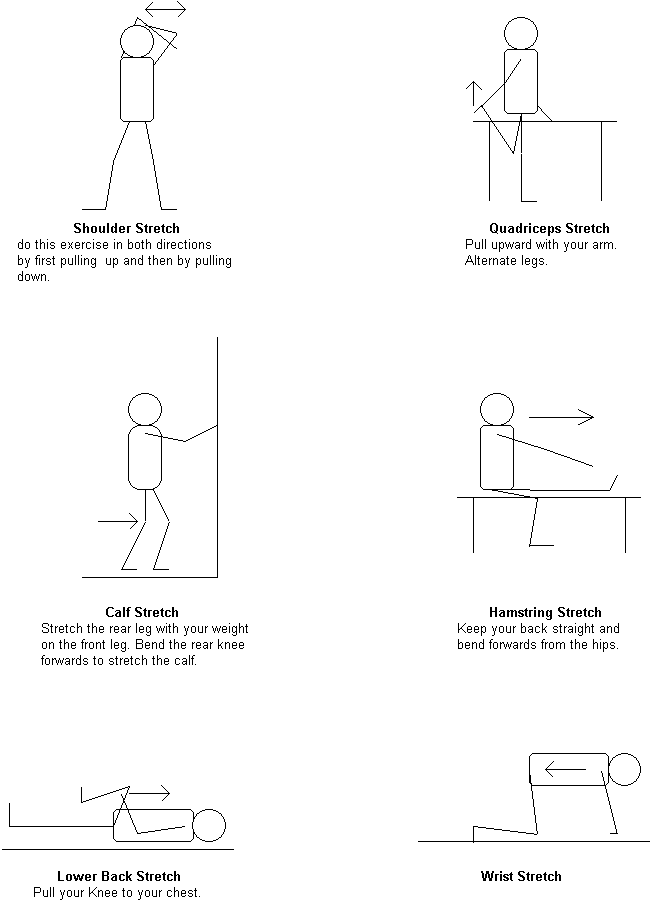
Try to incorporate the exercise on the next page into your daily routine. They won't turn you into a champion overnight but they will benefit you in the long term. You will be less prone to injuries, be able to adopt a better position and recover more quickly. Remember to stretch slowly to the point of comfortable tension and hold for 15-30 seconds. It shouldn't be painful.
What Is Food?
carbs
protien
fat
vitamins & minerals
fluids
How Much DoYou Need?
When Do You Need It?
pre
post
during
between
Recommended Reading
Road Racing, Technique & Training.
Bernard Hinault and Claude Genzling. (Capital City Press).
Greg Lemond's Complete Book of Bicycling.
Greg Lemond and Kent Gordis. (Perigee Books)
Serious Training For Serious Athletes.
Rob Sleamaker. (Leisure Press)
Benjamin Franklin's The Art of Virtue.
George L. Rogers. (Acorn Publishing).
Training Lactate Pulse-Rate.
Peter G.J.M. Janssen. (Polar Electro Oy).
The Edge.
Howard E. Ferguson. (Howard E. Ferguson)
Race Day
warm up
things to take
ride home
food
numbers
Tips
use normal equipment
name on bag and bottles and wheels
Paul Eddleston's Training Manual
Page - 42
TEAM STRATEGY AND TACTICS
Introduction
One of the greatest joys of competitive cycling comes from being part of a small, successful group or team. It doesn't necessarily have to be a super team of elite athletes either; a great deal of enjoyment can be derived from any collective band of cyclists pulling together in a joint effort for the benefit of all the members, even at category five level. Racing as a three member team, for example, gives you three times as much chance to share in some glory and to know you did a good job even if you did not personally win the race.
What is required, however, is a bit of effort on behalf of the riders concerned to learn and apply a few basic principles and maybe some help from an objective person such as a local coach. In this chapter, I hope to introduce these basic principles.
Prerequisites
One of the first tasks for anyone collecting a group of riders together as a team is to look for riders of well matched ability in the general sense. Specific individual talents, such as sprinting, are important but it is more important that the riders are of a similar, overall level. In order to bring these people together and give a sense of identity or team spirit to the group, it is often useful to separate the team from the club by providing different jerseys. This is not essential however, and many successful teams function purely as "cliques" within their clubs.
If you are going to race "for the common good" it is very important to talk about distribution of prizes before the season get under way and not wait for the first spoils to come in. This avoids a lot of problems later even though there will inevitably be some as egos start to get bruised or inflated. It is also important to decide the common goals and objectives of the team and to make sure these are aligned with the personal goals of the individuals. Some examples of a cat four team's goals might be to all progress to cat three or to win the local criterium series.
It is also useful to set a common race schedule so riders know where the team is racing throughout the year. You don't have to schedule every weekend, just choose some events that you would like to do as a team like the local spring training series or district championships. If your team has funds, you could class these team races as "supported" events and pay the entry fees for the team to ride them.
Strategies
A strategy is the overall plan for a race and tactics are the individual skills a team can use to pull off their strategy.
Some examples of a strategy include keeping the race together for your sprinter, trying to get a member in the race winning break, trying to win all the primes.
To execute a strategy a team depends on:
Commitment
It is important to have a group of individuals that will pull together for the good of the team and subordinate their personal goals to those of the team. Having said that, it is also important that the overall goals of the team are compatible with those of the individual members or there may be problems later.
Patience
It is sometimes difficult to hold back the implementation of a strategy. Most of the important moves in a race take place in the second half after people begin to feel tired and less invincible.
Reading the race
Along the same lines as patience is the ability to read a race. Most races follow a similar pattern of futile attacks in the early stages followed by more genuine attacks by the riders who will ultimately triumph during the middle third ending with the decisive break in the last third. The ability to read a race will help you decide which moves to go with at any particular time or, indeed, whether to go with any if it looks like the race will stay together. At some point in a race there comes a point when the decisive move will be made. The best riders try to make this the only move they are involved in at all. To do this takes great judgment which can only be acquired through experience. The ability to detect "the move" is one of the talents that separates the good from the great.
Element of surprise
The element of surprise can mean doing the unexpected thing or it can mean doing something so quickly and decisively that the competition has little time to react. A lot will depend on your reputation. If you are known for example, as a killer sprinter, it may well pay off if you jump with a kilometer to go instead. It still has to be a good move in it's own right but if everyone is looking to get on your wheel for the last 200 meters this could well win the race.
Along the lines of decisiveness, it is important to learn to attack from behind so as to gain speed over the other riders before they see you. An explosive effort is required but sometimes, because of the mood of the race it can be more successful to simply ride off the front as if you are not making a serious attack.
Efficient use of energy
Most events in cycling, even criteriums, rely on endurance to some extent. To that end it is important to avoid wasting energy during the race. If you are not attacking you should be looking for the best opportunity to rest at all times. This is accomplished by hiding from the wind as much as possible. When you move up, try to do so in the middle of the bunch rather than around the outside which would afford little shelter and never do more work in a break than the person doing the least unless you have ulterior motive in mind like gaining time in a stage race. While waiting in the bunch for the right time to act, make sure you are always in a low gear and spinning. Be especially careful to change down rather than lug a big gear up a gradual climb.
Complete execution of tactics
Many riders fail to fully commit to an effort once it is initiated. This may be due to lack of confidence in their ability or lack of direction in their strategy. i.e. they may be attacking for the sake of attacking. Once you have attacked, even if you don't think you can out-ride the bunch, persist. One or two riders may join you resulting in a successful break to the finish. Most race winning moves start with one rider dangling off the front, being joined by another, then another, until the bunch gets complacent and then it is too late as the gap has grown to such an extent that they can't close it.
Adaptability
Racing to a strategy is all very well but you must learn to be flexible. Sitting in and waiting for the final sprint may well be a great strategy at the beginning of a flat road race but it quickly becomes outdated if the wind picks up and the race forms into echelons and your team is at the back missing the move. You must learn to adapt your strategy to the changing and unexpected conditions. This comes with experience. Your team must know what strategy to adopt in a given situation.
Risk-taking
It is sometimes required to take risks. This does not necessarily mean compromising safety but taking a tactical chance. This might be something like waiting till the last 50 meters before coming round an opponent. Risk taking allows you to push the envelope; a chance to learn from your mistakes.
Consolidation
Consolidation is like taking responsibility for the consequences of your strategy. You have to believe in the strategy you are employing and be prepared to follow through with it's implementation. To do this you need to be aware of your opponents ability to respond. Are they showing signs of weakness or are they bluffing?.
Capitalizing on your opponents weaknesses
Most of the time you will race against the same group of people. It is important to learn as much about them as possible. You must test the race from time to time and mentally record the reaction of each opponent for future reference. If you know someone is a great sprinter you will adopt a strategy that results in you not having to sprint against this person at the end of the race.
Racing their strengths
Conversely, you must adopt strategies that play to your strengths or those of your teammates. For example, if your team contains a particularly gifted hill climber in a race with a significant hill 10 kilometers from the finish, you might aim to keep the race under control and this rider rested until that hill. Your team should develop an arsenal of strategies to be used depending on the conditions you encounter.
A number of factors should be taken into account when deciding the team's strategy. Among them are:
Course profile
Always a major factor in cycle racing are the relative ups and downs of the course, particularly in road races but also with criteriums. It might not be a good idea to adopt the strategy of keeping the race together for your sprinter in a mountain stage of the Tour de France.
Race distance
Shorter races tend to stick together because there is not ample time to weaken opponents unless the course is severely hilly. Longer races wear riders down and should be ridden more conservatively.
Idiosyncrasies of the course
It is important when devising a strategy for a particular race to take into account all the various aspects of the course. Things to look for are railway crossings, tricky sections, cobbled sections, cow dung on the road. All manner of things may have a bearing on the outcome of the race.
Type of event
It might seem obvious that in a time trial there is not much point in employing the tactic of sitting in and waiting for the final sprint but there are different aspects to criteriums, road races points races and stage race which have an effect on strategy. Choose plans appropriate to the event.
The finish
Often, the last kilometer is the most important kilometer of the whole race. You need to become very familiar with the last kilometer so you can time your effort to perfection. All too often you here stories of how a rider left his effort too late or went too early because he wasn't sure where the finish was. After all the hard work of training and preparation, driving to the race, countering all the breaks and getting in the right move it seems somewhat pathetic to not know exactly where the finish is and blow the race.
But don't forget that during the last five kilometers are where all the setting up for the finish takes place so you need to be familiar with that too, especially in a point to point race or off-circuit finish. Equally important then, is the last 200m as this is often where the race is won or lost. Check out the direction of the wind, the condition of the road surface, the location of the barriers (they often narrow), the location of the 200 meters flag and pay particular attention to the actual location of the finish line. I say this because it may not always be directly under the finish banner, if there is one, and it is the line that counts, not the banner.
If there is a corner in the finishing area, you need to be familiar with it's location and possible bearing on the outcome. A tight corner with 300 meters to go may mean that the first one out of that corner is going to win the sprint. A similar corner at 200 meters to go almost certainly means that you need to be first in and first out.
Competitors (quality and quantity)
Always look at the start list before the race begins to find out who is there. Look for teams and individuals that may dictate your strategy for you and find out what they look like or what numbers they are so you can spot them in the race. If a another good team is present, you know it may be a good idea to be in a break with one of them because you can almost bank on the rest of their team blocking for them.
Feed zones
If there is an official feed zone make sure you know where it is so you can time your drinking and eating and you know how much to take with you. In a large field, you need to be in the right place in the bunch; this takes knowledge of the course so you can prepare.
Weather conditions
The weather can play a big part in the outcome of a race. Wind is an obvious factor; both it's direction and severity. The wind can change a relatively flat, easy race into a slog. Rain too, can also influence the outcome. Watch out, particularly in longer races, for changing conditions so that you can be prepared.
Rules of the event
It might seem obvious but you need to employ different strategies for different types of events. For example, stage races decided on points rather than time may become a sprinting fest, where as a time based race requires more break away skill. It is usually necessary to finish all the stages in a timed stage race but this may not be necessary with a points format.
In a points race criterium with an impending storm approaching it would be wise to gather as many points early on as possible as the chances are that the officials may call or reduce the length of the race if the weather turns.
Tactics
Tactics are the building blocks of strategy. They are the tools with which you get you strategy accomplished. They include:
Lead-outs
A lead out is when one or more riders, intentionally or unintentionally, break the wind for one rider during the final stages of a race. The idea is that you find a wheel, either one of your teams or another sprinter's, and you follow it in the hope that they will take you to a great position from which to launch your final sprint with about 200 meters to go.
Ideally, if you have a strong team around you towards the finish, they would congregate at the front in a line with the team sprinter in last place in that line. They would then attempt to speed the race up to such an extent that nobody else can move up the field or can attack the race. As each member makes an all-out effort, they peel off the front, the effort being taken up by the following rider until, hopefully, with 200 meters to go, the final lead out man pulls off after a flat-out effort to unleash the sprinter for the line. The key to this tactic is timing, and of course, having riders capable of being at the front at the end of the race, and being able to perform. The bigger the team, the longer the lead-out can be and the more control the team can exert over the field.
With a smaller team, it is not always possible to be so dominant at the finish. In this case, it might be better, rather than to specifically lead out your sprinter, to concentrate on keeping the pace really high so that he can at least maintain his position near the front. As often happens in citeriums, the bunch is huge and fresh so there are a lot of riders trying to get to the front and it is easy to lose position if the bunch slows down. In this case it can often be beneficial to rely on your sprinters individual ability to actually sprint and concentrate your efforts on keeping the pace really high for the last kilometer or two even if he is not actually on your wheel.
Attacking
Attacking is the practice of accelerating in order to detach oneself from the main group.
You should never attack without a reason. It might be to ride away on your own, to shed some people from your group, to make the race hard for another team or to test your opponents to see who is feeling aggressive.
Usually, the best way to attack a group is to surprise them by accelerating up one side of it from about five or six places back while sheltering from the wind. It is often a good idea to drop back a little first so that you can accelerate on a wheel. Then you should dive to the opposite side of the road to avoid someone getting on your wheel. Once you have attacked you must ride hard till the gap is established or other riders come up to you.
Never attack down hill or with tail wind. It is just a waste of effort as everyone has the same advantage. It is usually ineffective to attack out of a corner as the other riders will already be in acceleration mode at the time and will easily catch you. Some of the best times to attack are over the crest of a hill, going into a tight turn, as another break is about to be caught or into a cross or head wind (but not on your own).
Sometimes it can better to just subtly ride of the front if you catch the right psychological moment, but this can be difficult to judge. Another tactic is to make a couple of 90% efforts before launching a decisive 110% effort to create a false sense of security among the group.
Whatever you do, make a point to not telegraph your intentions by screaming up the outside of the bunch to the front before launching yourself down the road. If you do that you will attract the attentions of the other riders in the bunch and your effort will just string out the field. Then you sit up creating a perfect opportunity for someone else to attack.
Of course, everything I said above is subject to the principle of doing the unexpected.
Blocking
Blocking is the tactic of slowing the field down in order to allow a break to gain ground or to allow a chasing group to catch up. There are lots of ways to block but they do not include physically blocking another rider or weaving all over the road. Not only are these tactics dangerous, but they are often futile as they only serve to anger the group and make them work harder.
The best blocking techniques are the undetectable ones. Most of them involve simply disrupting the smooth rhythm and cohesiveness of the group. This can be achieved by not going through when it is your turn, leaving gaps in the line, slowing excessively in corners. Just sitting on the back of a small group and refusing to work can often be enough to discourage a break from persisting.
One of the most subtle and effective blocking techniques, especially in a really fast criterium, is to actually pretend to chase the break you are trying to block for. If you can ride at the front at a pace that is fast enough to make others think you are chasing while actually being just a hare less than the break's speed, it is often enough to discourage the rider behind from taking up the chase. It works even better if you can look like you are going hard even if you are not. This is very effective in the decisive moment when a break is trying to get established and can just create that small hesitation in the bunch that allows it to slip away.
The above techniques work well when you have a group that is trying to work together to pull back a break. But often you'll find that individual riders will attack the chasing group in order to get across the gap on their own. This usually happens in the early stages of a break when the gap is relatively small and the final selection may not have been made. In these circumstance it is not enough to go through a bit slow in the group. That is not going to have any effect on the rider who is half way across to the break already. What you need to be doing in this situation, is going with every attack immediately. You have to be on them straight away or you will drag the field along and reduce the gap to the break. You need a strong team as it is hard to cover every attack on your own but you must try to cover as many as possible. Once on the wheel of the attacker you stick to it like glue until they get frustrated and sit-up. This usually takes a only a few hundred yards or so, then they will swing over, look round and expect you to pull through. Don't!. Just stay on their wheel all the way back to bunch and watch for the next attack, ideally being covered by your teammate.
Sometimes, while employing this tactic, you will end up in an established chasing group. The basic philosophy in this situation is to refuse to contribute to the effort of the group. This will really annoy everybody and you have to be ready to take some abuse but you should remind yourself that you have no obligation to chase your own teammate who is in the break. The riders you are with should realise this but will still probably try to intimidate you. The outcome in this situation is that you either get caught by the main field, which is ideal, or you go on to catch the break which is also a good outcome as you just got a free ride up to it and have a teammate with you. You should probably attack.
There are occasions when it might be advantageous to work in a chasing group like the above. One of these is when there is no longer any chance of catching the break. Your goal then becomes to stay away from the main field and thus, you start working. Another is when you feel that there would be more to be gained than lost in having you and these other riders up in the break with your teammate. This is a difficult decision to make and it is often wise to fall back on the basic principle of not chasing teammates. However, if your teammate in the break is weak and you are strong, it may be better for the team if both you and he were in the break together. You have to know the riders with you and those up the road very well in order to make a decision like this.
The key to applying tactics is to make them as subtle as possible, especially with blocking. If nobody knows your are blocking, they probably wont attack or chase the break.
Technical skills
Although these are individual skills, for you to operate in a slick, well oiled team it is important to become proficient in techniques such as pace lines, echelons, feeding, wheel changes, group riding, cornering and bike handling. These can be practiced together and will help to build team camaraderie and confidence.
If you are intrigued by this team concept, try getting on one of the local teams or even starting one yourself. Then you will have the opportunity to experience the joys of working collectively with your teammates and sharing the inevitable successes.