|
AFFONSO I
KING OF THE KONGO (1506-1540)
Affonso I was a visionary, a man who saw his
country not as a group of separate cultures, but as a unified nation fully
equipped with advance knowledge and technology. He was also known as the
first ruler to resist the most despicable act ever known to man, the European
slave trade.
AKHENATON
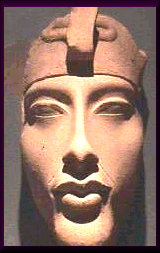 The Creator of Monotheism The Creator of Monotheism
(1375-1358 B.C)
Akhenaton was the first ruler in recorded history to believe in the
concept of One God. He also taught this concept to all his citizens. He built
a new city in the desert that was
dedicated to religion, art and music. This new city, Akhenaton (now Tell el Amara), with its lush gardens and magnificent buildings
is where Akhenaton and his wife Queen Nefertiti
changed Kemet's culture so radically that their
influence is felt for centuries right up until today. Akhenaton was also the
first Pharaoh of whom a true likeness is recorded as shown in the picture to
the left.
ASKIA TOURE
KING OF SONGHAY (1493-1529)
Askia Toure united the
entire central region of the Western Sudan, and
established a governmental machine that is still revered today for its detail
and efficiency. He divided his country into provinces, each with a
professional administrator as governor, and ruled each fairly and uniformly
through a staff of distinguished legal experts and judges.
BEHANZIN HOSSU BOWELLE
THE KING SHARK (1841-1906)
Behanzin was the most powerful ruler in West
Africa during the end of the nineteenth century. He strongly
resisted European intervention into his country. This was done with a
physically fit army which included a division of five thousands female
warriors. He is often referred to as the King Shark, a Dahomeyan
surname which symbolized strength and wisdom. He was also fond of humanities
and is credited with the creation of some of the finest song and poetry ever
produced in Dahomey.
HANNIBAL
RULER OF CARTHAGE (247-183 B.C.)
Hannibal is well known as the
greatest general and military strategist who ever lived. He used his
overpowering African armies to conquer major portions of Spain
and Italy and
came very close to defeating the Roman Empire. His
audacious moves-such as marching his army with African War elephants through
the treacherous Alps to surprise and conquer northern Italy and his tactical
genius, as illustrated by the battle of Cannae
where his seemingly trapped army cleverly surrounded and destroy a much
larger Roman force, won him recognition which has spanned more than 2000
years. His tactics are still being studied in many military schools today.
IDRIS ALOOMA
RULER OF BORNU (1580-1617)
He is credited with re-uniting two of Africa's
Kingdoms, the kingdoms of Kanem and Bornu. This union
lasted many generations with sustain peace becoming a part of the Bornu.
IMHOTEP
THE WORLD FIRST KNOWN GENIUS
Imhotep was the royal advisor to King Zoser during the Third Dynasty of Kemet.
Regarded as the world's first recorded multi-genius, Imhotep
was 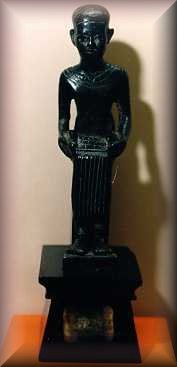 an
architect, astronomer, philosopher, poet and physician. As an architect he
was responsible for designing the Step Pyramid and the Saqqara
Complex. During his lifetime he was given a host of titles, among them:Chancellor of the King of Lower
Kemet, the First after the King of Upper
Kemet, High Priest of Heliopolis and Administrator of the Great
Palace. As a physcian,
Imhotep is believed to have been the author of the
Edwin Smith Papyrus in which more than 90 anatomical terms and 48 injuries
are described. This is well over 2,200 years before the Western Father of
Medicine Hippocrates is born. Some 2,000 years after his death, Imhotep was deified by the inhabitants of Kemet and was known later as Asclepius,
God of Medicine, to the Greeks. His very name, Im-Hotep,
translates as the Prince of Peace. His tomb near Memphis
became a sacred place and the site of pilgrimages for those seeking a cure.
As a philosopher and poet, Imhotep's most
remembered phrase is: "Eat, drink, and be merry for tomorrow we shall
die." There still remain many bronze statuettes, temples and sanatoria bearing his name, as is depicted in the picture
of the statue above. an
architect, astronomer, philosopher, poet and physician. As an architect he
was responsible for designing the Step Pyramid and the Saqqara
Complex. During his lifetime he was given a host of titles, among them:Chancellor of the King of Lower
Kemet, the First after the King of Upper
Kemet, High Priest of Heliopolis and Administrator of the Great
Palace. As a physcian,
Imhotep is believed to have been the author of the
Edwin Smith Papyrus in which more than 90 anatomical terms and 48 injuries
are described. This is well over 2,200 years before the Western Father of
Medicine Hippocrates is born. Some 2,000 years after his death, Imhotep was deified by the inhabitants of Kemet and was known later as Asclepius,
God of Medicine, to the Greeks. His very name, Im-Hotep,
translates as the Prince of Peace. His tomb near Memphis
became a sacred place and the site of pilgrimages for those seeking a cure.
As a philosopher and poet, Imhotep's most
remembered phrase is: "Eat, drink, and be merry for tomorrow we shall
die." There still remain many bronze statuettes, temples and sanatoria bearing his name, as is depicted in the picture
of the statue above.
JA JA
KING OF THE OPOBO (1821-1891)
He was the founder and leader of the territory
of Opobo
an area near the Eastern Nigeria
River. This area was very
favorable to trading. This trading route soon attracted the greedy Europeans
who seek to capture this trading route. Ja Ja put up fierce resistance to this outside intervention.
This resistance lasted for many years until at an older age of 70 he was
finally captured by the British and sent into exile to the West
Indies. The greatest Ibo leader of the nineteenth century never
saw his kingdom again.
KHAMA
THE GOOD KING OF BECHUANALAND (1819-1923)
Khama distinguish his reign by being highly regarded
as a peace loving ruler with the desire of advancing his country in terms of
technological innovations. He instituted scientific cattle feeding techniques
which greatly inproved his country's wealth and
prestige. During his reign crimes were known to be as low as zero within his
country.
KHUFU
The Father Of Pyramid Building (2551-2528 B.C)
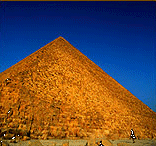 King
Khufu, who is also known by the greek
name "Cheops," was the father of pyramid
building at Giza.
He ruled from 2551 - 2528 B.C. and was the son of King Sneferu
and Queen Hetpeheres. Dates Built: c. 2589-2566
B.C. Total Blocks of Stone: over 2,300,000 King
Khufu, who is also known by the greek
name "Cheops," was the father of pyramid
building at Giza.
He ruled from 2551 - 2528 B.C. and was the son of King Sneferu
and Queen Hetpeheres. Dates Built: c. 2589-2566
B.C. Total Blocks of Stone: over 2,300,000
Base: 13 square acres, 568,500 square feet, or 7 city blocks. The length
of each side of the base was originally 754 feet (230 m), but is now 745 feet
(227 m) due to the loss of the outer casing stones.
Total Weight: 6.5 million tons. Average Weight of Individual Blocks of
Stone: 2.5 tons, the large blocks used for the ceiling of the King's Chamber
weigh as much as 9 tons.
Height: Originally 481 feet (146.5 m) tall, Khufu
is now, 449 feet tall as the top stones have since fallen off or been
removed. Until early in this century, this pyramid was the tallest building
on earth.
Angle of Incline: 51 degrees 50' 35"
Construction Material: limestone, granite
MANSA KANKAN MUSSA
KING OF MALI (1306-1332)
A scholar, a great economists and a true man of the arts, Mansa Mussa is well known for
the impact he created with his flamboyant style. In 1324 he led his people on
the Hadj, a holy pilgrimage from Timbuktu
to Mecca. His caravan consisted
of 72 000 people whom he led safely across the Sahara
Desert and back, a total distance
of 6,496 miles. So spectacular was this event that Mansa
Mussa gained the respect of scholars and traders
throughout the world. Also during his reign, Mali
was one of the most prestigious and wealthiest empires in the world. This empire at this time also contain one of the worlds
most prestigious university in Timbuktu.
MENELEK II
KING OF KINGS OF ABYSSINIA (1844-1913)
Menelek II united many independent kingdoms into
the United States of Abyssinia (Ethiopia).
The feat of pulling together several kingdoms which often fiercely opposed
each other earned him a place as one of the great statesmen of African
history. His further acomplishments in dealing on
the international scene with the world powers, coupled with his stunning
victory over Italy
in the 1896 Battle of Adwa, which was an attempt to
invade his country, place him among the great leaders of world history.
MOSHOESHOE
KING OF BASUTOLAND
(1815-1868)
Moshoeshoe was a wise and just king who was as
brilliant in diplomacy as he was in battle. He united many diverse groups
into a stable society where law and order prevailed. He knew that peace made
prosperity possible, so he often avoided conflict through skillful
negotiations. Moshoeshoe solidified Basotho defenses at Thaba Bosiu, their impregnable mountain capital.
MUTATO
THE GREAT MUTOTA (1440)
The year was 1440. The King was Mutota. In any
other European country he would have been known as Mutota
the Great. He and his council was quick to see that even the most advance
states each standing independently and alone, were doomed to European
criminal exploits unless unified into a single nation with a strong central
government. This also should be achieve through
voluntary association if possible. Mutota and the
new leaders understood this very well. Therefore, Mutota,
in 1440, began the campaign to carry out his grand design. This was a great
plan aimed at nothing less than uniting Africans into a vast empire that cut
across South Africa below the Limpopo river, and
covered Zimbabwe with an indefinite boundary beyond the Zambezi River in
Zambia, and on over Mozambique to the Indian Ocean, sweeping southward again
to re-posses the entire coastline fronting the New Empire. This area
contained the majority of the world precious metals such as gold, copper, tin
and iron held in over 4000 mines. After 30 years of struggle, unity was
finally achieve in 1480 into the Empire of Monomotapa.
NARMER
THE FOUNDER OF DYNASTIC KEMET (3200 B.C.)
Narmer or Aha was called Menes
by the Greeks. Regarded as the founder of Dynastic Kemet,
he led an army from Upper Kemet
in the south to conquer Lower Kemet
in the north around 3200BC. Upon victory Narmer
united Upper and Lower Kemet
into one nation after which thirty dynasties would follow. It was at this
time that hieroglyphic writing or any type of writing in the world for that
matter, made its first appearance, in the tombs and treasures of the
pharaohs. One of Narmer's first tasks was to build
a city on his newly conquered lands. Here he was met with a difficult task as
the Delta region was covered by an immense swamp. To remedy this situation, Narmer drained the swamp by actually diverting the course
of the Nile River.
Upon this new land he built a city which he named Men-Nefer:The Good Place. This city served as the capital of
Kemet for several centuries. An Arab traveler
writing as late as the Middle Ages reported the city "stretching a day's
journey in every direction." The Greeks would rename Men-Nefer "Memphis,"
a name that even today honors an African king who lived nearly 5,000 years
ago.
OSEI TUTU
KING OF ASANTE (1680-1717)
Osei Tutu was the founder and first king of the Asante nation, a great
West African kingdom in what is now Ghana.
He was able to unite over six different nations under his leadership. The
Golden Stole became a sacred symbol of the nation's soul, which was
especially appropriate since gold was the prime source of Asante
wealth. During Osei Tutu's reign, the geographic
area of Asante
tripled in size. The kingdom became a significant power, that with his millitary and and political
prowess as an example, would endure for two centuries.
SAMORY TOURE
King of the Sudan (1830-1900)
The ascendance of Samory Toure
began when his native Bissandugu was attacked and
his mother taken captive. After a persuasive appeal, Samory
was allowed to take her place, but later escaped and joined the army of King Bitike Souane of Torona. Following a quick rise through the ranks of Bitike's army, Samory returned
to Bissandugu where he was soon installed as king
and defied French wicked exploits in Africa by
launching a conquest to unify West Africa into a
single state. During the eigthteen year conflict
with France, Samory continully frustrated
the Europeans with his military strategy and tactics. This astute millitary prowess brought him respect world wide.
SENWORSERT I
PHARAOH OF THE 12TH DYNASTY
Senwosert I was a Twelfth Dynasty King of Kemet (1897BC). Also known as Kepre
Kare Senwosert I, he was
known to the Greeks as Kekrops and Sesostris. Interestingly enough Herodotus, Greece's
Father of History, reported that Greece
had once been conquered by a king named Sesostris.
Greek mythology also indicated that the legendary founder of Athens
was an Egyptian named Kekrops.
SHAKA
KING OF THE ZULUS (1818-1828)
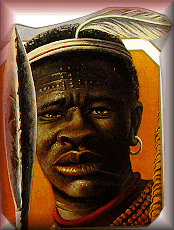 A
strong leader and military innovator, Shaka is
noted for revolutionizing 19th century Bantu warfare by first grouping
regiments by age, and training his men to use standardized weapons and
special tactics. He developed the "assegai" a short stabbing spear,
and marched his regiments in tight formation, using large shields to fend off
the enemies throwing spears. Over time, Shaka's
troops earned such a reputation that many enemies would flee at the sight of
them. He built the Zulus into a nation of over a million strong. He was also sucessful in uniting all the ethnic groups in South
Africa against the despicable vestiges of
colonialism. A
strong leader and military innovator, Shaka is
noted for revolutionizing 19th century Bantu warfare by first grouping
regiments by age, and training his men to use standardized weapons and
special tactics. He developed the "assegai" a short stabbing spear,
and marched his regiments in tight formation, using large shields to fend off
the enemies throwing spears. Over time, Shaka's
troops earned such a reputation that many enemies would flee at the sight of
them. He built the Zulus into a nation of over a million strong. He was also sucessful in uniting all the ethnic groups in South
Africa against the despicable vestiges of
colonialism.
TAHARKA
KING OF NUBIA (710-664 B. C.)
Taharka is probably one of the most famous
rulers of Napatan Kush.
He was 32 when he became king and was heir to a kingdom that included not
only Kush but KMT(Kemet) as well. He is said
to have commanded military campaigns in Western Asia
as far away as Palestine and led
expeditions all the way to Spain.
Mention of his great campaigns can be found in the Bible (Isaiah 37:9, 2
Kings 19:9). During his reign, Taharka controlled
the largest empire in Ancient Africa. He was able to initiate a building
program throughout his empire which was overwhelming in scope. The numbers
and majesty of his building projects were legendary, with the greatest being
the temple at Gebel Barkal
in the Sudan.
The temple was carved from the living rock and decorated with images of Taharka over 100 feet high.
TENKAMENIN
KING OF GHANA (1037-1075)
The country of Ghana
reach the height of its greatness during the reign of Tenkamenin. Through his careful management of the gold
trade across the Sahara desert into West
Africa, Tenkamenin's empire flourished
economically. But his greatest strength was in government. Each day he would
ride out on horseback and listen to the problems and concerns of his people.
He insisted that no one be denied an audience and that they be allowed to
remain in his presence until satisfied that justice had been done. His
principles of democratic monarchy and religious tolerance make Tenkamenin's reign one of the
great models of African rule.
THUTMOSE III
PHARAOH OF KEMET (1504-1450 B.C.)
Thutmose III was a member of one of the greatest families in the history
of royalty anywhere in the world, the 18th Dynasty of Kemet
(Ancient Egypt). He is credited with strengthened the sovereignty of Kemet and extended its influence into Western
Asia.
TUTANKAMUN
BOY PHARAOH OF KEMET
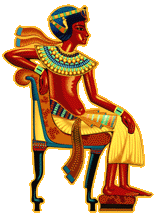 Tutankhaten became pharoah
after the death of Smenkhkare, and became one of
history's most famous royalty. Tutankhaten's
story has since come out, and we know more about this boy-king than we do
about any other person in the Kemartic period. Tutankhaten became pharoah at
the age of nine . He married Ankhesenpaaten
and ruled from Akhetaten. Four years after he
became king, Tutankhaten moved his capital back to Memphis,
and changed his name to Tutankamun, in honor of the
God Amun. Tutankamun,
ruled for nine years, until he was 18. The mummy discovered in the Valley
of the Kings has an injury to the skull, and it is believed that
Tutankamun was either the victim of an accident or
he was assasinated. His tomb is one of very few
that have been discovered almost untouched by theives. Tutankhaten became pharoah
after the death of Smenkhkare, and became one of
history's most famous royalty. Tutankhaten's
story has since come out, and we know more about this boy-king than we do
about any other person in the Kemartic period. Tutankhaten became pharoah at
the age of nine . He married Ankhesenpaaten
and ruled from Akhetaten. Four years after he
became king, Tutankhaten moved his capital back to Memphis,
and changed his name to Tutankamun, in honor of the
God Amun. Tutankamun,
ruled for nine years, until he was 18. The mummy discovered in the Valley
of the Kings has an injury to the skull, and it is believed that
Tutankamun was either the victim of an accident or
he was assasinated. His tomb is one of very few
that have been discovered almost untouched by theives.
RAMSES II
THE GREAT
 Ramses II (the Great) was one of the most prolific
builders of ancient Egypt.
Hardly a site exists that he did not initiate, add to, complete, or build
entirely himself. Some of the greatest monuments on any tour of Egypt
bear his stamp: Abu Simbel, Karnak and Luxor Temples,
the Ramesseum, and many others. He also
commissioned the largest monolithic statue ever, a seated statue of himself
at the Ramesseum. Now lying in pieces, the giant
red-granite statue inspired many. Ramses II (the Great) was one of the most prolific
builders of ancient Egypt.
Hardly a site exists that he did not initiate, add to, complete, or build
entirely himself. Some of the greatest monuments on any tour of Egypt
bear his stamp: Abu Simbel, Karnak and Luxor Temples,
the Ramesseum, and many others. He also
commissioned the largest monolithic statue ever, a seated statue of himself
at the Ramesseum. Now lying in pieces, the giant
red-granite statue inspired many.
Test your knowledge, take the
African Kings Quiz. OR the
African Queens Quiz.
|