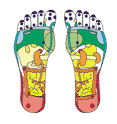
The theory underlying reflexology practice is that pressure on reflex points
stimulates the energy flow along a pathway (meridian, zone), clearing congestion
and balancing it throughout. Pressure applied to any part of the pathway affects
the entire pathway. Working on all reflex points in the feet returns the body to
homoeostasis, defined as the tendency towards a relatively stable equilibrium between
interdependent elements, especially as maintained by physiological processes. Once in
this state the body'’s own immune system will be able to overcome whatever is troubling it.
History
Reflexology is not a new method of treatment. It goes back at least 5000 years
when some form of pressure therapy was practised in China, India and Egypt; a wall
painting, found in the tomb of the Egyptian physician Ankhmahor at Saqqara
(about 2330 BC), shows such treatment being administered.
Development
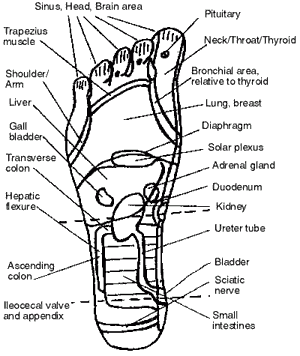
In charting their findings the pioneers of foot reflexology noticed that the
relationships between points pressed on the feet and the parts affected occurred
along definite pathways. They drew up a diagrammatic chart of these pathways
and called them '‘zones'’. Reflexology, the treatment based on
these zones, has also been know as '‘foot zone therapy'’. It has since occurred
to some reflexologists, notably Inge Dougans, that the zones discovered by
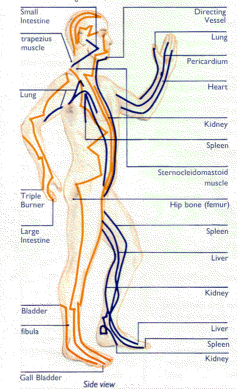
Dr Fitzgerald and Eunice Ingham correspond rather neatly with the meridian
theory of acupuncture. She argued that acupuncture and reflexology share
the same concept of energy channels which happened to have been given
different names; namely '‘meridians'’ in acupuncture and '‘zones'’ in reflexology.
She pointed out, though, that the energy flows in one continuum and that
dividing that continuum into different meridians is purely a measure to
facilitate discourse. Regardless of what the energy pathways are called,
empirical science has demonstrated that, though not visible, they exist
and that working on the reflex points can improve health, prevent or even
cure disease.
 Practice
The practitioner gently exerts firm pressure on the reflex points
in a systematic way, in order not to miss any, by making small, creeping
movements, caterpillar fashion, with a thumb or finger along each foot.
This stimulates and sends nerve impulses along the energy pathways to the
various parts of the body to which they are connected . The
impulses clear or reduce the congestion in the energy channels, thereby
revitalising the energy flow and promoting homoeostasis. Congestion or symptoms
of ill health in the body are revealed as tenderness or pain over the reflex
points in the feet which usually subsides on application of gentle pressure
over the points. Sometimes grit-like structures (calcium deposits) can be felt
which cause momentary acute pain; the treatment easily breaks them down, and
once broken down they are excreted in the normal way. Care needs to be taken
not to go beyond the patient'’s pain threshold, because reflexology is effective
through reducing tension and inducing relaxation; pain creates tension, and
going beyond the pain threshold is counter-productive as well as distressful.
There is, nevertheless, a level of pain which patients often call a '‘healthy pain'’,
because they are aware that this pain is a precursor to the relief of their symptoms
and ultimately better health.