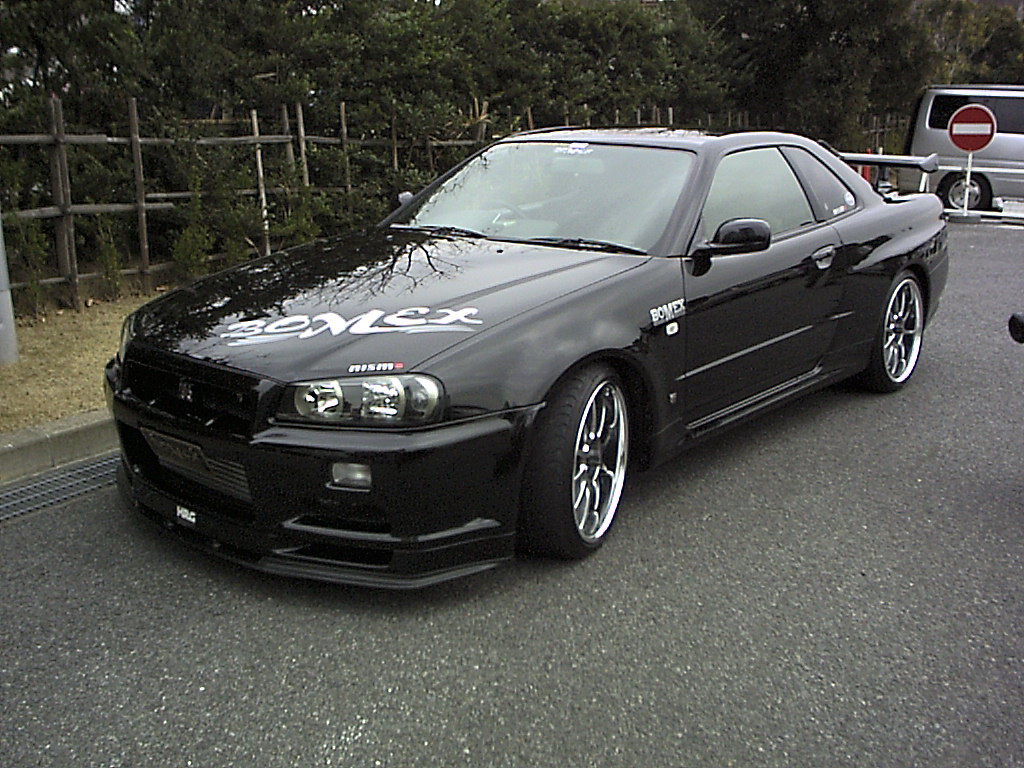
| Few Japanese cars are held up higher than the Nissan Skyline series. Thanks largely to the brilliance of the GT-R, the R32 and the R33 series Skylines have enjoyed great popularity and the instant image that only a successful racing model can give its lesser brothers. Understandably the release of the R34 has been treated as something akin to the second coming ( or perhaps the third ) |
 |
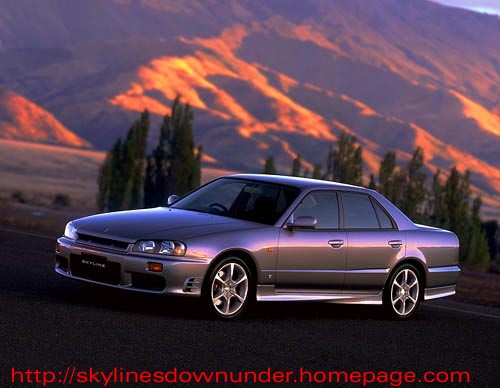 |
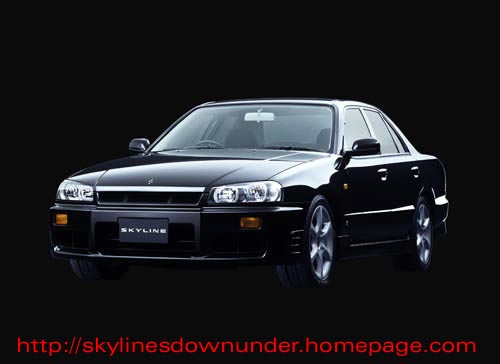
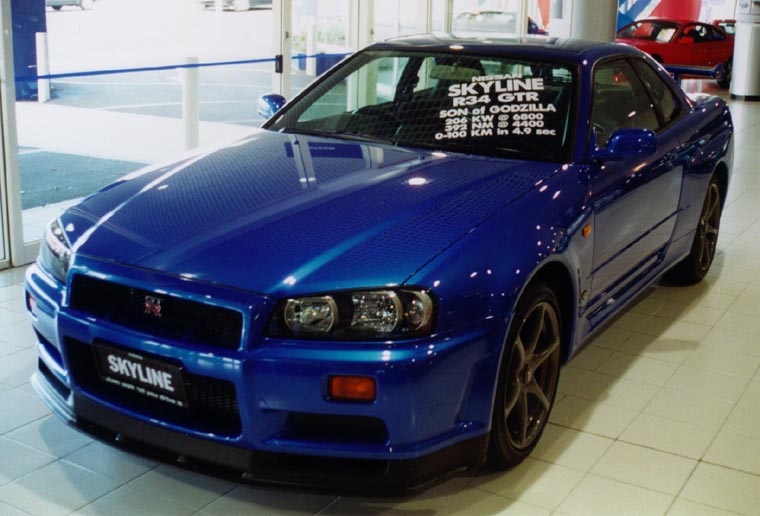
Nissan has played the marketing game of releasing the bulk of the model range first, late in 1998, leaving the new GT-R for release at the Tokyo Motor Show in January 1999. Put simply, there are four main derivatives of the Skyline, distinguished by engine type. All but the GT-R are avalible in a choice of coupe or sedan form. |
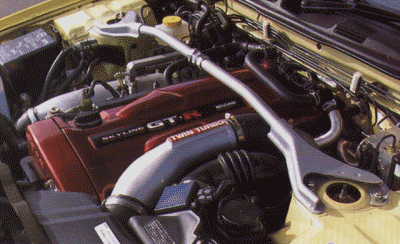
| The base model GT uses an RB20DE Neo 2-litre making 115kW, the 25GT has the RB25DE Neo with 148kW and the 25GT turbo has the new RB25DET Neo producing 207kW at 6400rpm and 343Nm of torque at 3200rpm. The GTR uses the latest version of the legendary RB26DETT twin turbo, still making 207kW at 6800rpm, but now with 392Nm of Torque at 4400rpm. If you want 4WD then you can buy either the non turbo 25GT or the GTR. |
 |
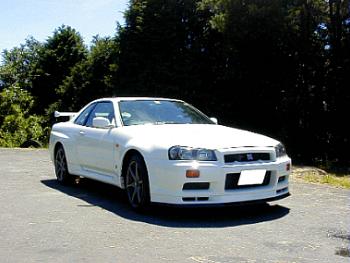 |
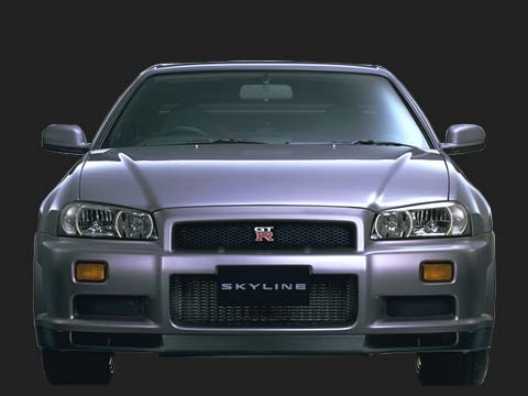
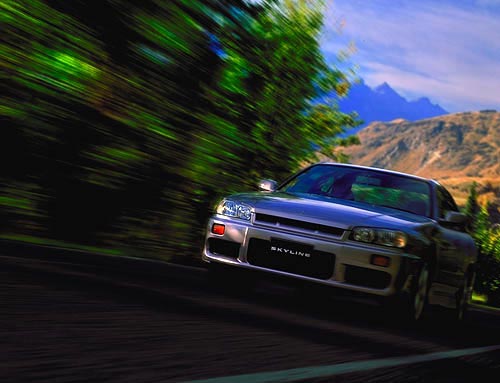
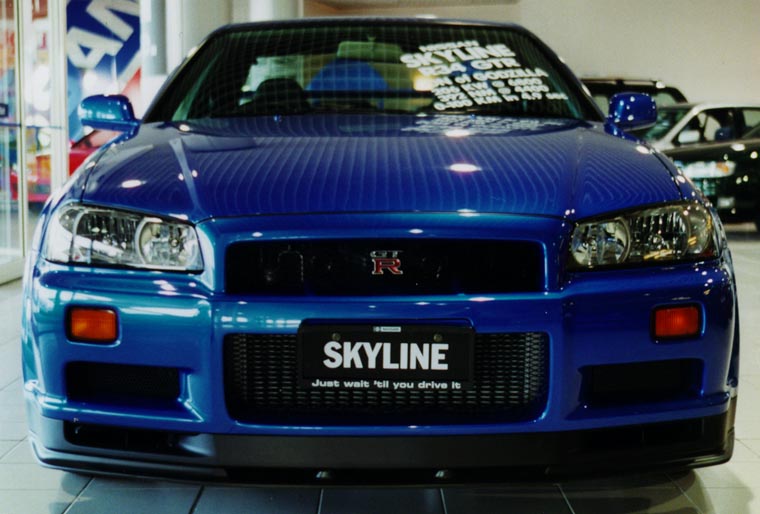
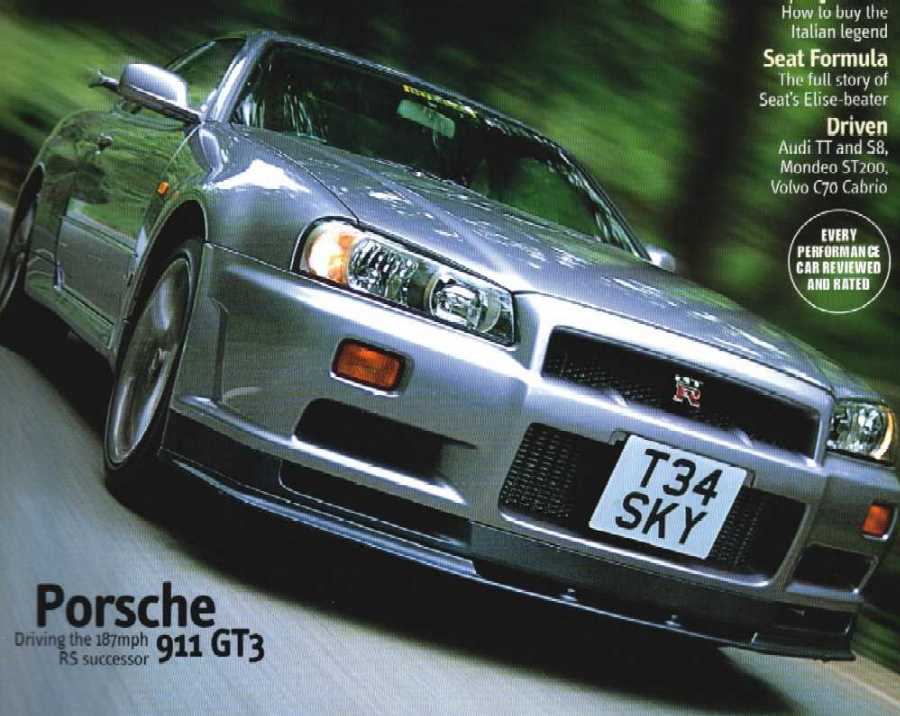
Styling wise theR34 has gone more aggressive than any previous Skyline, Though it's funny to see some influences from older Datsuns. The strong angled crease in the rear guard reminds me of the C210 1977-80 Skyline 2-door, while the odd-sized tail-lights are very much reminiscent of a 240K coupe ( 1972-76 C110 Skyline Coupe in Japan). The overall dimensions have actually shrunken slightly compared to the R33, especially in terms of wheelbase for the coupe which is 55mm shorter, with overall length also down by 60mm. |
| The R33 was often criticised for being two big, so Nissan have tried to get back closer to the dimensions of the R32 series. The shorter wheelbase not only gives the car a stockier look, but endows it with more responsive steering and a tighter turning circle of 10.2m instead of 11.0m. Unfortuanatly weight has still gone up over the R33 series; the 25GT turbo is 40kg heavier at 1410kg for the manual or 1430kg for the auto. Even the 2.0 litre GT is 80kg heavier than it's R33 GTS counterpart, at 1360kg ( auto 1380 ). The new GTR has also porked up to 1540kg for the V-Spec. |
 |
 |
Part of this weight increase can be attributed to a stiffer bodyshell, however. The new Chassis feature extra bracing in the C pillars, with a cross brace on the rear of the transmission tunnel and a strut brace now standard on all turbo models. The suspension has also been made firmer, for a sportier feel, though it still offers quite good degree of comfort. The most remarkable aspect of either car on the road was the near-perfect chassis balence. In the automatic 25GT it was virtually impossible to induce oversteer, yet it still turned into corners decisvely. The turbo felt even more responsive, yet even with great power increase the rear end is much better behaved than the R33 GTS5t. |
| Despite the extra weight, fuel economy has been improved with all four engine types. The turbo manages 9.43/100km, compared to 9,80 for the prevous model. The normal 2.5 automatic uses 9.43/100km also, which is a big improvment on the 10.31l/100km. Even the 2.0 has improved at8.33 compared to 8.88l/100km. It goes to show how much development has gone into the engines. Braking has been upgraded slightly again, with 310mm front discs and larger four piston calipers on the 25GT turbo, plus ABS of course. The brembo calipers on the GTR are also bigger than ever. Super HICAS four whell steering is used on all models and all use double wishbone front suspension with multi-link rears that are pretty close to a double-wishbone design also. |
 |
 |
A new feature is the TCS ( traction control system ), which can be switched on or off and in automatic models include a 'snow' setting which give more gentle gear changes to help maintain traction. The interior trim is nylon-like open-weave cloth, which seems to be popular on Japanese sports models now. The plastics are generally good, but the rough, sparkly finish on the center console and door control panels are not too appealing. |
| As the R34 are still so new, it's hard to be specific about prices. If you want a brand new one, the 25GT-t would cost as much as $115,000 ( Australian ) and the automatic 25 GT would be around $95,000 ( Australian ), while the GTR is expected to cost around $145,000 ( Australian ). |
 |
 |
THE ENGINES
The RB series six-cylinder twin cam engines have been updated for the R34 model with the Neo affix indicating the new design. Across the range these engines have been developed further to make more power with fewer emissions. In fact the non-turbo 2.5 has been named as an LEV engine, meaning it complies with future Californian 'Low Emission Vehicle' legislation. |
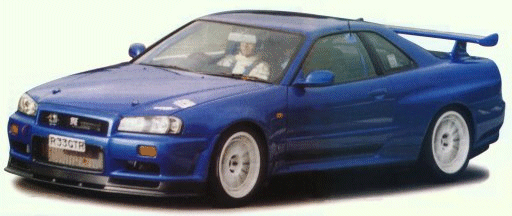
| The single turbo 2.5 has gained 20kW and 48Nm to match tthe previous GT-R's power output, using a larger turbo and intercooler, plus improved exhaust and engine managment. The intercooler is actually 36mm wider and 20mm thicker for 14 percent greater colume, while the turbo has gone from a 12.5 A/R to 17 witha very slight boost rise from 450mmHg to 470mmHg. This engine is extreamly tractable, with over 300Nm of torque from 1700rpm up to 6800. |
 |
 |
The non turbo 2.5 has also gained 14kW and a useful 30Nm more peak torque now producing 1200rpm lower in the rev range. This makes a great difference to the responsivness of the engine, one again using improved engine managment and exhaust , plus a new inlet manifold with a split pipe leading to the plenum chamber. This helps provide more even air distribution to the cylinders, improving effientcy. The same inlet is used on the 2.0 version, which hasen't made significant power or torque gains, but now produces its torque peak 800rpm earlier . |
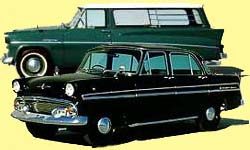
| The base single cam RB-20E has now thankfully disapeared, while the GT-R type twin turbo RB26DETT is yet to be seen in it's R34 guise. |
 |
|
|
|