Introduction
Subwoofers have received a lot of attention from audio software
writers primarily because of our obsession with bass and lots of
it! Moreover, simulator writers find that subwoofers are not
nearly as difficult to model compared to loudspeakers with
midrange to tweeter units... assuming anechoic response. Because
of this, countless subwoofer simulators can be found in the
Internet -- some are free -- some are shareware -- some are
demoware. One would expect for a commercial program to be as
feature-rich, easy to use and accurate as possible.
Unfortunately, such a great software package would be a bit costly for
most DIYers. Most freeware programs, on the other hand, are just
as good enough, but not so on the feature department. This is my
attempt to provide a freeware subwoofer program that will
hopefully prove itself useful to DIYers.
Actually, the very first version of Subwoofer Simulator was a basic vented-box calculator compiled in one little MS-DOS command-line utility, which I built early last year, 2001 (or was it 2000). The DOS executable file used equations from Ray Alden's book, "Advanced Speaker Design for the Hobbyist and Technician." It was all I could do since I neither had the time nor patience to hard code a graphical user-interface using only a command-line compiler. I had to use 3rd-party software to plot my program's output files. It was when Borland decided to let Australian Personal Computer Magazine release Borland C++ Builder 3.0 Standard to the public that I started my journey into the challenging world of loudspeaker CAD software.
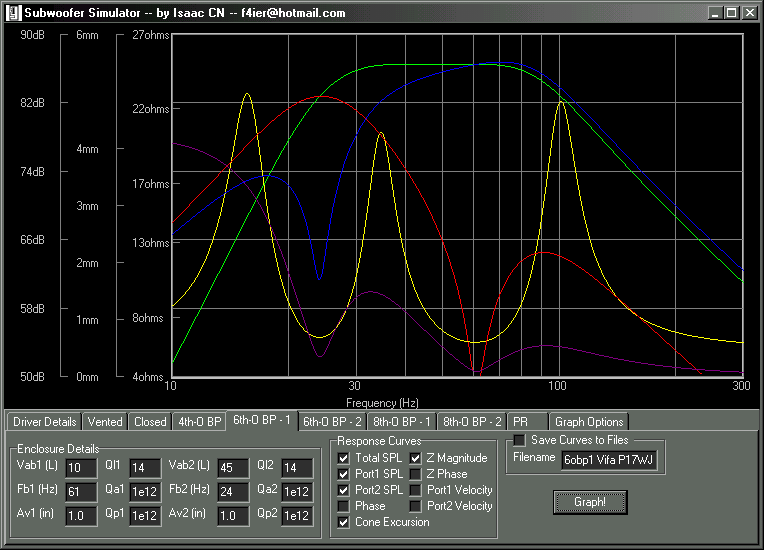
After a month of reading Builder's helpfiles and example programs, I was able to build a true Windows, fully-independent, box simulation program. The following picture is a screenshot of the old version.
First and old version of Subwoofer Simulator.
The most difficult part was making the graphing functions. I didn't like what was already available, so I made my own plotting routines. After the graphing functions were completed (though not necessarily bug-free), the nex time-consuming part of making the user-interface followed. Anyway, it was August, 2001 when I released the old version to the public. Many thanks to the FRD Group, of which I am a member, over 5,000 have visited this website and almost 2,500 have downloaded the program.
Unfortunately, school projects and exams left me with little spare time for completing Subwoofer Simulator and my other program -- Crossover Simulator. But my recent Christmas vacation provided for lots of programming time. The updated Crossover Simulator was the basis for the front end of the new Subwoofer Simulator.
I hope you find Subwoofer Simulator useful in your DIY projects. Enjoy!