 |
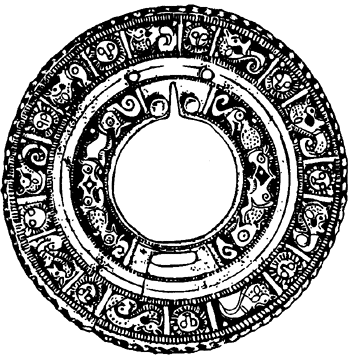
| The Quoit Brooch during the Migration Period in England The quoit brooch was the earliest ornament of the Anglo-Saxon period and has been variously identified as Frankish , Frisian, and Jutish. Now an English-trained Japanese archaeologist, Seiichi Suzuki, gives us the latest thinking on this challenging artefact. His verdict? Although the Quoit Brooch Style was derived from an earlier Romano-British design c400AD, the quoit brooch was worn by Hengist's Scandinavian army (Danes, Jutes and Angles) that had settled in southern England in the fifth century (but Academia keeps telling us that southern England was Saxon territory). Scandinavian craftsmen refined it further giving the brooch its distinctive style. It was eventually replaced by the Style I Brooch which a new wave of settlers brought with them from Scandinavia. But the seventh century document, the Ravenna Cosmography, refers to these Scandinavians as "Saxons once coming from Old Saxony". In regards to this Continental habit of mislabeling all the Germanics that settled in Britain, Suzuki advises us that: "It should also be noted that, as usual, the name 'Saxons' is used here as a general term for Germanic invaders." Are there any artefacts at all that were created in a 'Saxon Style'? Yes, but the German scholar Gunther Haseloff believes that the so-called Saxon Style has no distinctive stylistic features and therefore may be nothing more than "a variant of the late Roman bronze chip-carving style, rather than recognized as an independent style on its own." Below: An illustration of a quoit brooch from Seiichi Suzuki's The Quoit Brooch Style and Anglo-Saxon Settlement: a casting and recasting of cultural identity symbols. A map showing where quoit brooches have been found in England is shown on the next page. Please allow time for downloading. Previous Page......Next Page |