
ca. 1230 Thomas Fardein the son of James Fardein - he was a wealthy supporter of St. Nicholas Church in Bristol.
ca. 1240 Robert Fardein - he was a witness for St. James priory in Bristol. The Farthegn family had by now become well established in the southwest.
1248 Radulf Fardein - Radulf's fellow townsmen elected him to be one of their moneyers in Ilchester, Somersetshire. They knew that he was descended from a long line of moneyers and they could count on his expertise.
ca 1250-1 Robert Fardeyn - an important citizen of Bristol, he witnessed 3 charters to St. Mark's Hospital.
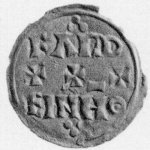
1257 Nicholas le Fardeyn' - he was accused of rape in Ilchester, Somersetshire.
The jury found him "not guilty" and the justices ordered the arrest of his accuser instead!
1257 Ralph Fardayn - he was an attorney for a plaintiff in Wells, Somersetshire. Like most members of the Farthegn family, Ralph would have had to speak French, the language of the legal system. For the next hundred years it would be a requirement that legal proceedings be conducted in French. He may have also been literate in Latin. And of course, he would have had to speak a Middle English dialect when conversing with commoners. To a modern English speaker, the language would be extremely difficult to understand. Have would rhyme with "lava", be with "say"; liking would sound like "leaking", moon like "moan", and town like "toon". The word knight would sound like "kuh-nee-guh-tuh".
1269, 1280, 1301 Peter Farcheyn (sic) / Fardeyn / Fayrdeyn - He and his wife Alice acquired extensive holdings in the villages of Ilchester, Hinton St. George, Ashcote, Walton, and Greinton in Somersetshire. They liked to keep a written record of their transactions. Peter knew how to read the Latin contained in his charter, for he proved in a court of law that the previous owner of his manor in Hinton St. George had given the property to the Farthegns for life. Peter produced the charter and, upon examining it, the jurors voted in Peter's favor. Practically all of the men that Peter did business with in Somersetshire were of Norman descent, requiring that he speak French. He must have also spoken an English dialect as well.
1273 Henry Farthein - He was the cleric (clerk) to the church of St. Owen in Bristol.
1273 Thomas Farthein / Fartheen / Farthing - He was one of the four bailiffs of the city of Exeter in Devonshire. Scribes spelled Thomas' last name in a variety of ways. Here we see an early example of the Scandinavian personal name Farthegn being spelled just like the modern English surname Farthing.
ca1275 William Ferthynge - he witnessed a grant in the town of Lincoln. At this time, the name Farthegn disappears in Lincolnshire and the surname Ferthynge appears to take its place. The Farthegn surname would stubbornly resist this change for another 60 years in Somersetshire.
1295 Walter Ferthing - he gave his name to Farthing Corner in Essex. Ferthing's neighbor, Richard Tubbe, had an Old Scandinavian name that survives today as the surnames Tubb, Tubbs, and Tubby. Did Walter's surname denote something of little worth, or perhaps an archaic unit of land measurement that was used for administrative purposes only? Or rather did his name, like his neighbor's name, commemorate a Scandinavian that had settled in England hundreds of years earlier?
1302 Thomas Fathein / Fartheen / Farthing - He was probably the son of the Thomas Farthein (above) and was also a bailiff in Exeter. There are records for him in 1302, 1307, 1308, 1311, 1313, 1315, 1317, and 1320.
1312 William Farthein - He may have been the son of Thomas Farthein (above) and was also a bailiff in Exeter in Devonshire.

1320 John Fartheyn - he recovered lordship of 17 acres of land and a manor in Bourton, Somersetshire. Bourton is now in County Avon.
1320 Thomas Fardeyn - he was a royal customs official for King Edward II working out of the ports of Plymouth and Weymouth. In 1324, he was elected to the Medieval Council of Exeter in Devonshire. This council was composed of 36 electors that chose the mayor and stewards of the city. Drawn from the local aristocracy, they were the most powerful men in the city and controlled it's activities. Twelve of the most prominent men in this group, including Thomas Farthegn, were chosen to be the councilors. They were a still narrower aristocracy. Although they were referred to as "the Mayor's Fellows", or collectively as "the Fellowship", they were in no way subordinate to the mayor but rather cooperated with him. The mayor took their advice and reported to them in important city business. The council's duties were "to govern the city, along with the mayor, to preserve the liberty of the city, well and truly to counsel the said mayor, to maintain his good counsel, to attend at his summons, to maintain the king's peace, to favour no disturbers of the peace, and to give common justice to each one." A Thomas Fartheyn is listed again in 1326 as an important customs official in the ports of Weymouth and Plymouth.