| The Real Anglian Homelands, continued From Widsith, A Study in Old English Heroic Legend, by R. W. Chambers: When the Angles migrated to Britain in the fifth and sixth centuries the neighboring Danes moved in from southern Sweden to fill the vacuum. Chambers writes: "...the Danish settlement of Anglian lands was a quiet and peaceable one.." This possession "...may have taken place by a friendly arrangement, an understanding that Danish immigrants might claim vacant land, but must not disturb such of the old inhabitants as chose to remain behind. A friendly settlement seems quite likely on a priori grounds." "Saxo Gramaticus begins his Danish history with the brothers Dan and Angul. He describes them as the joint founders and rulers of the Danish race: from Dan sprang the royal line of Denmark; whilst Angul gave his name to the province he ruled, and his successors, when they obtained possession of Britain, changed its name to a new one derived from their fatherland...The place of honour given to Angul as one of the two sources of the Danish race probably points back to a time when Danish bards and genealogists were conscious that their nation contained an Anglian element...every reference to the Danes in Old English verse is couched in the most friendly and respectful tones. From Origins of the Anglo-Saxon Race, by Thomas William Shore: It is very difficult to avoid the conclusion that the ancient Angles must have been more Scandian than Germanic. That the Angles and Danes were probably connected in their origin is also shown by the statement of Saxo, the Danish historian, who tells us that the stock of the Danes had its beginning with Dan and Angul, their mythological ancestors. Bede himself wrote that the English "have derived their race and origin" partly from the Danes. Indeed, a recent study on blood group characteristics shows that Englishmen and Danes are "amazingly similar". And, a DNA study has proven that Danes are more closely related to the English than the Danes are to other Scandinavians! Now if the Danes are indisputably Scandinavian, what does that make the English people? |
 |
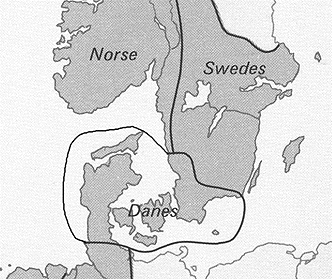 |
The map on the left shows the territory controlled by the Angles during the great migration to Britain in the 400s. By the beginning of the Viking Age the Danes had permanently settled in the same area. But it was not until the late 800s that the name of the new kingdom of Denmark appears in Old English records when Ottar describes it to King Alfred as the homelands of the English people. The name 'Denmark' (tanmarkar) appears for the first time in Danish only later, in the mid-900s. Previous Page......Next Page |