
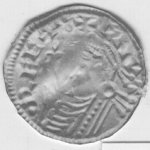
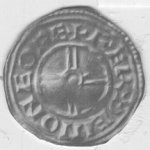
The coin shown above is one of the many produced by the Farthegn family of moneyers. It was struck some time between 1029 and 1036 at the mint in York during the reign of King Cnut. The reverse side of this penny (shown on the right), has the words "+FAERDEIN ON EOFE", or, Farthegn at York, placed around the outer edge with a short cross located at the center of the coin. This cross facilitated the cutting up of the coin into four pie-shaped pieces, then called feorthungs, later called ferthings, and today called farthings.
The obverse side of this coin (shown on the left), displays the words "+CNVT /.RECX:" arranged around the outer edge of the coin with the bust of Cnut facing left. Waves on the coin indicate that it was allowed to cool too fast after it was struck. This was a common problem with coins struck during this period because so many had to be produced in such a short time.
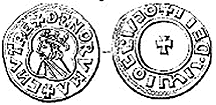
King Cnut was so impressed with the expertise of England's moneyers that he selected a number of them to establish and operate mints throughout his native Scandinavia. Farthein was one of these royal officials that helped found the town of Lund, Denmark (Lund is now a part of Sweden). Because of the efforts of these men, Lund began to grow and prosper and eventually became the most important mint town in all of Scandinavia.
The coin shown above is an illustration of a coin produced by the Anglo-Scandinavian moneyer Farthein. The crowned bust of Cnut the Great is facing to the left on the obverse side. On the reverse side of the coin the engraved words "FARDEIN AT LUND" are arranged around the outer edge.