REGION-NORTH-DALMATIA & ZADAR
The island of Pag is an attractive destination particularly for
boaters. It is about fifty kilometres long from the westernmost
cape Lun to the easternmost point Fortica. Sheep graze on scarce
rocky pastures that occupy the largest part of the island. A
famous sheep milk cheese is made here, which represents
everything Nature has to offer on the island: in its intensive
salty taste one can feel the salt swept from the sea surface by
the bora all over the Velebit coastal area and the rocky pastures
of Pag. The stern gray rocky attire of the island is
interestingly contrasted by the fineness of locally made lace.
Pag lace is very regular and geometric, perhaps an expression of
a desire to create a harmonious life in a harsh environment. Such
a desire affected the construction of the town of Pag in the 15th
century: it was built according to the plan by the architect and
sculptor Juraj Dalmatinac. He deliberately transferred the
traditions of urban planning of other Adriatic towns into the
foundations of the new Pag.
Not only boaters will find Pag interesting, but also those who
travel on its main road only to find themselves in the middle of
an incomparable landscape. The road across Pag runs from the
eastern part of the island to the bridge at Fortica that connects
the island with the mainland. From there one can get further east
towards what is known as the Novigrad Sea and the Karin Sea,
while enjoying the view of Velebit Mountain. Alternately, one can
turn south and visit the ancient town of Nin, the first seat of
Croatian mediaeval rulers. On this location, on the eastern edge
of the Ravni Kotari region, the first settlement was the Illyrian
Aenona, which continued as a relatively prosperous town in the
Roman period. Between the 9th and the 11th century, Nin became
the centre of the parish and the see of the "Croatian
bishop," whose jurisdiction extended over the whole area of
Croatia. The baptismal font of duke Viseslav was found in Nin,
containing the first mention of a Croatian dignitary. The church
of Sv. Kriz (Holy Cross) from the 11th century and the fortified
church of Sv. Nikola (St. Nicholas) in nearby Prahulje are
examples of early mediaeval architecture. A visitor in Nin will
be surprised by the difference between the craggy island of Pag
nearby and the tame plain around Nin with its long muddy beaches.
At the same time Nin offers a view of Velebit in the distance,
whose peaks are hidden in clouds. Such dramatic changes of
landscape are characteristic of central Dalmatia.
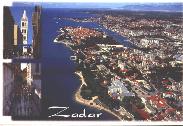
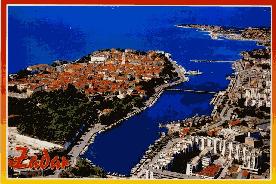
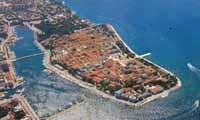
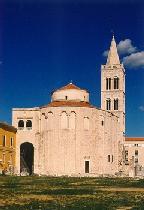
With a history of several thousand years, Zadar lies in the middle of Ravni Kotari. Its patron saint is Sv. Krsevan (St. Chrysogonus). The Zadar peninsula, now the town centre, is full of traces of various cultures that succeeded one another over the centuries. Since the arrival of the Croats in the early Middle Ages, Zadar considerably outgrew its original core, but the gridiron street plan of Roman Jadera is still visible today. The remains of the ancient Forum, the church of Sveto Trojstvo (Holy Trinity), later renamed after a mediaeval Zadar bishop by the name of Donat, the Romanesque cathedral of Sv. Anastazija (St. Anastasia), other mediaeval churches, town walls, the unique collection of Zadar’s Gold and Silver, residential buildings from the 19th century – all that comprises a small-scale mosaic of the ancient urban feel of Zadar. Once, one entered the town through a Renaissance town gate designed by Michele Sammicheli. The scent of Swiss chard and grilled fish fills the streets of Zadar, and a glass of red wine is usually accompanied by a song. A Mediterranean melancholy pervades this town, especially on the waterfront in the evening when the sun sets behind the Zadar islands. The wild rocky scenery of the Zrmanja canyon in the hinterland of Zadar is a must-see. The river runs in the area between the Karin and Novigrad Seas, where a Mediterranean atmosphere mixes with fierce karst. Zadar could not function without its hinterland, but it also cannot be imagined without its islands and the islanders who daily ferry to "town."
The "island connection" provides Zadar with vitality and seafood. It is a very rewarding experience to sail around Zadar archipelago-from the remotest island of Silba, by Olib and Molat to the closer Sestrunj, Ugljan, Veli Iz and Mali Iz, Dugi otok, and Pasman. Most boaters who sail here stay longer than planned, fascinated by the charming islands, their beautiful small towns, and sad half-empty fishing villages. The most spectacular part of Zadar archipelago are the Kornati islands, a group of 125 islands and reefs that form a wall of vertical cliffs facing the open sea, the highest of which is over a hundred meters. This geomorphologic phenomenon has almost a primordial aura, since apart from two small settlements on the biggest island all others are uninhabited. The water in the countless bays of the Kornati is deep and transparent, and the tranquility of the islands is almost matchless. This picture of encounters between small segments of land and sea cannot be complete without white sails gliding slowly in the afternoon sun. It should be added that the Kornati are not only a natural wonder, but that there are interesting historical monuments there too, such as the foundation of the Roman villa in Mala Proversa, and the ruins of the early Christian church of Sv. Marija (St. Mary) and the Byzantine fort on the biggest island. Many Kornati cliffs and reefs have no name, but some have unusual names that suit their appearance: Klobucar (Hatmaker), Balun (Ball), Kosara (Basket), Mrtvac (Dead Man). According to legend, the people of Murter, always quick of wit, reported these names to Austro-Hungarian surveyors.
Closer to land than Kornati, next to Ugljan, is the island of Pasman. Its settlements, from Zdrelac in the west to Tkon in the east, face the mainland and the ancient town of Biograd. The history of Pasman villages is closely related to the history of Biograd. Although Biograd is mentioned in 10th century records, nothing from that period has been preserved, due to destruction of the town in 1125, following which the Benedictine monks from Biograd built a monastery in Tkon on Pasman. Although Biograd was rebuilt after 1125, it was destroyed again by the town defenders themselves as they retreated before the Turks, in the middle of the 17th century.
Still, Biograd rose again like a phoenix, and its Riviera, stretching all the way to Pirovac, with the island of Murter off the coast and Vransko jezero in the immediate hinterland, is one of the most attractive sections of the Adriatic coast.
To the south of the Kornati, we continue our journey through Sibenik archipelago, which includes the islands of Zirje, Kakan, Kaprije, Zmajan, Prvic, Zlarin, and the miniature island of Krapanj. In two or three days of sailing in the archipelago, one can get to know the macchia and the picturesque bays of Zirje, and the Baroque churches of Zlarin. Until recently, here you could meet the only coral divers in the Adriatic, and their trade is still remembered in the traditional dress of Zlarin women and in the stories of the residents of Krapanj. The islands gravitate towards Sibenik; by land, one gets to Sibenik from Biograd by way of Tribunj and Vodice.
From the sea the view of the town is magnificent: to get to the harbour, vessels have to pass through the Sv. Ana channel (St. Anne), and by Fort Sv. Nikola (St. Nicholas), the work of the famous Italian Renaissance fortification builder Michele Sammichele. The town developed on hilly terrain, which is thoroughly packed with houses that have been huddled together since the town was first mentioned in 1066. Gradina, the oldest part of Sibenik, still exudes a mediaeval atmosphere. As the town expanded around Gradina, the building styles changed. Stylistic variation can also be seen on the most important building in Sibenik, the cathedral of Sv. Jakov (St. Jacob), which is on the UNESCO World Heritage List. It was built during the 15th century. The cathedral was the crowning achievement of Juraj Dalmatinac’s architectural work, a masterful synthesis of Gothic and Renaissance elements; Juraj’s work on the cathedral was completed by Nikola Firentinac. On the outer wall of the apse, the cathedral displays a remarkable frieze sequence of 74 human heads, probably representing the contemporary citizens of Sibenik. Unique construction techniques, involving grooved stone slabs, were used for the vault. The baptistery in the crypt under the south apse is perhaps the most impressive example of Juraj’s interpretation of different stylistic conventions.
The spirit of Sibenik is not embodied only in buildings, but
it can also be heard in popular harmony-singing and tasted in
quality wines from nearby vineyards. Grapes have been grown for
centuries by hardworking farmers who have been reclaiming small
tracts of fertile soil from the karst, particularly near
Primosten. The Krka River is also an
important part of Sibenik's identity, with its falls and the
picturesque area around Lake Visovac. In the middle of the lake
is a small island on which there is a Franciscan monastery. One
should experience the summer shade under the mulberry tree in
Skradin, taste the prosciutto ham (prsut), cheese and the famous
wine Babic in Primosten, or go for a swim on a scorching day in
Rogoznica.
Going towards Obrovac or Zadar on the Adriatic highway, a fine
view opens on the Zrmanja river and its tributary Krupa, which
flow along the eastern edges of Velebit. In the hinterland of the
town of Biograd lies Vransko Lake, the biggest lake in Croatia,
whose northwestern edge is an ornithological preserve. One of few
colonies of herons in Mediterranean Croatia can be found on this
lake. A long time ago, a fort of the Knights Templar stood on the
shore of the lake.
Kornati National Park includes most of Kornati Archipelago, about
one hundred and forty islands. On the southern part of the
neighbouring Dugi Otok there is a nature park called Telascica
cove, one of the biggest coves on the Adriatic coast, which
contains a number of smaller coves and six islets. Another
attraction is the view of 150-meter cliffs on the side of the
park that faces the open sea and the Kornati islands. In the
middle of this nature park there is a salt lake called Mir. The Kornati National Park is a
paradise for boaters and day-trippers. On its sparsely populated
islands people live in harmony with nature and to the tune of
seasonal change.
The whole Adriatic Sea abounds in fish, mostly the kind known in Croatia as "blue" fish (pelagic fish), such as anchovy, mackerel, tuna, and pilchard. There are also over eighty species of "white" fish (white-fleshed fish), and many species of shellfish, cephalopods, crab, snail, starfish, sponge, and algae; some of these are endemic. Red coral, which is found only in very clean seas, is also endemic.
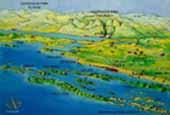
You will reach our " ZADAR " suite by folowing the
given map of the city of Zadar. Zadar is situated in the
immediate vicinity of four national parks : the Kornati archipelago ,
Paklenica , Plitvice lakes and
the river Krka waterfalls.
Zadar is a three thousand year-old town. It was the capital of
Dalmatia for many centuries. The Zadar peninsula still preserves
the ancient street grid of the town, as well as a Roman forum
dating back to the first century AD. The pre-Romanesque Church of
St. Donatus dates back to the ninth century, and it is
undoubtedly Zadar's most famous site.
However, the town is also renowned for having the most beautiful
Romanesque churches in Croatia, such as the Cathedral of St.
Anastasia (13th century), the Church of St. Chrysogonus (12th
century) and the Bell-tower of St. Mary (1105). The town is
fortified with thick walls, renowned for their impressive ports,
such as the Harbor Port and the Mainland Port, which date back to
the sixteenth century. The walls encircle the Square of Three
Wells, the Square of Five Wells, the Municipal Loggia, the
Municipal Guard Tower and many palaces that slumber under the
protection of the town's four patron saints: St. Simon, St.
Anastasia, St. Chrysogonus and St. Zoilus. The world famous
Permanent Exhibition of Sacral Art and the traditional St.
Donatus Musical Evenings represent only a small part of numerous
cultural events and manifestations that Zadar offers to its
visitors.
Zadar :