FULTON TURKEYTAIL POINTS
Late Archaic to Early Woodland: 3,500
to 2,000 BP
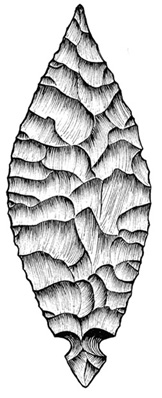
DESCRIPTION: The Fulton Turkeytail point ranges in
size from 100 to 180 mm in length, and usually a mere 6 mm in
thickness. These are beautifully made points, and the percussion
flaking style that was to dominate the Woodland period was brought
to its fullest development in the manufacturing of Fulton Turkeytail
points. They may or may not have basal grinding, but when it is
present it is quite lightly done.
DISTRIBUTION: The Turkeytail point is found chiefly in
the Ohio Valley region and adjacent areas. They were also traded
up into southern Ontario, and sizeable caches have been found
here. Moreover, the type quite commonly occures in caches ranging
in size from four or five to forty or more. To achieve maximum
length, the original tan cortex from the nodule may be left on
either or both ends.
RAW MATERIAL: Almost all of them were made from Harrison
Country, Indiana, dark gray or blue-gray Hornstone nodular flint.
AGE AND CULTURE: The Turkeytail seems to be associated
with the Late Archaic to Early Woodland cultures, and a suggested
date would range from about 2000 B.C. to 500 B.C. These points
appear to have a cerimonial purpose and value rather than being
made for use as a tool. Many cache points were purposely already
broken before burial, possibly to discourage any thievery.
REFERENCES: Bell, 1960, pp. 90-91. Ritchie, 1961, pp. 23,
76. Cambron & Hulse, 1969, p. 109. Waldorf, 1987, pp. 175-177.
Justice, 1995, pp. 174-178. Tully, 1998, p. 143. Overstreet, 2003,
pp. 596-597, 944-945,