 | |
| |
|
| |
|
Latest issue is also available at: www.oocities.org/tzorafolk and www.galilan.com/ ~folkster |
Contents
: Letter to Our Readers - Artist's Profile - Jacob's Ladder - Pipers, Whistlers, Fiddlers - Sirma - Wail Away Softly - Tel Aviv March 7thDear Jacob's Ladder Followers,
I live in Beer-Sheva and am looking to hook up with a family with young children. My daughter will be four years old come May. Last year she was very lonely, all she knew was her mom. So I was her only playmate. I noticed many campsites built around a few families and thought this would be nice. The children played together while the parents shared the child supervising, so everyone had time to see something during the day. If you're interested, please contact me at:
--Rachaeli and Rahbie
Artist's Profile -
Rahel Jaskow: Exotica Par Excellence
They say that confessions are good for the soul. Accordingly, I confess that when I reviewed Rahel Jaskow's CD several months ago, I didn't fully realize its uniqueness. I wrote that since it was somewhat specialized, it might not be for everyone. How wrong I was. Precisely because the material and performance are so extraordinary, Rahel's disc is selling like hotcakes, both in Israel and abroad. Indeed, it has gone into a second printing. Yes, folks, I should have known better, but better late than never to give this very special lady and her music their due.
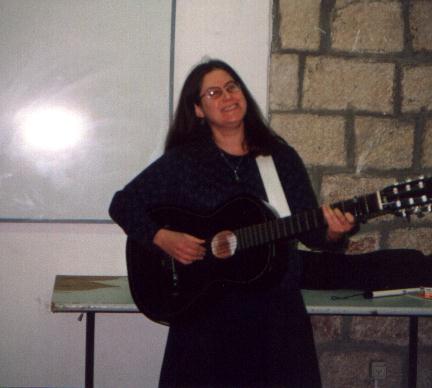
Rahel Jaskow
First about the woman, and then the dues. Rahel Jaskow was born in New York City, but when she was seven, her family moved way beyond the suburbs to rural Monroe. At first she stood out academically: she was what you might call a rather smart cookie. However, as she is wont to muse a bit ruefully, smart cookies do not necessarily stand out in the baking pan of teen social life. So she compensated by developing a dream. At eleven, she went to Jewish summer camp and learned Shabbat songs for the first time. Ever since then, she says, she carried the songs in her mind along with the harmonies she created, and waited for the time they would emerge to be heard by others. In the interim, she studied drama and English literature, and worked as a DJ at a National Public Radio affiliate in Rochester, New York. Those of you who remember Radio West may well recall Rahel's dulcet tones as she presented the Sabbath Eve program.
In her late teens Rahel became observant. During college and afterwards, she visited Israel several times as an army volunteer. Even as a little girl, she had fallen in love with Hebrew music. After her fourth stint in Israeli khaki, Rahel packed all her belongings and made aliya. Well, she did, but her belongings didn't. They were thrown off the ship during a storm at sea. (Rahel, the daughter of a former Merchant Marine seaman, mourned the loss of her belongings but notes with gratitude that the ship and her crew made it safely to port.)
And so Rahel arrived in Israel. She did a final volunteer spell in the army, then made her way to Jerusalem. While working at her day job, she discovered she had a knack for healing. So she studied with Yonina Jacobs, a decision that changed her life. (One of Rahel's many enduring traits is her willingness to use her healing hands on tight muscles and aching bones. I can tell you from personal experience, it is so very nice.)
It was inevitable that Rahel's beautiful voice began to attract attention. I first heard her perform at the second AACI song festival in 1997. For me, it was love at first sound. Shortly after that, she realized one of her ongoing dreams when she was introduced to Shuly Nathan, who first sang Naomi Shemer's Jerusalem of Gold. A fast friendship developed between them, and now Rahel occasionally accompanies Shuly in concert.
Rahel insists that she does not regard herself as a folk singer per se. But none of the folkies who heard her would agree. As a result, she kept getting invited to home hoots and folk clubs where she met an increasing number of singers and musicians upon whom she made a profound impression. She began to be invited to perform, first as a vocal accompanist and then as a solo performer in her own right. She has appeared all over the country and has captured the hearts of all who've heard her.
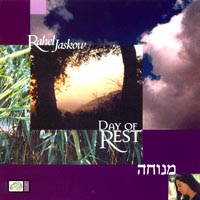
And now we come to the crux. Last spring, Rahel met Ray Scudero. She had long admired his songs and musicianship from afar, and had hoped she might work with him one day. So when Ray opened his new recording studio last year, she set to work with his assistance to bring her childhood dream to fruition. The creative energy was amazing, she tells me. Between Rahel's singing and Ray's expert engineering, they constructed an exquisite weave of music. Since I missed the boat before, you all are just going to have to bear with me while I expostulate about why people are buying the resulting disc, Day of Rest.
First, Rahel's voice. Plainly stated, it is very beautiful: soft, warm, clear as a gentle glass bell, and especially vibrant. It comes to her naturally.
Second, her harmonies. I might be ignorant, but I have yet to hear a local artist put down three- and even four-part harmonies, which are so musically precise and clean as a whistle. And please note, not a shred of printed music; it's all in her head.
Third, the disc is mostly a cappella, with instrumentation on only three tracks. Vocal ensembles are the ones who are supposed to do that sort of thing and get away with it. But one person? You'd better believe it, folks.
Fourth: the material. I must have fallen into the trap of thinking that all lovers of folk music prefer bluegrass, or blues, or Celtic, or just about anything in the English language. But Hebrew? Liturgical traditional Jewish stuff? Could it be? It could and it was. It transpires that not only local people liked it and bought it. Rahel put her disc up on the Net at a site called CD Baby. Has it sold? Has it ever! In addition, a gentleman named Noel Paul Stookey -- that is, Paul of Peter, Paul and Mary -- heard it and was enthralled. Thus, Rahel joins a small, august company of Israeli English-speaking recording artists who have gained fame and acclaim through the Net.
Rahel probably can't buy the Brooklyn Bridge just yet. But what she has achieved should serve as an inspiration to all those with music on their lips and dreams in their hearts.
Rahel loves the Stephen Foster classic Hard Times. We have sung it together often, and she considered the song a personal anthem until not so long ago. Now that things seem to be opening up for her, let me voice the congratulations of all those who treasure her as a friend and enjoy her wonderful music
.--Larry G.
Jacob's Ladder Festival will take place on May 4th & 5th at Karei Deshe on Lake Kinneret. The main lineup includes Diane and Ada, Essev Bar, Kahol, Midnight Mojo Blues Band, Black Velvet (their 20th anniversary) and Irish Cream. There will also be plenty of other country and other music both on Friday and on Shabbat.
Jacob's Ladder may be the subject of a new 50 minute film, which might make it onto the cable stations in Israel. A local journalist and filmmaker - Ofer Gavish of Kibbutz Yiftach - would like to produce it. He is looking for angles. Do you have any special Jacob's Ladder stories? Did you meet your spouse there? Did you hit the bigtime because of JL? Did you conceive your first child (who now plays banjo in Nashville) in the olive grove at Machanayim? All angles will be considered and you may achieve fame - if not fortune. Please send your stories to me by email at:
jaclad@matav.net.il or to Menachem Vinegrad, Mishol Nimron 2, Katzrin 12900 Tel/fax (04) 696-2231-- Menachem Vinegrad
Pipers, Whistlers, Fiddlers All: California Greenin'
Who among us doesn't love Irish music? Still, would dare to play it. Butwhen a friend said I could learn penny whistle free in Balboa Park at the House of Ireland, 10:30 on Sunday mornings, I couldn't resist giving it a shot. We were on Israeli time and arrived half an hour late for the first sesson. We followed the musical strains into a room filled with pipers, penny whistlers, fiddlers, harpist, mandolin, concertina/accordions, guitarists, you name it. All eyes upon us, we
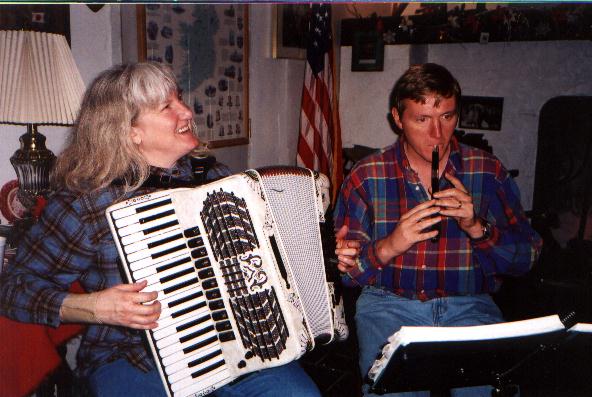 Marci Phelan
apologized and quickly retreated. But someone jumped up and said, "no no, come in, come in, right place," and we found ourselves sitting clueless next to the apparent leader, Marci Phelan. She quickly caught on that we were total novices and sent us out of the room with lightning fingered Ron Steed to show us which end to blow out of. When the session ended Marci made sure we had sheet music she and Erskine had arranged for about 80 different Irish tunes.
This is a fantastic concept. Everyone -- really fine musicians and more tacky folks like myself -- appears promptly at 10:30. For the first half hour, we play the tunes extra slowly, moving around the circle as each person chooses a tune. You'd think this would be excruciating for the good players, but they claim it's good practice. The next hour we play the tunes slowly at first and then up to a reasonable speed, like immersion learning. You get the basic principles and then go home and play the ten songs you heard badly the first week, struggling to relate the music notation to the holes in the whistle.
The second week is a huge effort and you hit maybe a quarter of the notes but you leave with twenty songs. By the fourth week I could mostly stay with the "slow" versions and skip rocks over the up-to-speed ones and I had 43 tunes under my belt. What tolerant people, really! At noon, the doors are open to the public, we move on and the good musicians hang in and do a show for the
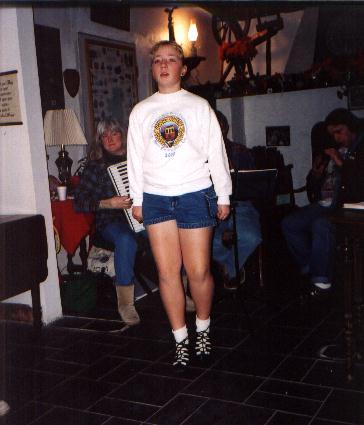 Stepdancing
passersby. In any month, the first week is for instrumentals, the second week is geared for step dancers, the third week is mixed intermediate and advanced, the fourth week is for singing Irish and the fifth week (if there is one) is for storytellers or whatever.
This is Marci's brainchild, which she came into gradually after years of playing Balkan music (that connection again!). What's in it for her? "I don't get paid for the House of Ireland. I consider it a responsibility and honor to help bring newcomers into the traditional music fold. Somebody nurtured me as I played my first Irish tunes, and now it's my turn to help others. Someday it will be their turn. This is how the music has survived through the years, and how it will continue to survive."
In the rush of trying to get that next CD out and preparing for that next microphone-assisted performance as part of our burgeoning electronic world, it's nice to remember there is more than one way to share and nurture musical growth, no matter what the musical genre.
--judi ganchrow
Sirma, Jerusalem, February 5th, 2001
It was a rare occasion on a few accounts: a concert in honour of the outgoing Spanish Ambassador to Israel, given by the Sephardi community of Jerusalem.
Lots of historical irony there; but how much more so when you consider who was playing. This was a relatively new musical outfit called Sirma: yes, non-Jewish Spanish musicians playing, of all things, traditional songs in Judeo-Espagnol (Ladino)! This was an opportunity not to be missed. I pulled my sister into the hall in downtown Jerusalem, and off we went on a fascinating journey...
Many of the songs were familiar; this is just as well, because the audience came to sing along! Maria Jose Cordero, the singer, sat for most of the evening, accompanying herself on tambourine and tambour; she was visibly moved when the audience began to sing along -- sometimes before she had even opened her mouth! There can't be too many places in the world where that happens. She sings very sweetly, but the full strength of her voice was only revealed when she put the percussion down and stood to sing.
Ms Cordero was very ably accompanied by three talented men: Carlos Gomez made his violin sing. Fidel Coral (I hope I got the spelling right) didn't play his oud the way it is played in this part of the world, but rather like a mandolin. The result was a mixture of east and west that he may not have intended, but which I found delightful. Moises Aranjuez added to the generally charming sound with his gentle guitar playing. All three musicians served the singer well, and they offered some exquisite renditions of such beautiful songs as Ija Mia, Mi Kerida and Durme Durme Ijico Mio.
Obviously, there are as many ways of singing and playing the Ladino repertoire as there are of other musical traditions: it isn't possible to please everybody all the time. Some of Sirma's interpretations were truly sensitive and artistic -- although puzzling to the audience -- with chord sequences that differed from more usual renditions. They missed the spirit of a few well-known, much- loved songs such as Adio Kerida, Pasharo d'Ermozura and Buena Semana. These were some of the songs that the audience most wanted to sing along with, but they were so thrown by the pace (two of them way too fast, and one too slow),that they were unable to do so.
One small frustration of the evening was that most of the violinist's apparently quite full explanations in Spanish were offered in an accent that even the most fluent Ladino-speakers in the room had trouble following. The gentleman who was supposed to translate into Hebrew had decided not to bother, blithely assuming that "everyone understood anyway." Finally, one Sabra in the audience voiced a strong protest (alas, about 3/4 of the way through the concert) and he acquiesced. What a pity that the rest of us were too polite to object earlier on!
Despite my reservations, however, it was an evening I wouldn't have missed for the world. No one may have expected the Spanish Inquisition (ref. Monty Python), but the Inquisition and its over-zealous perpetrators are dead and gone, and the beautiful music of the Sephardi tradition lives on in Jerusalem. How ironic that it also lives on, now -- after a gap of some 500 years -- in Spain itself! Anyone who attended the evening with Sirma can have no doubts on either score.
--Jill Rogoff
WAIL AWAY SOFTLY?
Avram is a small round elderly man with a constant smile on his face. He occasionally sits ringside at the TAFC and plays very curious looking string instruments which hail from even more exotic locations such as the Balkans or various 'stans. With his wondrous enthusiasm and exceptional musicianship he somehow manages to accompany an often surprised or dismayed performer or group of musicians who weren't prepared for the exotica. After a recent fun-packed Gamliel sing-along program where I was asked to accompany the folk singing with harmonica, I received a discouraging word from a musical colleague. So I decided to survey five music experts who were in the audience in order to determine if - oh my goodness - am I pulling an Avram? The responses were enlightening and ranged from: "It's a shrill instrument and can be too dominant" to "When you play along it's grand," or "Too much playing along doesn't sound good but the solos are terrific," or "It's great but not all the time," and finally "The harmonica is always a great addition, it raises the level of the music and spices it up." Well, after hearing all these opinions I flashed back on some of the culinary criticism I rightfully received in the past when I slightly overdid a spice or two. This can obviously spoil an otherwise enjoyable recipe. I think that this is something to consider. So from now on, it's wail away, but selectively.
--Harold Jacobs
Not-Your-Run-Of-The-
Mill Folk Stuff
On March 7, Ariela and the Tel Aviv Folk Club hosted the Twelve Tones, one of three Barbershop Ensembles directed by Alex Eshed. (The other male group is based in Jerusalem, and the all female Barbarinas are from the coastal plain.) They sang, harmonized, lulled and excited the audience with a wide range of materiin bothHebrew and English, including some that you'd expect this type of group to do, and some very wonderful and different material. The men were joined by the ladies for one song, and we were also honored with one number just by the Barbarinas. These wonderful ladies will be appearing again on their own at the TAFC in the late spring. I came from Jerusalem after a long day, just to hear these groups, and it was worth the drive.
--cfh
Milestones:
Happy Birthday to: Larry (Elazar) Brandt, Jonesy Clarfield, Shula Fuchs, Gayla Goodman, Marianna Navon, Ariel Orion, Linda Schlosberg, Amiel Schotz, Arlene Strasbourger, Aarne Tapanainen, Ariel Whetstone
A belated birthday (February 29) to Debbie Rosenfeld.
NOT TRAD ADS - fee is NIS 10 (NIS 5 for members).
**Sandy Cash's new CD, EXACT CHANGE, is available for 60 NIS, plus 15 NIS shipping (per order). Send a check, along with your name and shipping information to P.O. Box 1639, Bet Shemesh, 99522. For more information,
call Sandy at (02) 991-9686 or contact her at:
**SHELLEY ELLEN - guitarlessons, also available for performances (03) 674-5356. **Jill Rogoff's THE CELTIC CRADLE and ACROSS THE NARROW SEAS (ALC 129) are available on cassette. Tel/Fax (02) 679-0410.
**SUZALEH'S SILK ART - Glassed and Framed, modestly sized and modestly priced, door signs, mazal tovs, etc. Handmade by Sue Tourkin-Komet (02) 676-3346.
**DAY OF REST -- Rahel Jaskow's new CD. Unique renditions of traditional andslightly off-the-beaten-track Sabbath songs. NIS 65 plus NIS 10 postage. Contact Rahel Jaskow, 35/2 Aza Street Jerusalem 92383 or
rjaskow@actcom.co.ilDISCLAIMER
: FolkNotes is the official publication of the Israel FolkStuff Society. Views are those of the writers, not necessarily those of IFS.FolkNotes and all of the articles, photographs and material contained therein
are, unless otherwise noted, copyrighted by IFS 2001.
Advertisement tariffs for FolkNotes are available on request.
FolkNotes Staff: Sherry Whetstone, Larry Gamliel, Carol Fuchs - contributors welcome.
| |
| |
|
| |
|
JERUSALEM AREA :Wednesday, April 4, 8:30 pm. The Tango Project presents Argentinean tango music. Confederation House. Admission NIS 60. 12 Emile Botta St. For information and reservations: (02) 624-5206 or confeder@inter.net.ilThursday, April 12, 8:30 pm. JERUSALEM FOLK CLUB - an evening of Labor and Songs of the Union. 13 Helena Hamalka (S.P.N.I. - Haganat HaTeva) 8:30 pm. Admission NIS 20.
TEL AVIV AREA: Wednesday, April 4, 8:30 pm. TEL AVIV FOLK CLUB. Ariela's pre-birthday celebration party, with Maya Kohl and Tammy Kimchi; Sunita Stanislaw (an amazing harpist) and Eddy Goldfine (an amazing guitar picker). Bikurei Ha'itim 6 Heftman St. For more details, call Ariela: (03) 683-7441. Wednesday, April 18 NO TEL AVIV FOLK CLUB
NO KIBBUTZ TZORA FOLK CLUBKARMIEL AREA: Thursday, April 5, 9 pm. KARMIEL FOLK KLUB. Matnas Megadim. - Live on stage, YOU. Yes you, the beloved audience, will entertain us as well as possibly embarrass your friends and family at the KFK's 3rd annual Open Stage. Three songs get you a free beer. Contact: Larry Rosenfeld (04) 990-2455.
Try to get your information to the appropriate persons for the Calendar, as early as possible, so we can meet publication deadlines (15th of each month). Contact Larry Gamliel at (053) 801-202, or by email or fax to Carol at: (02) 675-8905. For late-breaking updates, join our email listing. Email Carol: carolm@shum.huji.ac.il------------------------------------------------------------------------------------------------------- ISRAEL FOLKSTUFF SOCIETY Membership (clip and MAIL today) Oh, yes! I'd like to become a member of/renew my membership in IFS. Includes a subscription to FolkNotes, discounts on IFS-sponsored concerts and Home Hoots, etc. (Send to IFS, P.O.B. 12188 Jerusalem 91120 Israel)Single: NIS 50 Family: NIS 65 Outside Israel: NIS 75 Name: __________________________________ Birth month: _____________ Address: _________________________________________________________ City: ________________ ZIP _______email: ____________________________ Phones: Home: _____________ Work: ___________ Cellular: ______________ YES!!! I want to be active - write - organize - do something | |
|
| |
|
| |

|
