 | |
| |
|
| |
|
Latest issue is also available at: www.oocities.org/tzorafolk and www.galilan.com/ ~folkster as well as www.oocities.org/folknotes together with the archives. |
 Folk N o t e s
A Happy and Peaceful Pesach to us all 
Contents:
Editorial
Southern Jam
Obsession (book review)
Jez Lowe in Concert
web site of the month
Editorial:
Going Up the Country
As part of our ongoing series of learned musico-logical symposiums, our rag shall deal this time with country music, whatever that is. “What do you mean by whatever that is,” you cry. “Isn’t country music that achy-breaky heart sort of whiny garbage with those pseudo fiddles and steel peddle excuses for guitars… That commercialized Nashville sound that is the farthest removed from folk music you can get…” Well, yes and no.
But hold on. Let’s start at the top. Whatever it is or isn’t, country music and folk are closely related. Indeed, it could be claimed that country music, in the pure sense of the term, is folk music. What is often referred to as “country and western” songs began to develop long before the turn of the previous century. Cowboy songs are one of the earlier manifestations of the genre.
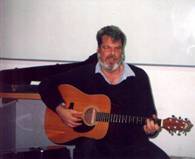
Larry Gamliel (our editorializer)
As the term implies, country music was, first of all, a rural music. It was, not surprisingly, primarily formulated in the Southern United States. It would be somewhat difficult to distinguish it from early forms of hillbilly and bluegrass.
Country music became recognizable as such when it slowly penetrated the urban areas of America. Even as early on as the 20s and 30s of the last century, one could hear country on the radio in the big cities.
It must also be pointed out that country was, and may well still be, a predominantly white music, with notable exceptions of course. But even so, the instrumentation and lyrics of country, and black music such as the blues, are similar enough so that we can easily discern their common sources.
In this regard, it is worth noting that early rock-n-roll music and country are very closely intertwined. Such rock pioneers as Elvis Presley, Buddy Holly, Jerry Lee Lewis and Johnny Cash, to name but a few, are revered by lovers of both genres. Musicians such as the late Chet Atkins had a tremendous influence on both. The instrumentation used in both is very similar. Indeed, often when I visit America I am struck by the similarity of the sound, which results in constant crossover tunes.
I do not propose to dwell at length on the musical development of country music. But it must be noted that a certain dichotomy exists in country, just as it does in many other genres of music. I am talking about the traditional, which is to say acoustic proponents of the genre, versus the electric or modern artists. The tension is perhaps heightened by the tremendous commercial profitability of mainstream country. As you all surely know, top forty country, if I can call it that, is a multi-billion-dollar business. Its sound is more “polished” with elaborate arrangements and well-trained singers, who may or may not be possessed of an Arkahoma drawl. But even when they couch their songs in an urban setting, modern country maintains a pretense of “country” values like red necks, white socks and blue ribbon beer.
But when we try to put a finger on what constitutes traditional country, things get a bit messy. We have examples close to home that illustrate the situation. I have two friends, both of whom play what they call country music. Shelley Ellen plays more acoustic stuff than not. A partial list of songs she does might include: Country Roads, Ramblin Man, Fox On the Run, This Land is your Land, Louisiana Man, and most recently, Rawhide. Are all of these songs country? Perhaps not in origin, but the way she performs them, with fiddle, occasional banjo and dulcimer and acoustic guitar, they have a very distinctive traditional country sound.
And then there is Marianna Navon. She introduced me to a sort of country music I had never heard before. She gave me recordings by such artists as Lucinda Williams, Steve Earl, Iris Dement, as well as some by such groups as the Juds. Many of these employ electric guitars and drums as well as the aforementioned acoustic instruments. The sound was at once much less polished and much more authentic. During my recent visit to the States, I couldn’t find any of these artists or the type of music they played on the radio. And yet they have a following. The setting and atmosphere of most of the material is very rural and to my mind represents the real continuation of country.
All of these reflections came together for me a couple of days ago when I read an article about the phenomenal success of the movie sound track of O Brother, Where Art Thou? (I haven’t heard it yet and I would love to do so.) The article reports that the songs are performed with traditional country (or folk) instruments, in particular fiddle and banjo. The tremendous popularity of the soundtrack’s album is all the more remarkable in that most country stations shunned it. It did not fit the accepted sound of country according to the play list makers. The article went on to observe that in view of a steep decline in sales of country in general, these play list makers ignore authentic popular demand at their peril. The moral, of course, is plain. While all music, even folk, has to grow and progress, it must never lose sight of the roots from whence it sprung.
--Larry Gamliel
SOUTHERN FRIED JAM
Let's sing away the "situation blues" and enjoy a musical interlude on Friday, April 19th in the Lahav Forest. We'll gather by 11am in the picnic area across the road and down the steps, opposite the Joe Alon Bedouin Museum (a good place for early jammers to visit).
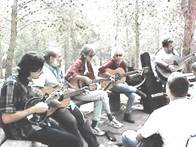
Southern Jam - November 1999
Take Route 40 to Dvira Junction, just a few minutes south of Bet Kama intersection (large intersection with traffic lights and gas station). Turn onto Route 326 at Dvira Junction and drive 7 kms down the road. You'll see a map of Lahav Forest.
Turn right and go up the hill, following the signs to the Joe Alon Bedouin Center and park. Bring a picnic lunch and munchies to share, folding chairs and blankets, and instruments. We'll kick off the jam with a rousing round of spirituals to soothe the soul.
For further information, call Laurie at (08) 653-2080 or (064) 464-377 or laurie@boker.org.il
A Poor Premise For An Obsession - Book Review
Where Dead Voices Gather
by Nick Tosches
Little, Brown and Company 2001. 299 pages
This is one of three books about music by Nick Tosches that I recently acquired and read. I will endeavor to review all three, editors permitting, in the coming issues of FolkNotes.
Where Dead Voices Gather is a book about an obsession. In part it is a detective story about the search for the elusive, mysterious Emmett Miller, and is based on the premise that Emmett Miller was a seminal and influential figure in the development of black popular music as well as white country music.
This premise merits some consideration and examination. Emmett Miller was a white minstrel performer who performed in blackface, apparently at least as well known as a comedian as a singer. He had a “trick voice” which broke into a kind of yodel. Mr. Tosches’ fastidious research reveals documented recording dates with musicians, most of whom when interviewed fail to remember Emmett Miller. The premise is also largely based on Emmett Miller’s alleged influence on the country singer Jimmie Rodgers. However, Mr. Tosches never establishes that Jimmie Rodgers ever actually heard or met Emmett Miller and he neglects to take into account than an unknown source may have independently influenced both performers. At best, the premise is doubtful, at worst, specious.
In spite of the flawed premise, I learned a great deal from the book. The entire phenomenon of minstrel entertainment and its contribution to the form and content of modern popular music, black and white, was a revelation to me. I will not go into the racist aspects of whites in blackface exaggeratedly mimicking black mannerisms. Mr. Tosches deals with it aptly, albeit, to my mind, somewhat indulgently.
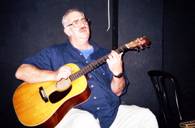
Marc Miller (our reviewer)
The book is not divided into chapters. It is one long mixture of detective work, historical essay and cultural criticism with a plethora of digressions. In some of these, the author seems to assume the reader knows classical Greek. Classical Greek is not in my repertoire. (I read an article around 1965 on the benefits of a classical education by one Arnold Toynbee, the same Toynbee who relegated us Jewboys to historical and cultural fossildom. I told myself that if he was the result of a classical education, I wanted no part of it. I was wrong, of course. Classical culture is a source of personal fascination.) Mr. Tosches is clearly not a musician and doesn’t have the tools to analyze music and musical development on a technical level. The book (as well as the other two I will review) is full of abstruse literary references, perspicacious cultural observation and delicious irony. Ultimately, Where Dead Voices Gather is well worth the effort.
--Marc Miller
Jez Lowe in Concert
A Geordie by ethnic language origin (Northumbria), Jez Lowe could be
labeled provincial. He hails from the northeast coast of England near where
Billy Elliot was filmed, “where the North Sea stands between his
house and Norway,” as he puts it. Sea, coal mines, working class: the stuff
good songs are made of. But could he sell them in southern California, in
Israel? Well, he hasn't been called the "Woodie Guthrie" of the
British Isles for nothing. His songs have a very strong social conscience and
even though couched in the backdrop of his own personal setting, they transcend
and can speak to everyone.
He played in Encinitas, California to an enthusiastic audience,
willing to sing along (he left his Bad Pennies backup group behind on
this tour) and ready to laugh at his good humor. He's been recording CD's about
20 years now, and even we have owned a copy from his Green Linnet period. Paul
Graham may have introduced us.
Aside from his good music, three things struck me.
2) He sang newly writtensongs with the same ease and passion as those from many years ago, leaving you certain he was telling you all these stories because you needed to know. Images he musically creates of those landscapes, those people, life's challenges, are locked in memory so you'll know if you meet those people or pass that way "again." Given that his songs are largely stories, he amazingly never seemed to forget a single line in that 2 hour performance.
3) His tunes remarkably didn't remind you of each other -- he had a startlingly broad "breadth of tuning" and rhythms. And his parents from this working class town wonder when he'll get a real job!
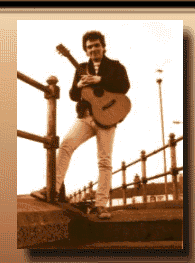
Jez Lowe (from his website)
If you want a deeper flavor of where he's at, as well as his
discography (he has 12 CD's under his belt), check out his website at:
http://www.jezlowe.com/
Don't be put off by the Bad Pennies joining him -- they come with a flare of colors on their guitars, mandolins, dulcimers, fiddles, and appropriate percussion, and occasional vocals. They don't fight him. Instead, they enhance him.
--Judi Ganchrow
Janet’s web site of the month:
Glossary of folk instruments - if you want to know what else is out there...
http://www.hobgoblin-usa.com/info/glossary.htm
MILESTONES
Mazal Tov to Menachem and Judith on the birth of their grandson
Happy Birthday to: Larry Brandt, Jonesy Clarfield, Sarah Einstein, Shula Fuchs, Gayla Goodman, Ariela Orion, Linda Schlosberg, Amiel Schotz, Arlene Strasbourger
Condolences to: Jon Wasserman on the loss of his parents.
NOT TRAD ADS - fee is NIS 10 (NIS 5 for members).
**Sandy Cash's new CD, EXACT CHANGE, is available for 60 NIS, plus 15 NIS shipping (per order). Send a check, along with your name and shipping information to P.O. Box 1639, Bet Shemesh, 99522. For more information, call Sandy at (02) 991-9686 or contact her at: sandycash@bigfoot.com
**SHELLEY ELLEN - guitar lessons, also available for performances (03) 674-5356.
**Jill Rogoff's THE CELTIC CRADLE and ACROSS THE NARROW SEAS (ALC 129) are available on cassette and CD. Tel/Fax (02) 679-0410.
**DAY OF REST -- Rahel Jaskow's CD. Renditions of traditional and slightly off-the-beaten-track Sabbath songs. NIS 65 plus NIS 10 postage. Contact Rahel Jaskow: rjaskow@actcom.co.il
** Voice and/or flute lessons. Call Marcie Schreier: (053) 834-174.
**Computer Support. Free telephone support, and house calls. Very reasonable rates. Ben Hizak. (050) 280-644.
DISCLAIMER: FolkNotes is the official publication of the Israel FolkStuff Society. Views are those of the writers, not necessarily those of IFS.
FolkNotes and all of the articles, photographs and material contained therein are, unless otherwise noted, copyrighted by IFS 2002.
The disclaimer is so that people do not "steal your article." In every case that people turn to FolkNotes for permission, we refer them directly to the author of the article. Advertisement tariffs for FolkNotes are available on request.
FolkNotes Staff: Sherry Whetstone, Larry Gamliel, Carol Fuchs, and Cecile Panzer
| |
| |
|
| |
|
JERUSALEM AREA: Thursday, April 11th, 8:30 pm. JERUSALEM FOLK CLUB. Songs of Spring (the season, bedsprings, Springsteen, etc.) with “Southern Wind” - Laurie Ornstein, Marianna Navon and Shaun Deakin. Admission NIS 20. At the ZOO near the Jerusalem Mall. For information call Larry at (053) 801-202 or Carol (053) 850-098. TEL AVIV AREA: Wednesday, April 10th, 8:30 pm. TEL AVIV FOLK CLUB. Ariela's Post Birthday F.C. (only 1-day post but it's a change from her regular pre-birthday ones.) The program includes: Six Appeal - a vocal-Jazz sextet under the direction of Alex Eshed (of "Barberinas" and "Twelve Tones" fame). Bikurei Ha'itim, 6 Heftman St. For more details, call Ariela at (03) 683-7441 Thursday, April 11th, 8:15 pm. Jill Rogoff in "Roses and Briars: The image of women in medieval and traditional song” in a concert at the home of Dena and Hadar Matmon, 20 Arlosorov St. Apt 16, Kfar Sava, Call (09) 767-5134 for details or (051) 218-463, (051) 212-615, fax (09) 766-0629. There is a NIS 40 admission fee, which includes light refreshment. KIBBUTZ TZORA and area Wednesday, April 24th, 9 pm. KIBBUTZ TZORA FOLK CLUB. Call Judi & Lynn Lewis at (02) 990-8382 or (051) 348-061 or email them at: judilynn@tzora.co.il There is also a rumour that there is a new Music Gathering monthly or so, but we have no information on that. SOUTHERN AREAS: Friday, April 19th, 11 am. Southern Fried Jam. Joe Allon Forest. Details above KARMIEL AND NORTH Tuesday, April 2nd, 12:30 (noon). Diane and Ada with Abe Doron. Haifa Cinematheque for the International Youth Theatre Festival- we will do World Music. Info: 04-8600-515 or 1-800-349999 or: www.childfestival.com Thursday, April 4th, 9 pm. KARMIEL FOLK KLUB – NO CLUB Thursday night, April 4th, Eli Marcus will be performing country blues and ragtime songs at Gidi's Place in Klil (just east of Nahariya, off Rt. 70 not far from kibbutz Beit HaEmek) For information: 04 996 8783 Thursday, April 11th. KFK's (KARMIEL FOLK KLUB) open stage 3 songs get you free entrance. Please let Larry (04-990-2455) know ASAP if you plan to perform. Thursday, April 18th, 9 pm. The new SARONA FOLK CLUB, with Yoav Biran and Julio’s friends. For more information, call Della: (04) 676-9148. RUSSIAN SPRING FESTIVAL - April 25-28, 2002, in St. Petersburg. For information, contact: Alexander Ivanov, RUSSIAN SPRING FESTIVAL Organizing Committee, Folk Music Association of Russia, Phone/Fax +7 812 183 8441, Email: folk@sp.ru, Web: www.fma.sp.ru Friday-Saturday, May 3rd-4th JACOB'S LADDER. Karei Deshe Despite the situation, interest is high, and there have been no cancellations by scheduled artists. Karei Deshe is situated on the northwest shore of the Kinneret - right next to the highly secure and patrolled pumping station of the National Water Carrier. Additional security personnel have been hired - and we have full coordination with the Police and the Border Police- who will be present and on patrol. Please arrive early to allow for security checks. BanjerDan Mazer heads the bill, and those who have heard him - in the States - assure us that he is "The real thing' So for all you bluegrass and country fans - this is an opportunity not to be missed. Dan will be ably assisted by our own "Bluegrass Incident" - Yonatan Miller (fiddle), Ari Meerson (mandolin), Lynn Lewis (guitar) and Joshua Goodman (galvanized contra-bass). We are proud to announce the participation of Abe Doron - percussionist. Abe played bodhran and other percussion instruments with Riverdance. He toured the world with this most famous of Irish folkshows for over 5 years. Abe plays with Ada and Diane, and with Evergreen. Speaking of Ada & Diane "The Many Colours of White" - this is one group in which peaceful cooperation and amity are truly manifested, with Salem Darwish and family playing darboukas and oud. East meets West; darbouka meets bodhran. Yonatan Miller heads "The Grinders" making a first time appearance at JL - grist to the mill of all wild rockers, Deadheads and Flower Children. Special concerts in the indoor hall will be given by Sandy Cash, Sunita Stanislow and by The Duo Renaissance. The Duo - Janine and Limor, play medieval music on authentic instruments - a classy act indeed! Seating is limited so get to the hall early to ensure a place. AND Sarona Weekend 2002 has been set for Thursday, November 7th – Saturday, November 9th, 2002. Open to suggestions for themes, ideas, etc. Contact Carol or Larry or Harold. Try to get your information to the appropriate persons for the Calendar, as early as possible, so we can meet publication deadlines (15th of each month). Contact Larry Gamliel at (053) 801-202, or by email or fax Carol at (02) 675-8905. For late-breaking updates, join our email listing. Email Carol: carolm@shum.huji.ac.il | |
|
| |
|
| |

|
