 . .
. .
Classified as Camite-Semites owing to their Camite nature mixed with Semite elements, the Egyptians have an
unknown origin as well as a language with mysterious roots believed to be linked with Semite and African tongues.
They are supposed to havecome from the Mesopotamia and to have been, originally, shepeards, though they were able
to modify this fact and turnagriculturers. But what has always amazed many different cultures has been its quolity
of being one of the oldest tribes on Earth, and the first unified State, perhaps, as A. Moret sustained, owing
to the lack of quaternary glaciers in the zone and the fertility of the soil.
By the wealth obtained by agriculture with the lime left by the river in each of its floods, a strong State emerged
centralised in different capitals and governed by a pharaoh; a religious Nation that traded with copper and other
surplus and that lived in a brotherhood strong enough to allow the concretion of monumental common tasks as the
well known pyramids that made it famous.
Its magnificence started to be among the Arabian and Syrian Deserts, the Red and Mediterranean Seas and the so-called
1st fall of River Nile, in the South of Aswan, being almost completed by the year 3,000 BC, even though there is
evidence of several settlements in the region after the glaciations, that is, by the year 10,000 BC, when the River
Nile ceased to being a lake to acquire the shape he still acknowledges nowadays but with a vaster quantity of resources:
animals, edible roots, fruits, etc.
In those times, the nomad tribes of Africa had established in River Nile valley and followed a Paleolithic way
of life of basic recollection until a rupture occurred. Apparently, by the year 6,000 BC and without any relation
with the already mentioned tribes, some groups with Neolithic sedentary life arrived from Asia crossing the Isthmus
of Suez and organised themselves, beginning to use agricultural methods by the year 3,600 BC approximately.
With the arrival of the Egyptians, many aboriginal tribes were expelled from the valley at the end of the Calciolitic-Old
Predynastic Period, being the key excavated fields of the time el-Amra, Nagada, el-Ballas, Abydos, Mahasna and
Hu among others, while the ones before had been, in the year 5,000 BC, el-Bahri and Merimda and, during the Neolithic,
that of the Al-Fayum Oasis, Deir-Tasa and Mostaggeda. The North African cultures remained similar in development
but were arranged in different settlements that sustained a net of relations and commerce, something also happening
later with those Nubian tribes so amazingly similar to the Egyptian ones. Finally, in the late prehistoric period,
the developement continues owing to new technologies acquired from contacts with Asia. Some time before the dynasty
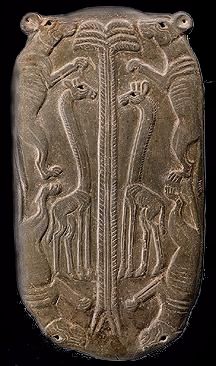
I, the Egyptians start the exploitation of flint in an era called Naqada II as a second stage in the development
of the native culture of that city. In that way, the archaic Egyptians start to live in a quite stratified society
that maintains different relations with foreign cultures and that, after the concretion of the monarchy of the
Dynasty I, needs to create a Southern border to separate its lands from the Nubian's.
Thus, a State unifying both crowns of High and Low Egypt is created without great modifications to the daily life
of the inhabitants and with a geographical limit placed near the 24ºN parallel. So it is that the inhabitants
of the zone dwelt in a relative harmony. Their towns were founded as groups of low square houses adobe and branches-made
in the higher points of the land where the floods could not damage the buildings . Their furniture and daily objects
were manufactured either with mud, stone, linen, ivory, bone, straw, shells, furs, wood or metals though the materials
were visibly increased later in time.
The first attempt to unify the whole land under a sole power was done by the Egyptians living in the delta, resulting
in the division of the lands in two kingdoms, one with capital in Memphis and a southern one with capital in Thebes.
Later, the Southern men, guided by Narmer and Menes, defeated the Northern coalition and, from the union of both
territories, the 1st unified state of history was made real.
By archaeologic testimonies and by the invaluable legacy of the Egyptian historian Manetho, we find that the legendary
pharaoh Menes is the one starting the dynasty I using the double crown and taking "Aha" as royal and
'Horus' name, the only important nick a pharaoh had.
With the establishment of a central power, big cities as important as Kom el-Ahmar (Hierakómpolis), Naqada,
Abydos y Qift (Coptos) start to appear and, with the growing commerce, the Mesopotamic influence and the strategic
settlements in places as the Sinai Peninsula became common coin.
In the reign of the Dynasty I we find the oldest tomb in Saqqara. The burials are done in Abydos and Memphis mainly;
the royal ones specially in Abydos. Unfortunately, the tombs in this period were completely sacked.
In Saqqara there are also to be found sepulchers of important functionaries of a special category, slightly greater
in number than those from rulers, where several stone glasses have been found, being in those times and appreciated
symbol of power.
During the Dynasty II, the unique necropolis is Saqqara.
It's a dark period of which the only clues inform of a struggle for the throne between two different bands, what
leads to pharaoh Peribsen changing his name for Seth, perhaps seeking to mark his distinction between his title
and that sworn by a second pretender, making an allusion to the Seth myth (still with a vague shape in those times,
see Seth and Osyris Myth), being as he was
the only leader that ever possessed a name of Horus.
Both dynasties were, in modern times, called "Tinites" by historians, since the capital of the Empire
in those years was in the city of Tinis.
With the Dynasty III, both Gods are unified again under the figure of the pharaoh Khasekhemui. Under the crown
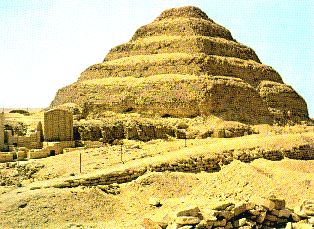
of his son and successor Djoser, Tjeser o Zoser (2630 BC-2611 BC), the Egyptian domains are increased Southwards
and the Great Stepped Pyramid of Saccarah was built. We're now in the "Golden Age" of construction and
its most extolled architect, Imhotep, who was specialised in adobe truncated sepulchers considered "eternal
abodes" by the Egyptians, enjoys such a great prestige that he will be turned into a popular divinity of healing
in the Greco-roman period.
Sekhemkhet (2611 BC-2603 BC) appears as Djoser's successor and the royal lines disappear in another dark period
in the Egyptian history.
The characteristics of this primitive state had small to do with those of the Egypt after the Dynasty IV. But a
conjunction between different climatic post-glacial changes bring a period of low floods, of drying of the Sahara
and of migration of tribes from those places beginning to be warmer and more arid.
This, added to the great revolution that four dynasties of life in a State meant to the Egyptian Tribes, changed
totally the system in which the Egyptians based their beliefs. That was why that early Nation first begins to be
more centralised but, then, weakens and enters a brief dark age.
. .
Above, left, a photo from the Stepped Pyramid of Zoser in Saqqara, Sakkara or Saccarah built approx. in the year 2650 BC. Above, right, a photo of a plaque from Naqada II Period in exhibition in the Louvre Museum.