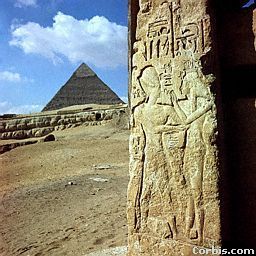
| With the IV Dynasty, Egypt enters the Ancient Empire, period of great constructions and in which the famous pyramids
were built. After the third dynasty, the capital was moved from the city of Tinis to Memphis, for what those years where called "Memphite period". The first pharaoh of the dynasty was Snofru, who, it is known, may have given certain territories to functionaries, forming small seigniory. The functionaries always belonged to the royal family in those times even though we may find some exceptions to the rule, as the one of Metjen, an influent man that guided several expeditions to Nubia. This small campaigns were a factor of power and, altogether with the Egyptian settlement in Buhen- maintained for centuries as an operation base for extractive and commercial operations- were organised as actions of strategy and defense. The Egyptian activities and changes in the climate had destroyed one of the groups with which the Egyptians used to fight in their quest of an extension of the territory to the south and a new group with whom they had good relations had occupied the place. In the spiritual field, the IV and V dynasties enlightened the solar cult and, as a kind of succession ritual, the pharaohs made symbolic campaigns to reinforce their powers in Nubia and built a solar temple at least once in their reign. |
|
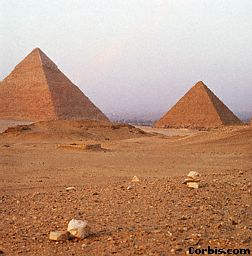
| The greatest "builders" then were Khufu or Keops (2551 AC-2528 AC) and Kephren or Khafre (2520 AC-2492
AC), being followed in magnificence by Menkaure (2490 AC-2472 AC), better known as Micerino. This ruler built his
funerary pyramid in Gizeh, as his predecessors, but did not concrete half the constructions completed by the first
ones. In spite of that, Keops and Kephren were remembered as tyrants when of Menkaure and his methods only good
memories remained after his death. The great majority of the stone works of this dynasty were made altogether in Gizeh, perhaps in solidarity with the previous leaders and to show their similar posture against the buildings of Opposite factions. |
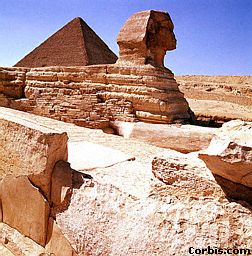
Khufu/Keops' Pyramid behind the Sphinx, a monument already old in those times. |
| The Dynasty V was united to the previous one for blood lines, since the mother of the two first pharaohs (Khentkaus) and probably also the father, belonged to the IV dynasty; but there was where the similarities ended and Egypt reached its apogee with the first pharaoh, Userkaf, son of the great Priest of Ra, beginning the priests to be vital figures in the government. |
|
| Even though the solar cult was continued, the pyramid construction to reach immortality was finished, being the magnificence replaced with decoration and tomb ornaments, in exchange. the royal family begun to lose power, after what a greater expression freedom appeared, and the functionaries were not any more part of the reigning dynasty, but could marry their members. After Neuserre (2416 AC-2392 AC), the pharaohs lose control in Nubia. Although the hegemony of their other possessions was still strong perhaps owing to the use of Biblos as a cohesive device. | |
| In the year 1323 AC, when the vi dynasty reached the power, there were already cleat signs of decadence and the nomarchs, the lords that had been specially chosen to govern the provinces, were making rebellions against a vulnerable ruling house to establish their own princedoms. Finally, in the large reign of Pepi II (2246-2152), the commercial practices in the south were still carried out but the relations with Nubia were cooling while the tribes in question were united in three main princedoms to end making a coalition that joined them in a same new strong state. |
|
| The VII dynasty shows a list of nominal week kings in the twenty years in which they are in the power. The construction
of underground tombs with not many ornaments shows the deepening of the crisis and the growing decay of the Empire,
but nothing could prepare the Egyptians for the catastrophe and hunger that would flagellate them, both for a poor
administration by a weak central power and by a serial of low floods. The lack of food grew together with poverty
and the quantity of burials in the popular cemeteries and hereditary challenging feuds appeared ruled by public
figures with charisma and power. The anarchy that emerged after the VII dynasty ruled for 200 years and those dark times were lately referred as "1º Intermediate Period". |
|