|
English & Scottish Nobility Titles |
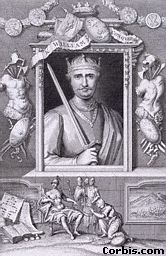
Picture of William I the Conqueror Duke of Normandy (1066-1087). |
|
|
English & Scottish Nobility Titles |
Picture of William I the Conqueror Duke of Normandy (1066-1087). |
|
Prince of Wales
The first one in using this title was Edward Plantagenet, later Edward II (1307-1327), honoured by his father
Edward I with the distinction. Since such a title begun being used by the ruling house, it has been reserved to
the heir to the crown. The actual Prince of Wales is Charles Windsor, and his son may be addressed both as William
and Harry of Wales or using the Windsor surname, only reserved to princes of the blood. The Black Prince, the original
owner of the Ruby in the royal crown and eldest son of Edward III, was Prince of Wales all his life: he married
Joan of Kent and produced an heir, but he died before his father and his son Richard II (1377-1399) inherited the
throne until he was deposed and murdered. In spite of having married two princesses- Anne of Bohemia, dau. of Emperor
Charles IV and Isabelle of France, dau. of Charles IV- he left no heirs and his death caused one of the bloodiest
wars of England: the War of the Roses.
Dukes are considered princes since their title is a consequence
of being ancestors of a king. In England the Premier Duke is the Duke of Norfolk.
Dukes have to be addressed as His Grace while a duke's elder sons are of a category immediately lower to Marquises
and may use the duke's various titles (as, for example, Edward Baron Downpatrick, being son of George Earl of St.
Andrews and grandson of Edward, Duke of Kent). The younger son and the daughters are addressed as Lord or Lady
and there names.
Marquises appeared as lords fighting in the march, a dangerous area between England and the enemy. Scottish Marquises were called "Marquis" owing to the well known French and Flemish influence in the noblest houses of the country. Being a Marquess the "Most Hon" (honourable), his children are addressed equally to a Duke's and the eldest son also uses one of his father titles.
Earls (Counts) in England were a derivation of the Anglo Saxon charge of Ealdorman shown, for example, in the family of Alfred the Great's wife being her father Aethelred the Great, Mucil, Ealdorman (governor) of the Gaini. The eldest son of an Earl bears one of the secondary titles of his father or mother, the other siblings are addressed either as "Hon" or "Lady". We may mention as an example in the actual British Royal Family, Edward, the fourth child of Elizabeth II, being an exception when the queen's younger son bears the ancient Title of Earl of Wessex instead of a Dukedom, a title specially chosen among the most ancient of England. The oldest Earldom is that of the Countess of Mar, also taken as the oldest English lineage, since the title had been inherited by the descendants of the same family since it was created.
Viscounts bear an ancient and noble title and, thus, it
cannot be considered a courtesy designation merely. All a viscount's sons are treated as "Hons" in spite
of the viscount having other secondary titles. The roots of the viscounties are deep in history and show a reminiscence
to continental titles.
One of the most famous cases of Viscounty in royal family is that one of David, Viscount Linley, Princess Margaret's
elder son with Anthony, Earl of Snowdon.
Barons are the most ancient titles and the lowest of the nobility
ones. Some baronies may pass through female line. Sons are addressed as "Hons" or "masters"
(in some Scottish cases) without exception. As an example we may highlight Prince Michael's wife, the Baroness
Marie-Christine von Reibnitz.
Baronets were created in the XVII century and were meant
to serve for various political, economical and strategical purposes. As a way of ennobling the middle class, the
last baronets were created in the middle of the XX century.
Lords, Lairds and Sirs, signs of public recognition or knighthood
acquired from the king or, in the case of the Lairds, an indication of property and domain.