Invertebrates |
|
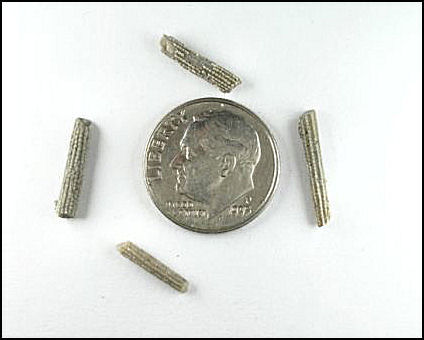
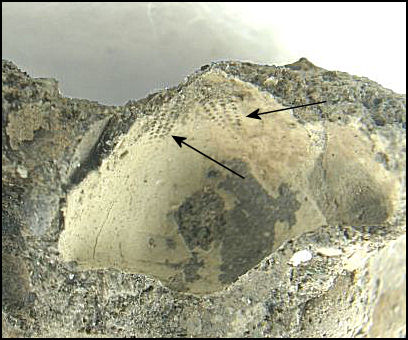
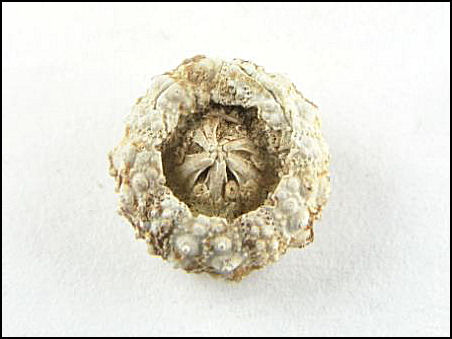
Sea Urchins Sea urchins are members of a much larger group of marine animals called echinoderms. These include sea stars, brittle stars, crinoids and sea cucumbers. The fossil record shows divergence from sea stars nearly 450 million years ago in the late Ordovician period. It is believed that during the Cretaceous period, sea level rise may have accounted for a dramatic increase in their diversity. There are about 7000 extinct species of sea urchins and about 900 living species. The sea urchin shell or skeleton is called a test, which protects the soft internal organs, and is covered with spines arranged in five broad areas that are separated by narrow unprotected areas. The mouth, on the underside of the body, has a complex dental apparatus called Aristotle's lantern. A number of species have been reported from the New Jersey area, usually fragments, or of very poor quality. The spines of the sea urchin are common in some locations but because of their fragile nature are normally found broken.
Typical finds from Monmouth County, NJ.
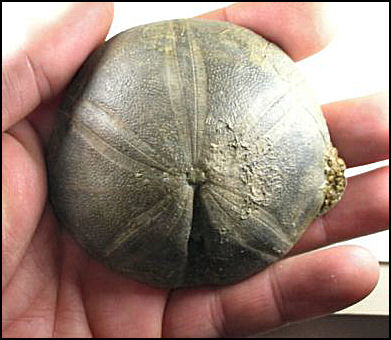
The only specimen of a sea urchin shell from Monmouth
County, NJ
The sea urchin shell or skeleton is called a test,
which protects the
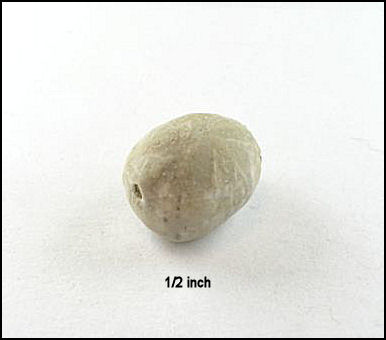
Catopygus columbarius, this particular species
has been
A view of the mouth on a fossilized sea urchin. |
|
|