|
THE SHARKS |
|
The Extinct Thresher Age - Cretaceous Commonality - Less common
The extinct thresher (Paranomotodon angustidens) saw worldwide
distribution during the Cretaceous period. Fossil records of
Paranomotodon angustidens are confined to the Cretaceous sediments
with Alopias latidens, the ancestors of today's thresher,
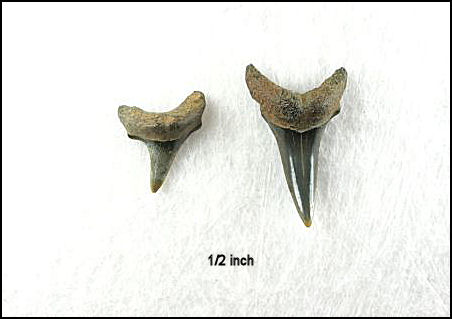
appearing during the Miocene. The teeth of the thresher are small,
averaging about ½ inch and can be fairly common in some locations. The
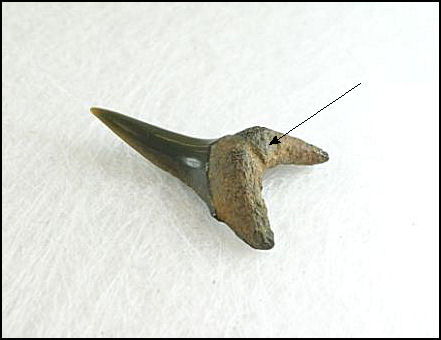
root has a “U” shape appearance with a short nutrient groove, this
nutrient grove is often worn away by stream action. A very distinct
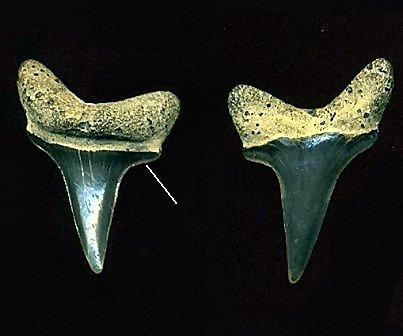
feature of Paranomotodon angustidens is the concave basal
root margin seen on the labial side of the tooth. The shoulders of the
crown have a block like appearance which I have seen described as “weak
lateral cusplets” or “vestigial
cusplets”. The crown is erect on anterior teeth and
distally curved on laterals.
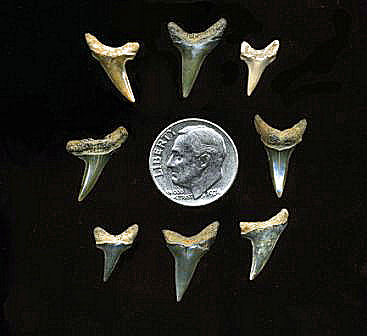
Lateral and anterior teeth of
Paranomotodon angustidens.
The short nutrient groove on an anterior tooth.
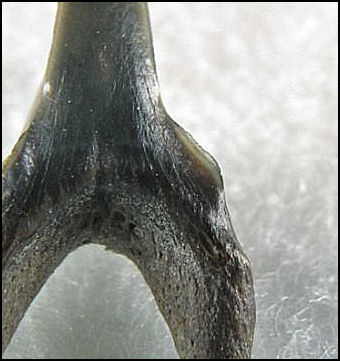
Identified as a pristine first anterior tooth by Jerry Case.
Paranomotodon angustidens. |
|
|