|
THE SHARKS |
|
Extinct Early Mako Age - Eocene Commonality - Uncommon One of two species of mako shark
found in New Jersey, Isurus praecursor is the earliest known mako
and is restricted to the Eocene. Both species, Isurus praecursor
and Isurus desori belong to the
narrow-toothed form of mako. Averaging between ½ to 1 ½ inches long, the
teeth of I. praecursor, when
compared to other teeth from Monmouth County are relatively robust and
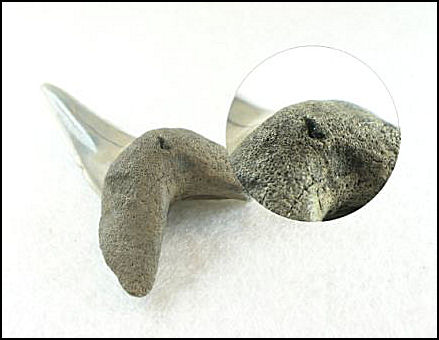
the anterior teeth have no cusplets. A nutrient grove is lacking, or a
best shows as a weak depression. On specimens that are not too stream
worn nutrient pores may be present, these may form what looks like a
single opening due to clustering and/or stream wear. Kent
mentions that the “lateral teeth of I. praecursor are nearly
indistinguishable from those of the later Isurus species”.¹ Most
reference material notes the similarity between these two species and
suggests using
stratigraphic origin
as an aid to identification. Large
sand tigers that are missing their cusplets may be mistaken for makos.
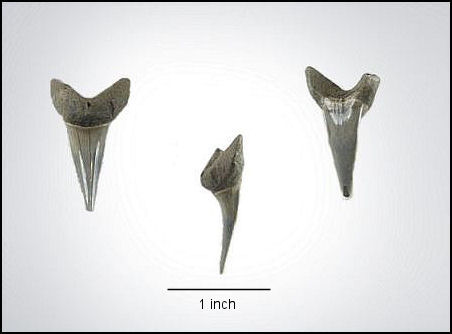
Anterior and lateral teeth of
Isurus praecursor.
Different views of an anterior I. praecursor. This species has
the shortest,
Lateral teeth if
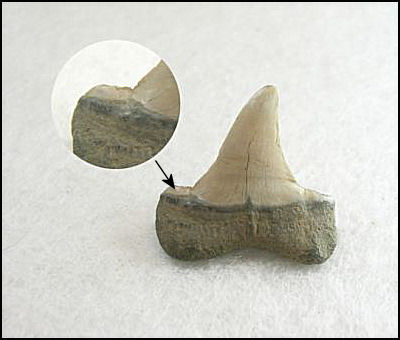
Isurus praecursor. The roots on the lateral
"Weak" cusplets on a lateral tooth.
Nutrient pore on an anterior tooth.
¹ Kent, W.B, 1994. Fossil Sharks of the Chesapeake Bay
Region, Egan Rees & Boyd, Inc., 57pp. |
|
|