| ANTI COUGH EFFECT OF LAGUNDI TABLET 5.2 PHASE II CLINICAL TRIAL Open clinical evaluation of the safety and efficacy of Vitex negundo ,L (Lagundi) tablet as anti-tussive agent. An
open design phase II clinical trial was undertaken from January to December
1984 to determine the efficacy and safety of lagundi tablets as anti-tussive
agent. The lagundi tablets were prepared by the NSTA-UPCP Pilot Plant
from dried lagundi leaves (Batch No. 200583 CLSU-L). Patients were recruited
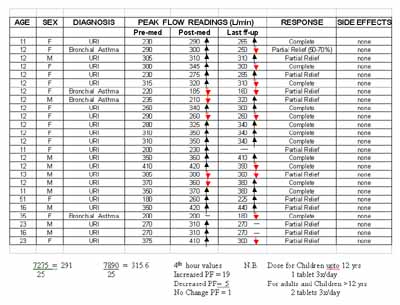
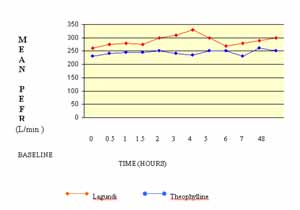
from the There were 25 patients evaluable, 14 females and 11 males. There were 19 children, 5 adults and one 16 years old. Bronchial asthma of mild severity was present in 4 patients and the rest (N-21) had upper respiratory, non-bacterial infection. Peak expiratory flow rates (3 trials) determined prior to drug administration. Directly observed drug intake for the first dose was done and hourly PEFR was determined. Dose for children 7-12 years was 1 tablet 3x daily and for >12 years and adults, dose administered was 2 tablets 3x daily. Improvement in cough frequency and PEFR was manifest by the 4th hour. Lagundi therapy was continued at home for up to 2 days. Parameters of efficacy were mainly based on relief of cough, ease of phlegm expectoration and lung findings. Complete relief, with disappearance of coughing was recorded in 52% (N-13) and partial relief of cough in 48% of patients. Baseline PEFR ranged from 180 – 410 L/min. with a mean value of 291 L/min. by the 4th hour, the PEFR mean value increased to 315.6 L/min 9 range of 180 – 420 L/min.) with improvement. After 2 days of lagundi therapy, the PEFR gave a mean value of 307.7 L/min with 5.7% increase compared with baseline. Of the 13 patients with complete cough relief, ten showed increased PEFR by the 4th hour, 2 had a decrease in PEFR and one showed no change. After 2 days of drug intake, there were 24 patients with PEFR values greater than their baseline while 5 patients showed decreased values. Of the 12 patients with partial relief of cough, 9 (75%) showed increased PEFR by the 4th hour post-drug intake and only 5 (42%) of them continued to have higher values than baseline after 2 days of therapy; 4 patients had decreased PEFR and 3 reverted to baseline values. Evaluation of efficacy of lagundi for acute cough of mild severity showed complete or partial relief in all 25 patients. However, whereas there were more patients with complete cough relief who demonstrated improved PEFR values (74%) by the 4th hour post-dosing and after 2 days of treatment (61%) a few reverted to their baseline values or even had a decrease in PEFR (15%). It was also noted that significant clinical and pulmonary function improvement occurred 4 hours after lagundi intake. No untoward effects were reported among the 25 patients and tablet acceptability and no difficulty in tablet swallowing were also reported. 5.2.1 Objectives General: To determine the efficacy and safety of lagundi tablets as an anti-tussive agent Specific:
To investigate the efficacy of a batch of lagundi tablets as an anti-tussive
agent To
determine to possible adverse effects of lagundi tablet. The lagundi tablets used were prepared by the NSTA-UPCP-Pilot Plant from dried lagundi leaves with Batch No. 200583 CLSU-L and the Control No. 14088400. 5.2.3 Methodology 5.2.3.1 Recruitment of Patients: Patients
were recruited from the 5.2.3.2 Screening of Patients The
subjects were selected based on the following criteria: Criteria
for absolute exclusion form the study:
• Patients who satisfied the criteria for inclusion were invited to participate in the study. The nature and methodology were explained, and informed consent was signed by the patients or parents or guardians for minors. • Patients were observed at the health centers or the school clinic for at least 4 hours by member/s research team. • History of illness was taken and physical examination was done including baseline and follow-up Peak Expiratory Flow Rate (PEFR). • Lagundi tablet was administered at the dose of 2 tablets 3x daily for adults; 1 tablet 3x daily for children 7-12 years. • Vital signs were monitored, noting frequency of cough and character of expectoration before and after intake of the lagundi tablet. Peak flow was measured hourly and 2 days after. • Other effects were noted. Parameters for Evaluation of Efficacy: Complete relief – complete disappearance of symptoms and cough during the period of treatment. Partial
relief
Lagundi tablet labeled BN 2000583-CLSU-L CN: 14088400 was tested on 25 subjects-volunteers with acute cough due to Acute Respiratory Infection and Bronchial Asthma. Thirteen patients or 52% had complete relief of symptoms while 12 patients or 48% had partial relief after 2 days of treatment. Peak expiratory flow readings using the Peak Flow Meter did not correlate well with clinical results. However, 19 patients showed increased peak flow levels post-treatment among thirteen patients who reported complete cure, 10 others had corresponding increase in PEFR values, 2 had decreased values and one had no change. FEV or FVC measurements using Spiro meter could probably better objectively gauge pulmonary function and response to treatment. Comparison with a standard anti-tussive drug or placebo is necessary in order to determine relative efficacy of the medicinal plant preparation. Comparative studies using different batches of tablets should also be done to determine the efficacy of different plant sources. There were no untoward side effects noted or volunteered by the patients. 5.2.7 Conclusion Of 25 patients treated with lagundi tablets, 13 were completely relieved of symptoms after 2 days of treatment; 12 patients were partially relieved and claimed that hey felt better after intake of the lagundi tablets. There was better expectoration of phlegm and relief of coughing especially at night. Within the 4 hours observation period, patients commented on feeling of well-being but no immediate relief of coughing. Patients reported improvement of symptoms within one day of treatment. Figure
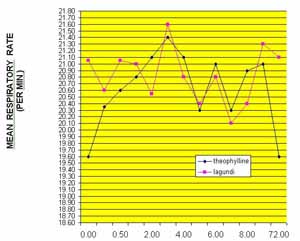
2: MEAN PULSE RATE OF LAGUNDI AND THEOPHYLLINE
|



 |
|
|

|
|
Copyright © 2002 Altermed Corporation. All rights reserved.