







PHASE III Clinical Trial
Efficacy
and Safety of 50% Akapulko Lotion Compared to 25% Sodium Thiosulfate among
Patients with Tinea Versicolor;
A Double Blind Randomized Controlled Clinical Trial
(
Lina de Dios-Torralba, M.D., Maria Beatrice T. Alora, M.D.,
Department of Dermatology,
INTRODUCTION
Tinea
versicolor is a superficial, chronically recurring fungal infection of the
stratum corneum caused by the filamentous form of Pityrosporum orbiculare.
Lesions are characterized as slightly scaly, with well delineated borders,
irregularly shaped macules usually located on the trunk, neck and upper extremities.
Color can vary from brown to red; hypopigmented patches may also be present.
The prevalence rate of Tinea versicolor in the
Several forms of topical therapies exist; however, each has certain disadvantages.
Akapulko, scientifically known as Cassia alata (L) or Herpetica alata (Ref),
is a course, erect, branched shrub growing up to 3 meters in height. It is
locally abundant throughout the
MATERIALS AND METHODS
A total of 113 patients seen at the STUH-Dermatology Clinic diagnosed clinically and by KOH mount as Tinea versicolor were included in the study. The study population excluded:
1.
Pregnant and lactating mothers
2. Any infection/super-infection of the skin requiring additional treatment
other than the trial drug, except systemic anti-histamines.
3. Any systemic disease or condition predisposing a patient to developing
fungal infection
4. Poor compliance to previous topical treatment.
5. Patients with known hypersensitivity to parabens and chrysophanic
acid.
A double blind study was done, and patients were randomly assigned to one of two regimens: Akapulko lotion or 25% Sodium thiosulfate. The solution was applied twice daily over affected areas for 4 consecutive weeks.
PATIENT ASSESSMENT
The following parameters were monitored initially and weekly for 4 consecutive weeks: KOH mount, erythema, scaling and adverse effects.
STATISTICAL ANALYSIS
Statistical analysis was done using the Chi-square test.
RESULTS AND DISCUSSION
Tinea versicolor is a superficial , chronically recurring infection of the stratum corneum. Usually, topical medications are the are the drug of choice for Tinea versicolor, 25% sodium thiosulfate is often selected because of its effectivity and low cost. It is applied twice daily for 4-6 weeks. Other topical preparations available include clotrimazole, econazole, sulfur-salicylic acid soaps, selenium sulfide. However, their use is limited because of financial constraints.
Akapulko lotion has been traditionally used by rural folks for the treatment of superficial fungal infections. Chrysophanic acid has been isolated as its active component. It is locally available and cheaper than other available preparations.
Of the total 113 patients entered in the study, 52 did not return for follow-ups as required. In one patient, treatment was discontinued on the second week of treatment because of contact dermatitis.
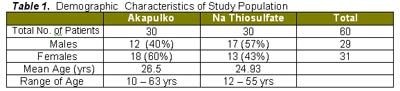
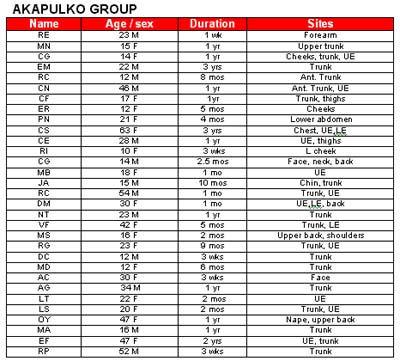
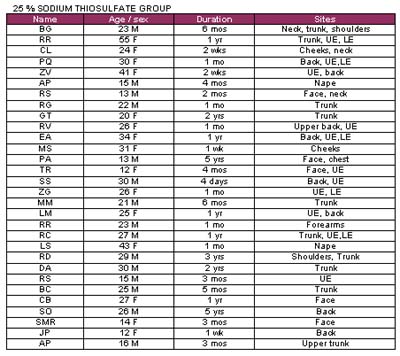
The study was completed in 60 patients. There were 29 males and 31 females included in the study. Table 1 shows the characteristics of the study group.
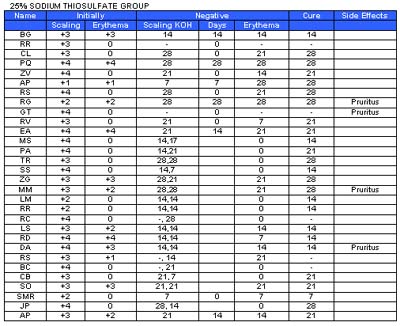
Tables 2,3 and 4 show the number of weeks it took for erythema and scaling to disappear and to attain a negative KOH mount. Results revealed no significant differences between Akapulko and Sodium thiosulfate in the disappearance of scaling and erythema and attaining a negative KOH mount.
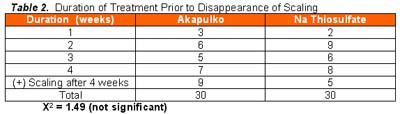
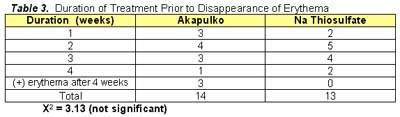
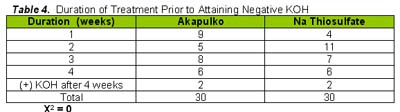
Cure is defined as the disappearance of clinical symptoms and negative results on KOH mount. Results of the study revealed no significant difference between the two groups.
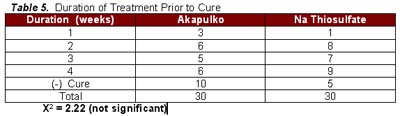
Although no severe adverse reactions were noted, it appears that more patients receiving the Akapulko lotion complained of pruritus initially after applying the medication. However, this is not statistically significant. One patient using Akapulko regimen also complained of a burning sensation initially lasting a few minutes.

CONCLUSIONS
This study shows the comparable efficacy of Akapulko lotion and 25% Sodium thiosulfate applied twice daily for 4 weeks in the treatment of Tinea versicolor. Except for one case of contact dermatitis secondary to Akapulko lotion, no other significant adverse effects were noted.
Thus, Akapulko lotion is an effective substitute for the treatment of Tinea versicolor.




 |
|
|

|
|
Copyright © 2002 Altermed Corporation. All rights reserved.