The Belly of the Beast
A look at Binky the Thunderwyrm and a description of its insides, which make up the Wyrmgut Hive's home.
The WyrmGut Hive's actual homepage can be found here.
The Wyrmgut Hive
Caern: The Deep Gut of Binky the Thunderwyrm (affectionately named so by the Sept Leader, Zha'am-Gaal)
Level: 5
Gauntlet: 2
Type: Organism
Tribal Structure: Black Spiral Dancers and assorted other Wyrm-tainted creatures.
Totem: The Green Dragon
Geography:
The Caern is situated inside the gut of what has to be the most monumentally immense Thunderwyrm ever encountered, its form dwarfing the previous record holder, 'Grammaw', which is situated at the Trinity nuclear test site in Alamogordo, New Mexico, and which was thought to be the species broodmother. This massive beast is so much bigger than Grammaw it is thought to be the progenitor of the entire species, if not a mutated and vastly oversized sibling of Grammaws.
Bawn
The meteor crater which Binky's inhabitants parked it is somewhere in the central American wilderness, just exactly where is something no member of the Caern is willing to divulge, though given Binky is still a living Thunderwyrm, should they need to, the Hive could move the beast elsewhere. Currently, there is a large city some distance away to the south, and a small village which houses the Hives kinfolk is but a couple of miles away from the center of the bawn.
Center
The focal point of the Wyrmgut Hives current site is the meteor crater, formed millions of years ago in the middle of nowhere. A yawning great cave stretching down into the earth breaks the crater, on the north side. The Crater is big enough to use as an amphitheater, a combat arena, a racing circuit for motorbikes, and numerous other functions. It is here that the open air rites and ceremonies of the Hive occur under the light of the moon. Within the crater and deep within the caves and warrens of the Hive, is the mouth of the Thunderwyrm, though when desired by the elder of the Hive, who possesses a link and affinity to this monstrosity, it can shift through the tunnels and its maw can be seen emerging from the ground. The burrows and warrens under the crater stretch off in all directions and have some surprising exit locations.
Landmarks
There are no distinguishing landmarks around the Caern, save for a single abandoned log cabin in the middle of the woods to the north-east of the crater, which is maintained by the Hive. It is most often used for pack sports such as stalking a single target, herding them toward the cabin, the hapless prey will enter the cabin thinking they are safe within there, then in true horror movie style, pack members will crash through the windows and doors and rip dinner apart after giving them the fright of their lives. Sometimes it is also used for private meetings as it can be warded off and made to vanish from sight. The only other notable feature is a creek that runs beside the cave entrance in a north/south direction.
Umbrascape
Within the Umbra, the crater seems so much more foreboding and like something out of a painting of an alien world. The grass is totally non-existent and the ground is warped and cracked like huge scales, the creek teems with piranha-like Banes and other nasty surprises. There is practically no Weaver presence here aside from the few deformed and tainted spirits infesting bits of machinery and broken cars the Hive members have stolen. The trees around the area are twisted and warped, stabbing into the sky like great blackened skeletal fingers, within each one of them resides a Blight Child, tainted nature spirits.
Binky's Gut
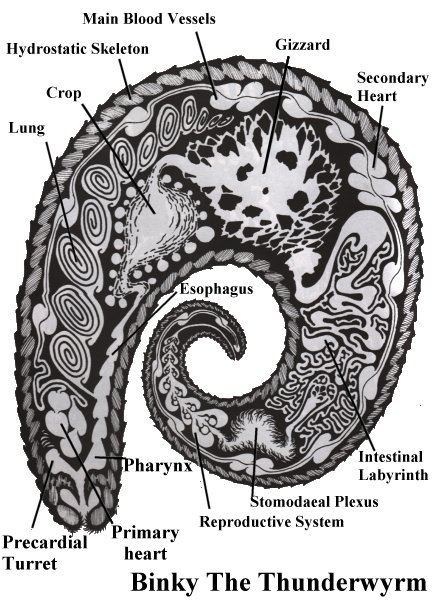
(Refer to the linked image)
To enter the Caern proper, one must undertake the journey down into the Thunderwyrms digestive tract, reaching the center of the Caern itself must be done in the Umbra as traversing deeper into the beast is extremely dangerous and nearly impossible to survive physically. The insides of the great monster are teeming and alive with the elemental spirits it has devoured while tunnelling through the earth over the aeons, they have been corrupted and serve the Caern devotedly.
In place of a hard exoskeleton, the Thunderwyrm moves and maintains its form by forcing fluid through a series of cavities lining its outer rings (these rings form the hydrostatic skeleton). The fluid is extremely toxic and inhabited by Wakshaani (Wyrm toxin elementals).
The Thunderwyrms circulatory system is a river of fire that runs back and forth from head to tail and back. It is used by the Caerns guardians to travel rapidly back and forth through its mile long body, they are immune to the fire of the beasts 'blood' via the Rite of Arterial Introduction, which attunes them to it. Non-guardians can 'attempt' this method of travel if they are immune to fire and have an extremely good knowledge of Thunderwyrm anatomy (highly unlikely). Finding some areas is easier than others via this method.
The Thunderwyrms excretory system takes the form of nephridia ("little kidneys") which line the gut and force anything placed inside to its outer hide, in physical form as opposed to Umbral. Resident spirit-helpers will dump anything they don't recognise into these nephridial portals and out of the Umbra. This excretion causes a large amount of crushing damage, though is not toxic or harmful beyond the crushing unless the hydrostatic skeleton has been ruptured in that area.
The omnipresent danger of being within the Thunderwyrm is peristalsis, rippling contractions along the beasts entire length that move everything along, there are areas safe from this, like the lung, though only the Hive members would know that.
1: The Pharynx: Binky's mouth, designed for chewing through the earths crust itself, is equipped with huge scythe-blade teeth grinding together like rotary drillheads, hard sharpened tongues cutting like steel rasps, and a thick bony wedge covering the primary heart. This wedge of bone can be heated to white hot proportions to assist the use of…
2: The Precardial Turret: This lunglike arrangement is constantly roiling and seething with volatile gases which are used to melt rock to lava or can be used by the Hive to flush the warrens with a sudden rippling blast of fire that is hotter than chemical flame (nearly unsoakable to vampires and others).
3: The Esophagus: A long tunnel that can be made to contract to such a degree that it becomes little more than a crawlspace lined with bony inward facing barbs making it impossible to crawl backwards. Midway through this area of the Thunderwyrm, the epiglottal trapdoor is located, though it is nearly impossible to see.
4: The Lung: The lung is the series of warm, steamy-aired spiralling chambers where the Hive members make their homes and the guardians make their barracks, a favourite tactic of guardians is to let intruders slip down the esophagus, missing the epiglottal trapdoor into the lung completely because it is hard to see and sphincters down into a near invisible dent in a wall, then emerge and herd the intruders into the intestinal system.
5: The Crop: This is a sort of holding tank with thickly folded, spongy walls that look like a human brain turned inside out, this is most often the first location intruders are confronted within, for it is packed with tainted elementals and a horde of swarming Wyrm-tainted pattern spiders that possess the Calcify charm and also a charm called Pickpocket: which lets them, for a small Power cost, steal anything a target is carrying. They will aim for stealing magical items from targets first, and anything else second.
6: The Gizzard: The Gizzard is a large rocky cavern strewn with sharpened boulders that grind and scrape together like scissors during the Thunderwyrms periods of peristalsis. It is inhabited by earth elementals and H'rugglings (Smog elementals), along with Gnomish Banes that are charged with making big things into little things by smashing them up, this includes intruders. These Banes possess the charms Materialise, Charm, and Break Reality (same as the Wyldling Charm).
7: The Intestinal Labyrinth: For spiritual creatures, this is the Thunderwyrms last ditch attempt to sway them to the Wyrms cause. Anyone not of the Wyrm that enters the Labyrinth will become subject to mind shattering visions of the Apocalypse, calculated to make them devoted warriors of the Wyrm, warping their nature. This intestinal journey lays the intruders soul and inner being bare, exposing it to the toxic glare of the Wyrm Itself. Those who survive intact are forever tainted to the Wyrms cause. This area is inhabited by Kalus, Psychomachia and Bitter Rage Bane spirits.
8: The Stomodaeal Plexus: This area serves any functions, though in earthworms human scientists have never been able to pinpoint its use. It is, among other things, the closest thing to a brain the Thunderwyrm possesses, and from here, Wyrm-tainted electricity elementals carry 'nerve impulse' messages around throughout the beasts form.
The Stomodaeal Plexus is also important because it is the center of the Caern. Supplicants who have made it through the long battlefield of the gut are granted permanent additions to their health levels and physical attributes as blessings from the Wyrm Itself. The Caern Totem, the Green Dragon, can sometimes be found here, or a Moon Bridge can be opened to the Green Dragons Umbral home. The Green Dragon must be confronted and appeased before it will offer the greatest gift the Thunderwyrm is capable of bestowing on its inhabitants. Rebirth as a Ferectoi, also known as the Larva of the Wyrm, a great, powerful, unswervingly corrupted being possessing the benefits of his werewolf nature, Wyrm spirit Charms, Fomori Powers, and the taint of a daemonic soul. If a supplicant appeases the Green Dragon, he allows them through the plexus into the reproductive system, at which point the Thunderwyrm will lay a ten foot wide egg in its slime trail. Upon hatching, the Ferectoi will smash out of its egg and returns to its service of the Wyrm, now one of the Wyrms most holy soldiers.