chris isaak: "king of lonely hearts"
Venice Magazine
June 1995
Steven Chean
An ominous shadow looms over the table. It's owner -a stern, matronly waitress in a freshly starched uniform, her white hair pinched back neatly -hovers dangerously close nearby.
"Sir can I get you anything?" she asks of the man sitting across from me. It's her third and by far most valiant attempt of the evening. But for what it's worth, she might as well ask the Formica counter top or the framed glossy photo of Randy Travis facing her from a nearby wall. Working on my second cup of coffee, I offer a apologetic "no thanks" for the both of us before she retreats to the far corner of the coffee shop.
Leaning into the my tape recorder, as he has for the past few minutes, my dinner companion stares dreamily into his water glass, unconsciously running his fingers through a slightly dishevelled pompadour. Suddnly, a soft smile spreads accross his uncharacteristically haggard face, his pale blue eyes brighten with the promise of resolution. For the first time since we sat down to talk, Chris Isaak begins to look as if he might have an answer to the question lying at the center of both his life and work. "If god came and said, 'Chris, you're never going to sing again, but you're going to have this woman and she'll treat you right and you'll treat her right and you're going to love each other forever,' man, I'd trade in music immediately," he declares. "Music is what I do...in some ways, it's who I am. But if it came down to choosing between music and that one shot at true love, I'd throw in the guitar and make a living doing something else."
As his response trails off, the smile seems to suggest anything but complacency with his amorous state of affairs. Rather, there sems a yearning for something that has remained sufficientyl elusive to have fuelled five albums worth of lovesick laments. Yet, though his sweet and sorrowful torch songs, and countless publicity photos brimming with puppy dog eyes and pouting lips, convey a hoepless romantic forever to be denied what he most wants, recently Isaak came sadly close to realizing the dream.
"Right after the tour my last album (San Francisco Days) ended, I broke up with a girl I'd been seeing for about three years. Well not so much broke up as exploded," he recalls. "I came home to San Francisco to an empty house full of boxes. The whole thing was devastating; I was totally messed up. It's like, (he adds playfully in mock-sports caster tone) 'That was a vicious tackle and Chris looks like he doesn't know where he is! He's wandering over to the sidelines and seems to be sitting down! He's waving at the crowd.'"
As is custom. both on stage and in persin, Isaak leavens his heavy-hearted tales with sharp, dry wit, lightening what might otherwise be perceived as the worst case of the blues with which any one person has ever been afflicted. But in this case, even his cut-up shtick can't sufficiently mask the effect the break-up has had on both him and his fifth release, Forever Blue.
"We split only about three months before I went into the studio," he explains. "Every song I wrote for this album is about this one girl, this one relationship. I've never done that before. It's also the first album where I've focused on a recent relationship, so the anger and the angst were right there in the studio, easy to access. On my first three albums, (Silvertone, Chris Isaak, Heart Shaped World) the material was mostly coming from a high school relationship that was so far in the past I think the memories became prettier and more romantic. On Forever Blue, I didn't have those rose-colored glasses and that definitely gives the album an edge."
Fuelled by the "anger and agnst" sitting in on the recording sessions, Forever Blue veers into some new, slightly rougher, musical terrain. Not to worry, there's still a whole lot of beautiful meloncholy ballads, such as the first single, "Somebody's Crying" and the sadder-than-sad "Changed Your Mind" But the opening track, "Baby Did A Bad Bad Thing," lays doen a hepped-up rockabilly snarl over Canned Heat-ish gutbucket blues, while "Goin Nowhere" disposes of rootsrock entirely in favor of the primitive trash of '60s era garage-psyschdelia, replete with delay and fuzz effects.
"For the past ten years, I've kind of done something that's strange. I make pretty music and I try real hard to make pretty music," he says. "I try to sing pretty have my band cleaned up. It's a different niche; I mean, nobody's trying to do that. And when you buy my album, you know what you're getting. But I guess every blue moon or so, I might get wild hair and want to push the boundaries a litte bit. Not too often, but, like this time out, considering the material, it felt like it fit in."
As Chris Isaak junkies are well aware, give the man some song-writting fodder like th kind he's recently had, and you've got a damn good album. But time is also essential, like the kind you don't have when you're busy, like a couple of years ago, doing a little From Here to Eternity type of roll with supermodel Helena Christensen, filming the video for your first video smash, "Wicked Game"; being interviewed and photographed for a newsstand's worth of magazines, doing the late night talk show circuit a dozen or so times; and filming with Bertolucci and Keanu in the Himalayan kingdom of Bhutan.
"Now Helena, I want you to lay down on top of Chris," Isaak deadpans, offering up his best Cecil B. DeMille. "No closer, closer damnit! Now Chris, I want you to look distracted, like you don't notice she's there! Imagine for a moment you're a plant!" He laughs, breaking character. "Listen, man, I know it probably didn't look like it, but it was alot of work. Fun sure, but c'mon, it takes a lot of work to make it look that easy."
"That whole period was like that:fun, but a lot of work. I mean as an artist, it's like the greatest thing that can happen to you -that kind of success and the attention it brings. But you gotta be careful not to let it go to your head or distract you from what it is that got you there. So a couple of years ago, after we did Little Buddha, I said to myself, 'Time to get back to what you fo,' I mean, do you think the great ones got there by goofin' around? Besides, I didn't want people to turn on their TV and say, 'Not him again!' At that rate I'm like, 'Who is that guy, and why is he on TV?"
When Issak speaks of the "great ones" it almost goes without saying that he is referring to Roy Orbison, whose shimmering falsetto he has been accused on more than one occasion of knocking off. Not necessarily, he clairifies. "Dean Martin. He's probably the single reason why I got into music. He had fantastic talent. He was one of those rare people who was just born with a great set of pipes. He always seemed like he didn't have to try, and I always admired that, especially coming from a guy like me, who's had to try so hard. It's like I'm a mediocre hitter who works every day, eight hours a day, and can kind of hit and people say, 'Hey you're a pretty good hitter now. Who do you admire?' Babe Ruth, because he didn't have to work. He just drank a couple of beers, went to the park and knocked'em out. Dean made it look so easy and sound so good."
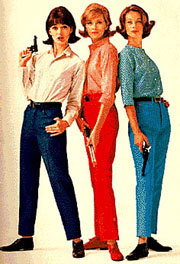
Up until this interview, Isaak kepth his passion for the inimitable Dino relatively under wraps. Unless of course, you count the movie produces upon which he has used his recent Hollywood clout to resuscitate Martin's famed Matt Helm film series from the jaws of syndicated television. For those unaquainted with the Matt Helm character in such '60s camp classics as The Silencers and Murderer's Row, we're talking a vodka and martini-swilling, super-secret agent rarely at a loss for witty one liners, or for that matter, a scantily-clad, disposable blonde. Throw in plenty of explosions and car chases and, well, you get the idea. "Not long ago," he remembers, "I was talking to some studio bigwigs about making the Matt Helm series again. I had this idea...okay, it was a dream, of playing Matt Helm's grandosn and Dean Martin would star as the guy who would teach me how to do the job of -you know, hot to Helm. The people I pitched the idea to litterally looked at me like, 'I have a frightening young man in my office."
So maybe Chris Isaak's gotten the occasional concerned stare from a producer or two, but all things considered, he's fared pretty well in the Hollywood system. From bt parts in Jonathon Demme's Married to the Mob and Silence of the Lambs, to starring roles in David Lynch's Twin Peaks: Fire Walk with Me and Bernardo Bertolucci's Little Buddha, he's one of the few music artists to have successfully crossed over into mainstream film. In fact, he'll soon grace the screen with a small role in Alison Anders' highly anticipated Grace of My Heart, executive produced by Martin Scorsese. But don't go looking for him to quit his night job anytime soon. "I'm not saying I wouldn't act again if the right part came my way," he smiles coyly. "Hey, look, Robert Mitchum was a singer and a movie star and he sang good; Sintra was a singer and a movie star, so why not? The two fileds seem to wrk well together to a certain point. But I think there is a point where it can go to far. The turth is, I think of my career like making hamburgers. You can have a place with a great big neon sign and you can have one in every town, advertisement on TV nationally and everyone can go there and know just what it is. They go and get a burger and it doesn't taste great, but, eh, there it is. And then there's another place you can go, right around the corner, and it's like Pop's Hamburger Stand, and you walk inside and go, 'This hamburger's twenty times as good as the one down the street.' He goes, 'Yeah, well I grow all the tomatoes out back, and my wife cooks all the burgers herself. We got our own sauce we make ourselves fresh everyday.' They ain't gonna be bigger than the chain because they don't have the time you need to make good food and market the product well. I try to take that home-grown, Mom-andPop attitude and apply it to my work. I want to make the best records I can, first. That's the priority, always has been. If I spread myself too thin -try to do too many things -I'll never be able to do that. And I accept the idea that if I choose to do things that way, I may not star in a lot of films or always connect with a multi million seller. But that's okay. If I succeed in making the prettiest songs I can, hey, where I come from, I've done alright."