More Stories on the Loss of the Galiano from Victoria's The Daily Colonist
The Daily Colonist, Victoria B.C.,
Thursday October 31, 1918SEARCH RAGING SEAS FOR MISSING GALIANO
Since She Sent Forth Her Faint Appeal for Aid Early Wednesday Morning No Trace of Canadian Naval Patrol Vessel Received - Many Victorians Aboard.With half a dozen rescue vessels battering their way through the tremendous seas in a heroic effort to reach the spot whence came early yesterday morning the faint and only call for help from the Canadian naval patrol boat Galiano, naval authorities here and the relatives and friends of members of the crew of the distressed vessel are anxiously waiting for word that will tell of the fate of the craft.
A Single Call for Help
Beyond the single wireless message sent out yesterday morning at 3 o'clock, which said "Holds full of water; send help," nothing has since been heard. When the call for help was flashed across the waters a terrific soutwesterly gale was raging. At that time, it is believed, the Galiano would have been about thirty miles off Cape St. James, at the southernmost point of the Queen Charlotte Islands. The spot is one of the most hazardous in times of rough weather of any along the Coast, and while the vessel's seaworthy qualities were high and undoubtedly, unless through accident she were disabled, she could ride the seas, it is feared that perhaps some accident had disabled her and that, helpless in the face of the storm and pounded by the terrific seas she may have foundered.Coming so soon after the tragedy of the Princess Sophia and the awful loss of life when that vessel slid off Vanderbilt Reef in Lynn Canal, report of the peril to the Galiano and possible loss of officers and crew, nearly all of whom are Victorians, greatly shocked people of Victoria yesterday.
Victorians Shocked
All afternoon and evening a constant stream of inquiries for news of the missing steamer was received at The Colonist, but since the call sent forth yesterday from the vessel not a word has been received concerning her fate. Every effort has been made by the naval authorities to secure some news of her whereabouts, but without success.A curious fact is that the wireless message sent out by the Galiano by her wireless operator Michael John Neary, was picked up by his brother, W.C. Neary, operator at the Triangle wireless station.
The Galiano left Triangle Island at 5 p.m. on Tuesday on her way to Ikeda wireless station at the southern end of the Queen Charlotte Islands. She was on her usual round of the stations. There was a fierce south-west gale blowing at the time. By 3 a.m. the Galiano would have been about thirty miles off Cape St. James, according to the calculations of local naval officials.
Several possible reasons have been given to account for the silence of the patrol boat's wireless. Operator Neary was using the powerful set of dynamos in the engine-room. The emergency wireless equipment of storage batteries on deck were probably put out of commission by the waves. The fact that no further messages were received might indicate that her aerials had been carried away and that it was impossible to make repairs in the heavy sea, or that the engine room had become flooded, putting the dynamos out of commission.
Well Equipped
Mariners state that the stretch of water in which the Galiano was is probably the worst piece of water on the Pacific Coast. There is a strong tide there and with the wind on her quarter the Galiano might easily get a wave over her stern that would break into the engine room. With the engines out of commission the boat would probably drift onto the southwestern extremity of Moresby Island. Even if the vessel had foundered she is equipped with a fine lifeboat and a big surfboat and the crew if able to launch these, would be able to live through seas that the Galiano could not according to marine men here.Rescue Vessels Hasten
All vessels within reach were notified to go to the scene whence the S.O.S. was sent out. The U.S. tug Tatoosh is on her way from Swanson Bay, whither she had towed the bark Acapulco, and the G.T.P. tug Lorne is hastening from Prince Rupert. Three steam whalers of the Consolidated Whaling Company have left the Rose Harbor whaling station to search for the stricken vessel. One of these chanced into Ikeda Bay to leave several messages to be sent, as none of these whalers are equipped with wireless. The operator at Ikeda told of the Galiano's distress and gave the whaler a note to the manager at Rose Harbor to which the whaler immediately went. She left soon after for Cape St. James. These whaling steamers are only 90 feet in length while the Galiano is 162.3 feet. These little boats, however, were built to stand ocean weather off the Queen Charlottes and are not daunted by the storms of those waters.Whalers to Rescue
Ever since the distress message was recieved by Triangle, wireless stations have tried to reach the steamer Gray, which was the vessel nearest the scene. Although easily within range, for some reason no reply could be got from the whaling tender, and she entered the Rose Harbor last night to hear for the first time of the occurrence. She left at 8 o'clock last night to join the other searchers.The steamer Alameda of the Alaska Steamship Company started for the Galiano but the last word from her said that heavy seas were being encountered and the chances of her getting to the scene were small. The steamer Humboldt was reported to be headed to the rescue of the Galiano but she reported that she was light and could not make headway against the waves.
The various rescue craft should have last night reached the vicinity where the Galiano was last heard from. They would have to wait until morning before any search could be carried on. The whalers will not be heard from until they reach port as they have no wireless.
The Galiano probably came within range of the great light at Cape St. James which throws an arc twenty-five miles out to sea. The distance from Triangle Island to Cape St. James is ninety-five miles and the Galiano would be making about ten knots with a following sea. It was by taking her time at sea and these figures that her location was approximately established by naval authorities.
A Staunch Craft
The Galiano was built at Dublin, Ireland in 1913 for the Canadian Naval Service to be used as a fisheries patrol vessel. She was 393 tons gross. Her length was 162.3 feet; her beam was 27.1 feet; and her depth 13.1 feet. The patrol vessel can make thirteen knots, but their sailing speed is eleven knots.The Galiano came from the Old Country around Cape Horn to Victoria under her own steam and encountered fierce storms on the way which tried the seafaring qualities of the boat. She stood the test splendidly.
From 1913 until a short time ago the vessel was in the fishery patrol service and then she was used at Esquimalt and as a patrol vessel under the White Ensign.
The Malaspina was scheduled to make the trip but owing to an accident she was unable to sail and the Galiano was sent in her place. Spanish influenza laid up so many of the Galiano's crew that she was forced to borrow some men from the Malaspina and also to take some from the Navy Yard.
Ship's Complement
The complement of the Galiano was as follows: Lieut. R.M. Pope, commander; J. Gilbert, chief officer; F. Greenshields, chief engineer; M.J. Neary, wireless operator; J. Vinnicombe, bosun; P. Watson, P. Edmonds, G. Williamson, A. Reeves, N. McLean, W.J. Bentley, G. Price, F. Whitworth, J. Aird, A. Jewkes, A.O. Jones, W.A. Ebbs, H. McGuffin, R.E. Newton, F.G. Peters, R. McLeod, A.E. Hume, C. Hanbury, H. Musty, G.S. Bate, M. Tabone, A.E.P. Munro, E.C. Poere, T.F. Kaneen, H. Stirrup, W.G. Pheriault, W. Wallace, W.J. Stafford, W.J. King, H. Mercer, J. Young, M. Dobbyn, P. Aitken, A.R. Ordano.
Lieut. Pope, commander of the Galiano, had commanded the Galiano ever since she came to this country in 1913. He was born in England and came to this coast about 15 years ago. He had already served on sailing ships out of Great Britain to India, and was an officer aboard the steamers of the East India Company. He was also an officer in the Cape service from England to Africa. Later he served on a cruiser in the British Navy as a lieutenant. After he arrived here he made several voyages with the Empress of Japan as third officer. He then joined the Quadra and was with her under Capt. J.F. Walbran and Capt. C. Hackett. Lieut. Pope remained ashore some time and then took command of the Galiano.
Frank Greenshields, chief engineer, has been on the Galiano ever since she arrived in Victoria.
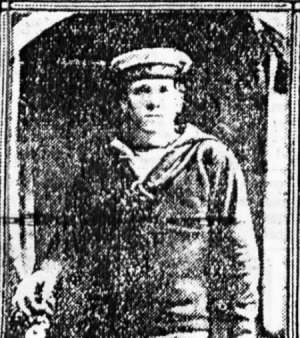
Boatswain of the Canadian Naval Patrol boat Galiano.In Navy When 14
James Vinnicombe, boatswain on the Galiano is a pensioner of the British Navy for over 20 years, having joined the Navy when he was 14 years of age. He has travelled to all parts of the world in war vessels. In 1914 he joined the Fisheries Department here, being first quartermaster on the Galiano and then boatswain. He was born in London 53 years ago and has two brothers there. Mrs. Vinnecombe lives on Cedar Hill Road, Victoria.Michael John Neary, the wireless operator on the Galiano, came to Canada on the Princess Sophia when she was brought out here from the Old country, coming out in capacity of wireless operator on that vessel. He is 33 years of age and a native of Scotland, and for a time was warrant officer in the Navy. He has been in the Government service for a considerable time, and is regarded as a thoroughly skilled wireless operator. His relatives live on Superior Street.
J. Gilbert, an officer on the Rainbow, was taking the place of Chief Officer Ernest O. Alcock, the regular chief officer of the boat, the latter having been taken sick as the boat was about to leave port.
The Galiano took from Triangle Island Miss Emily Brunton, the housekeeper there, who was on her way to Prince Rupert to take passage south from there. Another housekeeper was taken up to replace her.
The reason that the Galiano sailed on this trip instead of waiting until the Malaspina was repaired was that the wireless station at Triangle Island had almost exhausted its gasoline supply used to supply power for the plant and without it the station would be useless.
"A Dangerous Trip"
EDMONTON, Oct. 30 - Roderick McLeod, 16, son of Kenneth A. McLeod, a leading citizen of Edmonton, was a cadet aboard the steamer Galiano. In a recent letter home he wrote that they were leaving on "a dangerous trip" to carry food and supplies to the civilians on Carrington Island.
The Daily Colonist, Victoria B.C.,
November 1, 1918FIND BODY OF GALIANO SAILOR
Corpse of Seaman W.A. Ebbs and Skylight of Engine Room Only Traces of Missing Patrol Boat So Far.
Wilfred A. Ebbs (Able Seaman) The body of a dead sailor and the skylight of the engine room are the only traces of the Canadian Patrol Boat Galiano found by the many vessels which, since she sent out her distress call early Wednesday morning stating that her holds were filling with water and appealing for assistance, have been searching the storm-tossed seas southeast of the Queen Charlotte Islands, in the vicinity of Cape St. James. The body which was picked up by the trawler G.F. Foster has been identified as that of W.A. Ebbs, able seaman, a member of the crew of the Galiano. His home was at Nelson, B.C., where his mother is now residing.
These mute evidences that, in all likelihood, disaster has overtaken the Galiano, were the only signs secured up to last evening of the missing craft. Ebb's body was picked up about 28 miles off Cape St. James.
Body Found
The following wireless message was received from the whaling tender Gray at 3:47 yesterday afternoon: "Whalers went out to positions I gave this morning and met the G.F. Foster, a trawler, which accompanied them and picked up one dead body foul of a life jacket. Soon after picked up engine room skylight which without a doubt is the Galiano's. No more wreckage in sight. Weather thick and dirty."Yesterday evening at 5 o'clock the following message was received from the Ikeda wireless station: "Gray advises clothing on body picked up is marked W.H. Ebbs, a sailor."
The boats which have been searching for the Galiano are the U.S. tug Tatoosh, the G.T.P. tug Lorne, from Prince Rupert; the whaling steamer Gray, three or four whalers, and some trawlers. The Leebro has also stated that she would go to the scene, but it is not yet known whether she has managed to make headway in the storm which Triangle Island reports is still raging, with a lowering barometer.
The whaling boats return to port every night and then go out to renew the search in the morning. As they are not equipped with the wireless they cannot be heard from until they meet a vessel that has equipment or until they make port. They are 90 feet in length and built for working in heavy seas. But owing to the small size of the rescue boats and the height of the seas they would need to get very close to any wreckage before they could see it at all.
Must Have Hit Rocks
Lieut. Newcombe, captain of the patrol ship Malaspina, sister ship of the Galiano, believes that it was hardly possible for the Galiano to founder without striking the rocks. Local navigators have worked it out that the Galiano by the time she sent out distress signals at 3:30 on Wednesday morning would have been upon the rocks that jut out from Cape St. James. The commander of the Malaspina states that the vessel must have struck the rocks at Cape St. James and foundered.Victorians still have hope that the crew of the stricken vessel were able to launch and get away in the fine lifeboats which the Galiano carried. Searching vessels will stay out and scour the sea until survivors have been found or it is evident that none exist.
The steamer Gray was bound from Kyuquot to Rose Harbor near the southern end of the Queen Charlottes and was ahead of the Galiano. As land was just ahead and daylight was still some distance off she turned with her head to the wind, waiting until dawn. Some time later a steamer about the size of the Galiano passed the Gray, her lights being seen. This is thought to have been the Galiano and as there was no sign of distress, no wireless messages were exchanged. This was at 11 o'clock on Tuesday night, and it was only four hours later that the distress signal went out.
Many Opinions
Local mariners have many reasons for believing the Galiano has been lost. One reason stated with considerable conviction was that she found land close ahead and darkness still around and so decided to head into the wind and wait until morning just as the Gray had done. It was in turning that she might have been overwhelmed while broadside to the waves.Another mariner who has piloted a whaler many times off Cape St. James and travelled the stretch of water between Vancouver Island and the Queen Charlottes states that the commander, if he had gone full speed ahead, could have run up under Moresby Island, where he would have been protected from the waves. The great light with its range of 25 miles at Cape St. James would be a sufficient guide.
The skylight from the Galiano's engine room, the only piece of wreckage yet found, was about 15 feet in length and about 10 feet wide. It would not likely be hurled overboard by the waves, but if the ship should founder it would float off.
There is a superstition among mariners that all marine tragedies come in threes. Recent events would appear to give some shadow of reason to such a theory. First came the running of the Adelaide on Mayne Island at Active Pass, then came the foundering of the Sophia in Lynn Canal with a loss of over 300 lives. Is it the Galiano that is to complete the fatal number of three, local mariners of a superstitious turn of mind are asking.
Influenza a Life Saver
There were about eight or ten of the regular crew of the Galiano laid up with Spanish Influenza at home when the ship sailed. This undoubtedly saved their lives.Steward Saborne was ill and considers himself an unusually lucky man. It is the first trip he has missed in the four years he has been with the boat. Chief Officer Alcock was another that was ill on shore and his place was taken by J. Gilbert, of H.M.S. Rainbow.
Others who belonged to the regular crew and who were sick ashore were: Second Engineer Stewart, Chief Cook Davenport, Quartermaster Fiddler, Quartermaster Radford, Fireman Casey and Fireman Thompson. These men were replaced by part of the crew of the Malaspina and also several men from the Navy Yard.
The official list of the officers and crew of the Galiano, with the respective ratings and their next of kin, follows:
Robert M. Pope, lieutenant, next of kin, his wife Mrs. Edith Pope, 745 Newport Avenue, Victoria, B.C.
Frank Greensheilds, chief engineer, next of kin, his brother, Mr. John Greenshields, Townsite, Nanaimo, B.C.
Michael Neary, wireless telegraphist 3rd class, next-of-kin, his mother, Mrs. Honoria Neary, 239 Superior Street, Victoria, B.C.
Joseph Gilbert, 1st officer, next-of-kin, his wife, Mrs. Edith Gilbert, 4349 Knight Street, South Vancouver, B.C.
James Vinnecombe, boatswain, next-of-kin, his wife, Mrs. Mary Vinnecombe, 2422 Cedar Hill Road, Victoria, B.C.
Phillip A. Watson, engineer, next-of-kin, his wife, Mrs. Eileen Watson, 107 Bushby Steet, Victoria B.C.
Peter W. Edmonds, engineer, next-of-kin, his wife, Mrs. Helen Edmonds, 16 Malcolm Street, Dundee Scotland.
George Williamson, petty officer, next-of-kin, his brother, Mr. Henry Williamson, The Firs, Pershore Road, Birmingham, England.
Alfred J. Reeves, cook, next-of-kin, his wife, Mrs. Elizabeth Reeves, 541 Hillside Avenue, Victoria, B.C.
Neil McLean, leading seaman, next-of-kin, his mother, Mrs. Maggie McLean, 14 Lurebort Locks, Stornoway, Scotland.
William J. Bentley, leading seaman, next-of-kin, his mother, Mrs. Ann Bentley, 16 Denton Street, Liverpool, England.
Noel G. Price, leading stoker, next-of-kin, his stepmother, Mrs. M. Thomas, 246 Hibernia Road, Port St. Charles, Montreal.
Frederick Whitworth, leading stoker, next-of-kin, his mother, Mrs. C. Whitworth, Ladner, B.C.
James Aird, able seaman, next-of-kin, his mother, Mrs. Agnes Aird, Howford, by Inverurie, Scotland.
Arthur L. Jewkes, albe seaman, next-of-kin, his mother, Mrs. Sarah Jewkes, 334 Michigan Street, Victoria, B.C.
Allen O. Jones, able seaman, next-of-kin, his mother, Mrs. Ella Jones, 2658 Avebury Street, Victoria, B.C.
Wilfred A. Ebbs, able seaman, next-of-kin, his mother, Mrs. Mary Ebbs, 908 Silica Street, Nelson, B.C.
Hudson J. McCuffin, boy, next-of-kin, his mother, Mrs. Elizabeth McCuffin, 790 Hastings Street East, Vancouver, B.C.
Roy M. Newton, boy, next-of-kin, his mother, Mrs. Kate Newton, 1175 Nootka Street, Vancouver, B.C.
Frederick G. Peters, boy, next-of-kin, his father, Mr. F.W. Peters, 239 18th Avenue W., East Calgary, Alta.
Roderick McLeod, boy, next-of-kin, his mother, Annie McLeod, 9912 103rd Avenue, Edmonton, Alta.
Arthur E. Hume, stoker, next-of-kin, his mother, Mrs. Alice Hume, 2011 Carnarvon Street, New Westminster, B.C.
Charles L. Hanbury, stoker, next-of-kin, mother, Mrs. Maggie Hanbury, Vernon Hotel, Victoria, B.C.
George Henry Musty, stoker, next-of-kin, mother, Mrs. Ellen Musty, Lennoxville, Quebec.
George S. Bate, cook, next-of-kin, mother, Mrs. Edna Bate, 208 9th Street, New Westminster, B.C.
Michael Tabone, petty officer, next-of-kin, Miss Jennie Fennah, 142 New Hall Street, San Francisco, Cal., U.S.A.
Alex. E. Munroe, leading seaman, next-of-kin, his mother, Mrs. Mary Munroe, Nicola, B.C.
Edward C. Poere, leading seaman, next-of-kin, his friend, W. Hardy, Agent, Sailor's Union, Powell Street, Vancouver, B.C.
Thomas F. Kaneen, leading stoker, next-of-kin, his mother, Mrs. Emily Kaneen, 19 Derby Road, Douglas, Isle of Man.
Harold Stirrup, stoker, next-of-kin, his mother, Mrs. Margaret Stirrup, 1540 Lionel Street, Victoria B.C.
William G. Theirault, stoker, next-of-kin, his mother, Mrs. Agnes Butler, Deer Island, N.B.
William Wallace, boy, next-of-kin, his mother, Mrs. Issabelle Wallace, 514 13th Avenue E., Calgary, Alta.
Harold Mercer, engineer, next-of-kin, his mother, Mrs. Bessie Mercer, House 24, Michel, B.C.
John Young, stoker, next-of-kin, his mother, Mrs. Issabella Young, Commercial Street, Nanaimo, B.C.
Matthew Dobbyn, stoker, next-of-kin, his mother, Mrs. Elizabeth Dobbyn, South Wellington P.O. B.C.
Austin R. Ordano, able seaman, next-of-kin, his mother, Mrs. Ann Ordano, 974 Fisgard Street, Victoria, B.C.
Peter Aitken, able seaman, next-of-kin, his mother, Mrs. Elizabeth Gillard, 657 Kennedy Street, Nanaimo, B.C.
William J. Stafford, able seaman, next-of-kin, his brother, Mr. Thomas Stafford, 727 Simpson Street, Evanston, Ill., U.S.A.
William J. King, able seaman, next-of-kin, his wife, Mrs. Stella King, 1433 Grant Street, Victoria, B.C.
The Daily Colonist,
November 2, 1918BELIEVED LOST WITH ALL HANDS
Naval Authorities Entertain No Hope That Patrol Vessel or Any of Crew Survived - Search Being Continued.The Department of Naval Service has officially announced that the auxilliary patrol steamer Galinao was lost, with all hands on Wednesday, October 30th, off Cape St. James in a southwest gale. All search, however, has not been abandoned, the vessels which hastened to the scene when the distress signal was sent out early Wednesday morning being still engaged in scouring the seas in the vicinity of the Cape, while search is also being conducted along the southern shores of the Queen Charlottes. There are many who still believe that the crew of the little vessel managed to get away in the fine lifeboats carried by the Galiano. The searchers have found no further traces of the ship since the discovery on Thursday of the body of W.A. Ebbs, able seaman, and some wreckage in the shape of the engine-room skylight.
Will Join in Search
The Malaspina, sister ship of the Galiano, will be dispatched to join in the search just as soon as she can be made ready for sea. It was to have been her trip but by the irony of fate she rammed the drydock owing to a mistake in the engine room and the Galiano made the voyage, apparently her last. The crew of the Malaspina claim, just as their commander did, that the patrol vessel would not have sunk unless she struck something. They state that she carried four boats.That the skylight found floating off Cape St. James may not have been that of the Galiano is the belief held by some of the dockyard officials who state that as the skylight of the stricken vessel was held by iron stays from the inside it would break in pieces rather than float off as was claimed.
The whaling tender Gray, which reported having sighted the lights of the Galiano on Wednesday night, also reports that gratings were sighted floating in the heavy seas well off shore.
The Naval Department at Ottawa has sent out telegrams to the next-of-kin, notifying them that "the Galiano is feared to have been lost."
Vancouver Men on Board
VANCOUVER, Nov. 1 -- Among those in the crew list of the Galiano is J. Gilbert, officer in command under Lieut. Pope. The second officer was a resident of South Vancouver, where Mrs. Gilbert and four children, all under 14 years of age, await word of the vessel and hope against hope that on the life raft or one of the boats the husband and father may have been able to get clear away, and will be picked up later.Officer Gilbert was a member of the Rainbow crew prior to going on the lighthouse tender last Spring, and was well known in South Vancouver, where he came home for a short visit prior to leaving on the fateful trip on Tuesday last.
Mr. William Newton, of 1175 Nootka Street, received a letter from his son on the Maquinna stating that his brother Roy had sailed on the Galiano on Tuesday, so that the parents are now certain that their son was aboard the boat.
T.F. Kaneen, who was a stoker on the Galiano, was a brother of Constable Kaneen, of the city police force, and a brother-in-law of Frank Corrin, of the engineering staff at the City Hall.
The Daily Colonist,
Nov. 3, 1918TWO MORE BODIES OF GALIANO CREW FOUND
Corpses of Able Seaman Aird and Stoker Hume Secured East of Danger RocksWith four days passed since the distress signal was picked up from the Galiano on the morning of the 30th, the only trace of the little patrol vessel yet found by searching craft are three bodies, a skylight supposed to be the Galiano's, and a lifebelt. The body of Seaman Ebbs was located on Thursday, and on Friday two more bodies were found by the whaler Brown, these being identified as Able Seaman James Aird and Stoker Arthur E. Hume. The last two bodies were found about fifteen miles east of Danger Rocks on the east side of the Queen Charlotte Islands. The body of Ebbs was found twenty-eight miles well to the south of Cape St. James.
Mariners state that the tide would carry the bodies to the eastward of the Islands.
The men of the Galiano died in the performance of duty. They have ventured into rough places and taken their chance many a time before. They did it without a flourish of trumpets. This time they took a chance and lost.
Lieut. R.M. Pope, R.N.R.
Leiut. Robert M. Pope, commander of the Galiano, was a disciplinarian. He had captained the Galiano ever since she came out from the Old Country in 1913. Born in England, Lieut. Pope served on sailing vessels out of Great Britain to India and also was an officer aboard the steamers of the East India Company. For some time he was on steamers running to South Africa, and later became lieutentant on a British cruiser. Arriving on this coast about 15 years ago he made several voyages with the Empress of Japan as third officer. He then joined the Quadra and, was with her under Capt. J.F. Walbran and Capt. C. Hackett. Lieut. Pope remained ashore for some time and when the Galiano came out from Ireland he took command of her. Mrs. Pope, wife of Lieut. Pope, resides at 745 Newport Avenue.Came from Rainbow
First Officer J. Gilbert was formerly on the Rainbow but owing to the illness of Mr. Frank Alcock, regular first officer of the Galiano, he made the trip. The first officer was a resident of South Vancouver where Mrs. Gilbert, and four children under fourteen years of age, are now residing.Frank Greenshields, chief engineer of the Galiano, has been on a great many of the boats operating on the Coast. He was formerly with the fisheries patrol boat Falcon. He has a brother, John, who is chief engineer on the C.P.R. steamer Charmer.
James Vinnecombe
In the Navy ever since he was 14 years of age and a pensioner for over 20 years, Mr. James Vinnecombe joined the Galiano in 1914 as quartermaster and later became boatswain. He had travelled to all parts of the world in warships. Born in London Mr. Vinnecombe was 53 years of age. He has two brothers in the Old Country, and his wife resides on Cedar Hill Road. The bosun was a good singer and was prominent in minstrel troupes formed on the vessels on which he served.Michael J. Neary
By a curious freak of fate Michael John Neary, wireless operator of the Galiano, had his distress signal picked up by his brother, operator at the Triangle Island station. It was Michael that came out with the Sophia from the Old Country. He was 33 years of age and a native of Scotland. For some time he was a warrant officer in the British Navy. He has been in the Government service for some time and was a thoroughly skilled operator. Mrs. Neary, mother of the wireless operator, lives at 239 Superior Street.
James Aird
"We are running into very stormy weather since leaving Vancouver. I don't think we will be home until the end of November. The C.P.R. boat Sophia got into difficulties in a storm. I dread the Triangle. I am not worrying for myself, but I hate taking chances with a green crew, but it's all in the day's work who go down to the sea in ships." So wrote James Aird, able seaman, from Alert Bay just a day or so before the Galiano started across what mariners call the worst piece of water on the Pacific Coast. The letter was written to Mrs. Ranns, mother of the Sailors' Club at Esquimalt, for it was there that Aird stayed when ashore, because he had no relatives here. Mrs. Ranns tells how well they knew the young man by saying that he was one of the few she "took into her kitchen, so to speak."Before Aird went away on his last trip he was sick, but he would not stay ashore, because he said that as so many of the boys were laid up with "flu" it might be thought that he was shirking. They needed him. And so he went to his ship wearing several plasters, the work of "Mother" Ranns." who had been doctoring him. From Vancouver he sent her a book with a message scribbled on the lid of the box enclosing it, the title being "Old Friends Like You."
James Aird came from Calgary. His mother lives in Scotland. In a recent letter from her she told of a brother being killed in action. The last letter told of another brother being wounded in France.
Other men of the Galiano's crew also seemed to have a premonition of trouble to come.
James Reeves
When Mr. James Reeves, cook on the Galiano, left his wife to join the ship for her last trip he said: "This is going to be an awful trip; but don't worry. We'll all come home." This was not the first wreck Mr. Reeves had been in. He was cook on the grain steamer Wexford, an old whale-back, operating out of Fort William, when a terrific storm caught her in 1910 and opened her seams, causing her to founder. The cook and one other man were the only survivors, Mr. Reeves being washed ashore tied to a raft by his belt. For two years he was steward on the Empress of Ireland. Mr. Reeves entered the naval service in June of 1915, joining the Niobe at Halifax. He was on her for five months, as long as she was in commission, and then he came to Victoria and joined the Rainbow. He stayed with her until she also went out of commission, about five months ago. He was in barracks for some time, finally joining the Galiano. Mr. Reeves was 30 years of age and was born in the United States. His wife lives on Hampshire Road.Roderick McLeod
Roderick McLeod, boy, sixteen-year-old son of a prominant citizen of Edmonton. Mr. Kenneth A. McLeod, wrote home recently, saying that he was leaving "on a dangerous trip." He was captain's boy.
William J. King
William J. King, able seaman, commonly known as "Jimmy", was a popular young Victorian. He was born her twenty-six years ago and has lived in Victoria all his life. He received his education at the St. Louis College and after leaving school learned the bicycle trade in the employ of Mr. Thomas Plimley. He then entered the printing trade and for some years was with the Dominion Carton & Printing Co. and The colonist. He entered the Navy about ten months ago, being previously employed as book-keeper at the C.P.R. Telegraph Co's offices.Working in the Armory at the Navy Yard, Mr. King was chosen to replace a member of the Galiano's crew incapacitated with "flu". The longest journey he had ever made on the water was as a passenger to Vancouver and Seattle. Before leaving on the trip his relatives teased him about getting seasick. He resided at 1433 Grant Street. Mrs. King was Miss Bayntun before she was married, daughter of Mr. And Mrs. E.J. Bayntun of this city. Mr. King leaves his father and mother, Mr. And Mrs. James King, and two sisters, Mary and Margaret, all of whom live at 1909 Fernwood Road.
Harrold Stirrup
Stoker Harold Stirrup, whose body was found on Friday, was born at Haydock, Lancashire, 18 years ago. He entered the army as bugler in the 143rd Battalion and transferred to the 21st C.A.S.C. as trumpeter. After two years' service he transferred to the Navy, going first on the Rainbow then on the Malaspina. He was transferred later to the Galiano. His father, mother, two sisters and one brother reside at 1293 Centre Road. He worked at Yarrow's Ltd. as heater-boy, before joining up.Charles Hanbury
Charles L. Hanbury, a member of the crew of the Galiano, is the son of Mr. And Mrs. Hanbury of the Vernon Hotel. He joined the Navy shortly after leaving school in Juanuary, 1917, and has since served on the Rainbow and the Galiano. Mr. Hanbury, the father, went overseas in July, 1917, with a draft of the Inland Water Transport of the Imperial Forces and is at present in the Old Country where he was sent after contracting illness while on service in France.William J. Bentley
William J. Bentley, quartermaster on the Galiano, was well known at the Sailors' Club. He was about 25 years of age and joined the service with a number of others on Dec. 15, 1917. He was born in the Old Country, his mother living at Liverpool.George S. Bate
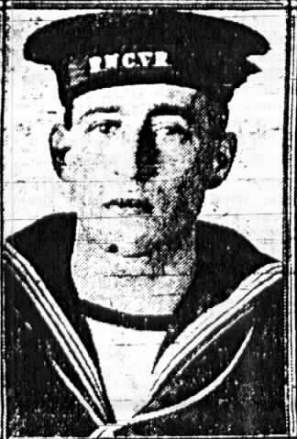
George S. Bate, cook on the Galiano, was about 21 years of age and played in the R.N.C.V.R. orchestra.Matthew Dobbyn
Matthew Dobbyn, stoker, was with the Galiano when she was in the fisheries service, and when she went into commission he left to work in the up-Island mines. He was conscripted into the army and then transferred to the navy. His mother lives in South Wellington.Peter W. Edmonds
Peter W. Edmonds, engineer, had been with the boat about four years. He was a Scotsman about 50 years of age. A plumber by trade, he came out to this country and not being able to get work he joined the navy. His wife is residing in Scotland.Wilfred A. Ebbs
Wilfred A. Ebbs, able seaman, lived here with Mrs. Case, of Superior Street. He had been with the Galiano just a year last Friday. Previous to that he was clerk in the Nelson City Hall, and a member of the Elks' Lodge in that city. Mr. Ebbs was born 29 years ago in Ontario. His father, mother, and sister live at Nelson. The body of Seaman Ebbs was found off Cape St. James, the first to be discovered.Arthur E. Humes
The body of Arthur E. Humes, stoker, was picked up on Friday. His mother lives in New Westmnister.Arthur Jewkes
Arthur Jewkes, able seaman, had been serving on the Galiano for 18 months. He was formerly second steward on the Princess Alice. He was born in England about 22 years ago. His parents reside on Michigan Street. One brother is employed on the Princess Charlotte and the other by Ormond's Ltd. Mrs. Harry Clark and Mrs. Fred Winterburn are sisters, and a small sister lives at home. The family came to this country about eight years ago.T.K. Kaneen
T.K. Kaneen, stoker, was a brother of Constable Kaneen, of the Vancouver police force, and a brother-in-law of Mr. Frank Corrin, of the Vancouver engineer's staff at the City Hall. His mother resides on the Isle of man.Alex E. Munroe
Alex. E. Munroe, quartermaster, had been with the Galiano about four years until she was taken over by the Naval Service when he went into the dockyard and was later on the Malaspina. Owing to a shortage in the Galiano's crew on account of influenza he was pressed into service on the boat. His mother lives at Nicola, B.C.A.O. Jones
A. O. Jones, able seaman, was born in Vancouver 28 years ago. Prior to joining the Navy in January he was oiler on the Princess Sophia, his brother working on the same vessel. He is son of Mr. T. M. Jones of Avebury Street.Austin R. Ordano
Austin R. Ordano, able seaman, went to sea at the age of 17, being employed on the tug Berquist and also with the Victoria Tug Company. He worked on the Tugs Respond and Edna Grace, for Capt. W.E. Gardner, on the tug Lorne, on the tug DesBrisay for the Genoa Bay Lumber Company, reaching the position of mate. He was mate on the Edna Grace and received favorable recommendation for the position of skipper. Feeling that as his three brothers and many friends had joined the colors he should do the same he joined the Navy as able seaman on May 22 at Esquimalt. Mr. Ordano served on the Rainbow for a time then was on the Galiano about two months. He was 20 years of age and lived at Cowichan Bay during his boyhood days. Mr. Ordano was the son of the late C.B. Ordano, a merchant of Cowichan Bay. He leaves his mother, six sisters and five brothers. One of the brothers, Mitchell Ordano, who is overseas, has been reported wounded and is now in the Canadian Hospital in England; Sapper Frank Ordano, R.E., is serving in Italy as chief engineer on a transport, and A.D. Ordano is with the Royal Flying Corps. His two younger brothers reside with his mother and sisters at 974 Fisguard Street.George Musty was a stoker on the Galiano. His mother resides at Lennoxville, Quebec.
Neil McLean was quartermaster on the Galiano. His mother lives in Scotland.
Hudson McCuffin was a boy on the boat. His mother resides in Vancouver.
Roy Newton, another boy, was aboard the Galiano. His parents reside in Vancouver. His brother is on the Malaspino.
Noel G. Price was leading stoker on the Galiano. His stepmother lives in Montreal.
Edward C. Poere, quartermaster, was on the Malaspina, but owing to the influenza epidemic hw was taken over to the Galiano.
Frederick G. Peters was a boy on the Galiano. His father resides in Calgary.
William J. Stafford was able seaman with a brother living in Evanston, Illinois.
Michael Tabone was a petty officer, and his next-of-kin is Miss Jennie Fennah, San Francisco. He was a member of the Malaspina crew, but filled a gap in the Galiano crew.
William G. Thierault was stoker, and his mother resides on Deer Island, New Brunswick. This was his first trip on the Galiano.
George Williamson, petty officer, had been on the Galiano about a year. Previous to that he was steward on the Atlantic boats. His brother lives in Birmingham, England.
Phillip A. Watson was engineer, and his wife lives at 230 Irving Road, Victoria.
Frederick Whitworth was leading stoker, and his mother lives in Ladner, B.C.
William Wallace, boy on the Galiano, has been here for many years and went to school here. His mother lives in Calgary. He was formerly with the Malaspina.
John Young, stoker, was with the Niobe for some years. His mother lives in Nanaimo.
Harold Mercer was an engineer. His mother lives in Michel, B.C.
Peter Aitken, able seaman, was with the Rainbow, but was transferred to fill a gap in the Galiano crew.
The Daily Colonist,
November 5, 1918NANAIMO YOUTH IS LOST ON GALIANO
NANAIMO, Nov. 4 -- Mrs. E. Gillard, of Kennedy Street, received word from Ottawa regarding her son, Able Seaman Peter Aitken, who was on board the Galiano at the time of the disaster. The following is the communication: "Sincerely regret to inform you that the patrol vessel in which your son, Peter Aitken, A.B., was serving, is feared to have been lost with all hands October 30. Any further information received will be telegraphed to you but trust that you will accept the heartfelt sympathy of myself and the department of naval service. C.C. Ballantyne, Minister of Marine."A.S. Aitken was born in Nanaimo twenty-nine years ago and had lived here practically all his life. He leaves to mourn his loss his parents, Mr. And Mrs. Robert Gillard, one sister, Mrs. Thomas McMillan, and five brothers, Thomas and John, of this city; James of Drumheller, Alta,; David, who is now serving in France, and Robert, who is living in the United States.
The Daily Colonist,
November 7, 1918CAPTAIN TELLS OF SEARCH FOR GALIANO
Trawler C.E. Foster Reaches Prince Rupert With Body of Ebbs - Captain Believes Galiano Was Swamped.When the steam trawler G.E. Foster arrived at Prince Rupert after searching for the lost patrol ship Galiano and finding the body of Seaman Ebbs the captain of the vessel said:
"There seems to be no doubt to me but that the vessel has foundered in the heavy seas. The whole of the Hecate Straights is just one mass of white foam, and it is blowing a living gale, with a tremendous sea running. It is possible that one of these unlucky seas was shipped by the Galiano and with that weight of water rolling around inside her, her bulkheads would soon give way, causing her to roll the more and ship other seas."
"The man we picked up had on a lifebelt, which had evidently been fastened in a hurry, as it was not done correctly, and his clothes bore the appearance ofhaving been hurriedly put on, as if he had just tumbled out of his bunk before rushing on deck. There is every probability that as the ship filled, the air in her cabins blew off the skylight, which we picked up."
Hanging on to the skylight picked up was the ditty bag belonging to George Henry Musty, stoker, containing a few articles of clothing.
Do you have any information on the Galiano or her crew? If so, please contact me.