(c)2000-2009, Roberto Pedreira. All rights reserved.
Jiu-Jitsu Training in Rio
August-September
2008
Alpha Release 1.1, February 10, 2009
By Roberto Pedreira
**
Contents
|
As usual, I went directly from the Tom Jobim International airport to Corpo Quatro, stopping only to drop off my bag at the room I had prearranged conveniently close to the academy. Because it was Thursday I didn't expect to see Bolão and so I wasn't surprised when I didn't. I was surprised--and dismayed--when I learned that Bolão was no longer teaching group classes. To be sure I hadn't misunderstood, I asked around. Ricardo Vieira and Felipe Costa both confirmed it. Bolão only taught privately now. In a way, that was good. Cazuza would teach group classes, and Bolão would teach me personally. Obviously, individualized instruction costs more, but after the expenses of flying from Japan and staying in Rio for another six weeks, it didn't seem like much. Since Bolão is my sole teacher, I try to learn enough during my 6-12 weeks in Rio a year, to work on the rest of the year in Japan with my own students. In this way, supplemented with an occasional DVD, I have been able to progress steadily (but slowly, very slowly). Group classes in Rio are not like group classes in most places. Because in the group will usually be many highly experienced, but unknown out of Brazil, black belts, and they will usually be happy to teach you whatever you want to know. If it is obvious that you love jiu-jitsu and want to learn, you will generally find no shortage of people to learn from. So it was, but with a difference. Without Bolão a lot of his students had gone on hiatus. According to Bolão's brown belt student Ricardozinho, they were waiting for Bolão to open his new academy, which he said he planned to do, someday. But for now he needed to make money and teaching group classes wasn't the way to do it. This is life. The downside was that there were fewer black belts in Cazuza's classes. As Bolão himself said, there are too many academies in Rio now. But there was Cazuza, a walking encyclopedia of jiu-jitsu (which however is like saying there are guitar players in Texas). There was Big Leo, recently promoted to black belt since last year. There was Little Diangelo, also a new black belt, and a professional shooto fighter. And there was Ignacio Aragon. Ignacio's black belt was almost white. He had been doing this a long time. He was in fact one of the first vale tudo fighters, famous locally at least for his contest against Bruce Lee. This Bruce Lee was not the star of The Green Hornet, The Big Boss, The Chinese Connection, Enter the Dragon, Return of the Dragon, and The Game of Death. He was just a fan of the movie star/JKD founder Bruce Lee and adopted the name in honor of his hero. Possibly had it been the real Bruce Lee the outcome might have been different. But even more probably it would have been the same: tackle, mount, choke. There is a reason for keeping things simple (or no more complicated then necessary.) Most academies don't have classes on Saturday. But Fightzone, the home base of Ricardo Vieira, has Saturday morning open mat. Fightzone is only a few steps from my room so I stopped in. The mat was covered with athletes, with and without kimonos, young kids, really old men (an American from New York), and a few comely lasses--with brown belts, who obviously took their training very seriously. Free training day, you don't have to spend 20-30 minutes doing laps, jumping jacks, and burpees in the guise of "warming up." This is attractive to the older guys with less time and energy to spare, who prefer to get their aerobic work-out rolling rather than running around. Older guys, on average, have more experience, and so there are usually more brown and black belts on such days. There are also more guys laying around talking but that is undoubtedly because they train more efficiently and have time left over for catching up with old friends. It's Saturday morning after all. Most normal people are at the beach or in bed. Jiu-jitsu people are different.
Daniel from Malmo, Sweden was still there with his purple belt and impressive guard. No one could pass it, including Ricardo, and he didn't look like he wasn't trying (but who really knows?). Of course, there's more to jiu-jitsu than a great guard, and maybe Daniel is lacking in other departments, as he suggested himself, when he said "I have to perform better"...after all he failed to reign supreme in the previous Mundial, taking home only third place bronze (irony intended). Maybe he was disappointed, but according to psychologists, 1 he was probably happier with the bronze than he would have been with silver (Olympic bronze medalists (judokas, at least) are happier than silver medalists--and gold medalists are happier than either). Ricardo, as much as his famous brother, is a guard fenom. When I first met him in 1998, he was a purple belt and his guard was good, but not extraordinary. A year later, he had found his rhythm. People (at his belt level at least) didn't pass his guard, and got very tired and frustrated trying.. By 2006 Ricardo was a multiple times black belt world champion, noted for his amazing guard skills. In the past I had, just for reference, asked professors what they charged for privates. One-hundred reais per hour seemed about average. Apart from Bolão however, I didn't do privates. Unless you have a special problem that a particular professor can help you with, and your are only in Rio for a couple days, there isn't much point (although for some people the point is to be able to say they "trained" with the famous professor.) However, I was tempted in Ricardo's case. I was pretty confident about my guard passing. I thought, who would be better to test my skills on than Ricardo Vieira? I inquired about his rates. One-hundred and fifty reais per hour was his answer. For that, he would give you a complete check up, confirming that your guard was in tune and in good working order, diagnosing for holes and gaps. If you are a comparative beginner, this wouldn't be tremendously useful. Any professor, in fact, any blue or purple belt, could provide this service. If you are at a more graduated level, say high purple or brown, it might be worth while. However, time is limited and politics is an unpredictable factor. I decided to forego the opportunity for the time being. Maybe next time. GTR readers sometimes ask where is the best place to train in Rio? Our answer is always that there isn't a best place because everyplace is best. Every academy that we have trained at or visited have lots of people to roll with and lots of very experienced and generous teachers. But academies may be a little more "best" than others. Fightzone would have to be near the top of the list. Below are some pictures. It is said that even monkeys have submachine guns (submetralhadoras) in Rio. The homicide rate (about 26 per 100,000) is well above the world average (about 8 per 100,000), but far from the highest in the world. Iraq seems to be the place most to stay away from, at least since the indigenous personnel failed to be shocked and awed enough by American bombers to voluntarily become democratic capitalistic friends of the United States. Rio's homicide rate (about 36 per 100,000) is above the national average. But averages don't mean much without some measure of variance. Ghettoes and favelas are likely to be more dangerous than gated, guarded, well-patrolled upscale communities. Rio is a little unique in that these communities and the favelas are often right next to each other. Pavão-Pavãozinho is right next to, and in fact, directly above, Copacabana and the Arpoador area that connects to Ipanema. Look up and there it is. A lot of the service people you will have contact with live there and several jiu-jitsu instructors too. Some nights you can hear local kids setting off fire-crackers. Only it isn't firecrackers and they aren't kids. They are policias militares and they are exchanging fire with drug gangs. In other favelas the gunfire can come from milicias executing suspected gang members, competitors for "protection" services, and miscellaneous people who are in the wrong place at the wrong time. Significantly, a fair number people are hit by balas perdidas (stray bullets), and citizens report that their greatest fears are being caught in a cross-fire or mistaken for a gang member. They are worried more about the police than about the criminals.2 Sergio Malibu Jardim, or maybe it was Romero Jacare Cavalcanti, (or both) told me in 1997 that the BJJ black belt generally should take about seven years to earn. They neglected to mention that like them, you should be training in Rio with great instructors and lots of talented and helpful teammates and opponents, and competitions every weekend, for that to be true. By 1997 I had been training BJJ for three or four years. By the time of the 2008 GTR update, that had become 14 or 15 years. But my belt wasn't black. Why was that, I thought? Maybe I had spent too much time visiting academies and interviewing professors. Maybe what I should have done is just forget everything else and focus on my own training. I didn't want to be a brown belt for the rest of my life so that's what I decided to do. Accordingly, I tried not to visit any academy or interview anyone, and the GTR 2008 update is going to be narrow and retrospective. Nevertheless when you are training personally every day with Bolão you can't avoid learning a lot about every aspect of BJJ. But there are some things that no Brazilian can teach you. Because they don't know either. One question that originally motivated me to go to Brazil and nose around, was simply, "how did this superlatively awesome art remain secret for so long?" No Brazilian knew. There weren't trying to keep it secret. They were just doing what they did. But no one outside of Brazil (or basically the South Zone of Rio) cared (until Rorion came along and revolutionized the martial arts world). The answer came to me in the form of a different question. Why did so many people think for so long that things like TKD, ninjitsu, kenpo and all the rest were state of the art and that old school boxing, wrestling, judo, and muay Thai were irrelevant "sports." The answer can only be Hollywood. Hollywood is in the business of selling fantasies, and no fantasy is as attractive to the type of individuals, often adolescent boys, who were and are drawn to Asian martial arts than that of being a fear-no-man, ass-kicking machine, by learning some "secrets" from a stereotypical broken-English speaking ("if do right, no can defense") elderly Asian man. After Rorion and his brothers and cousins demonstrated how misguided this wishful thinking was, people gradually began to reinvestigate the other combat sports. Today there are plenty of people still fantasizing about secret techniques and sources of power (reality is too boring for them), but there are also people who understand that what really works is the same as what has always worked and that guys in Mexico, Thailand, and American high school gyms, not to mention Rio, have been doing it all along. For some people, seven years is too long, let alone 10 or 15 years. They wanna black belt fast, mistaking the finger pointing at the moon for the moon itself, as Bruce Lee explained in Enter the Dragon. Smart guy that he is, Rorion anticipated this problem. You cannot register the phrase "Brazilian Jiu-jitsu" as an exclusive trademark. Anyone can buy a tape and say they train BJJ. You also cannot exercise control over peoples' fashion statements. If someone wants to purchase a black belt and wear it, that is their right in a free-market economy. Rorion registered "Gracie Jiu-Jitsu" for his exclusive use in the United States of America. Some of his family didn't like that, but in fact, they never called what they taught in Brazil "Gracie Jiu-Jitsu." Rorion made that name a valuable asset, first in North America and subsequently globally, through his personal energetic entrepreneurial endeavors. Some people may fraudulently claim to have Gracie Jiu-Jitsu black belts, but thanks to Rorion's foresight and the miracle of the WWW, they are quickly exposed. More problematic are people who claim to have Brazilian Jiu-Jitsu black belts. The phrase "Brazilian Jiu-Jitsu" as a brand name is not anyone's exclusive property. Anyone can claim that they have trained Brazilian Jiu-Jitsu. They may in fact have had some basic training, since BJJ is now being taught in many locations (thanks to Rorion, who did for Brazilians basically what Brian Epstein did for English pop groups, via his mop top clients, John, Paul, George and Ringo, in the 1960's---creating phenomenal demand for a product where there had previously been zero3). Anyone can also claim to have a black belt. Rather than skill, it requires audacity and some luck--hopefully no one will ask WHO gave it to you, which is what gives the belt its meaning. Someone who acquired a one or two year black belt in traditional Japanese ju-jutsu in Brazil could, with obvious intent to deceive, claim to have a black belt in Brazilian jiu-jitsu. There is no end to the ways people will try to justify their bogus claims to have a BJJ black belt and as each turns out to be a dead end, new scams are being schemed up. The easiest is simply making up your own "style" and promoting yourself (or promoting a friend and then having him promote you). As far as I know, this is not illegal, and therefore it must be expected that, as long as gullible students have money to spend on lessons, people will do it. In a way, Rorion is responsible for this too. He made BJJ black belts valuable, ironically, much more valuable outside of Brazil than they ever were in Brazil. And the world has no shortage of people who want valuable things without working for them. The problem of fake black belts was not a topic that came up much between 1997 and 2008. Most Brazilians, unlike some Americans and Koreans, don't live in a narcissistic fantasy world where everyone has high self-esteem and everyone believes that they are above average. For some people (insecure males, perhaps?), being a "martial arts instructor"with a "black belt" is the ultimate in social status and if they have to make up their own "style," form their own "organization," and "promote" themselves, that's what they are going to do. Sylvio Behring explained the attitude of Brazilians (Cariocas at least) to people like this. Basically, Sylvio said, just let him do it. Without having gotten his belt legitimately, and being connected to a network of personal relationships, he won't be allowed to participate in the championships, and without gold medals he won't get any students. So who cares if he wants to call himself a black belt. He can call himself the President of Brazil too if he wants to. That isn't going to change reality. What is a "black belt"? A black belt, according to Bolão, is someone who has a "game" and has enough experience to execute it under a wide range of challenges, that is, against a considerable variety of opponents all with their own games. How do you get that experience? By training with jiu-jitsu practitioners of all belt colors, over a period of years, sometimes seven (for highly motivated athletes with access to the best instruction and training conditions), but often 10 or 12 or more years. Then, what is a "game"? A game does not mean you know every possible variation (no one does), or that you can submit everyone every time (no one can), or that you have a wall full of trophies and medals (only a few guys do). What it does mean is that you know the fundamentals of jiu-jitsu in a very intimate, personal way. A game contains sub-games. You need a top game, a bottom game, and a standing game. What you do from top or bottom or stand-up is up to you, but you should have viable options from wherever you are. If your game is top-heavy (like Wallid, for example) and you don't want to play from bottom, then your game necessarily must include take-downs, or at least some way to take the contest to the ground with yourself on top. That usually means you'd better practice judo or wrestling too (Wallid trained judo with George Mehdi). Otherwise, you won't be able to apply for your top game, and your lack of a bottom game would be a problematic deficiency. If however, you have a strong bottom game, then taking the opponent down with yourself on top is less essential. A Brazilian jiu-jitsu belt is like a college degree. College degrees vary in value. So do belts. A degree from Harvard represents something because Harvard is selective about who it accepts. Jiu-jitsu professors are less picky about who they teach--they will teach anyone who is motivated to learn and doesn't have obvious mental problems--but they are choosy about who they award belts to. Their students are the measure of their productivity. That is why BJJ belts mean something. The meaning of the belt is that the person who awarded it attests to your ability, based on his capacity to judge, which derives from his experience and training with his teacher, and so on down the line. The name of the professor who awarded the belt is more important than the color of the belt. A black belt represents a finished product. All of the pieces are in place, the fundamentals are dialed in. It is like a Ph.D. in that sense. Some who has earned a Ph.D. from an accredited university has a general overview of his field in general (such as psychology), a much more thorough knowledge of a narrower sub-field (such as social psychology), and a near perfect comprehension of the specific topic that he is investigating, and has made a "significant" contribution to knowledge within that topic area. In practice, most such "significant" contributions are trivial but the point is that the new Ph.D. is now qualified to begin contributing to the field. A new BJJ black belt is now ready to begin perfecting his (or her) art and contributing to its continuing evolution. It sounds easy. But how easy something sounds is no indication of how easy it really is. When the beat poet Alan Ginsberg was asked how to play bebop music like Charlie Parker, he said, "just pick up a horn and blow." As anyone who has actually tried it knows, it isn't that simple. Charlie Parker himself went through the white, blue, purple, and brown belt stages of jazz and devoted many years to strenuous study and practice and doing the musical equivalent of sparring, namely, jamming, before he (and Dizzy Gillespie) revolutionized jazz music as much as Rorion revolutionized commercial martial arts. From the beginning, Brazilians have been skeptical about belts. Black belts did not help their taekwondo, karate, and kung fu opponents to avoid getting tackled and choked out. Originally, Carlos and Hélio's jiu-jitsu program on the 17th floor of 151 Rio Branco, had three belts (white, and two shades of blue, described in Corpo Quatro), simply to distinguish the students from the teachers and to distinguish jiu-jitsu from judo. All of the different colors and strips we now see probably seemed unnecessary for adults whose only objective was to overcome the self-doubts that stem from fears of getting sand kicked in their face on the beach by a bully. But to motivate juveniles and to retain paying customers whose goals are more diffuse, you need belts and strips, and other tokens of achievement. But the belts are just tokens. The finger is not the moon. If you walked into a BJJ academy in Rio wearing a black belt that you gave yourself, no one would care. After choking you out a few times, they would actually probably feel sorry for you, someone who can't tell the difference between his finger and the moon, and would regard you in the same way that most normal people would regard a toothless, bedraggled schizophrenic homeless person who is loudly proclaiming himself to be Jesus Christ or Elvis while pushing a shopping cart.
"It's all just the blues anyway." --Grant Green The father of power analysis and foremost proponent of reporting effect size measures rather than obsequiously relying on null hypothesis testing for statistical significance, Jacob Cohen, wrote an article in 19904 summarizing what he had learned (so far) in his long and productive career in social sciences research. The most important thing he had learned, he wrote, was that "simpler is better." Keeping it simple is operative in music too. Jazz guitarist Joe Pass knew 2,000 thousand songs. How do you memorize 2,000 songs? By "learning them in the simplest possible way," Joe advised. That is, you learn the structure of the melody and the chord roots. The rest you improvise. Heinrich Schenker took it a step further. According to Schenker, 5there are really only three songs (or more accurately, melodies). Everything else is variation and context. What is true in the social sciences and music is also true in jiu-jitsu. Keeping it simple is Bolão's philosophy. Ironically, Bolão's student Cazuza seems to go to the opposite extreme. But that may be because he wants to know and be able to teach every possible variation. Bolão's view is that by the time you get to brown belt, you will know the fundamentals inside and out, you understand what is going on at an abstract level such that what is key to the technique and what is a detail that can be freely modified is intuitively obvious. Jiu-jitsu is a very personal thing in Bolão's way of thinking. The professor's job is to create an environment, provide a good example, and offer meaningfully relevant feedback. The student (brown belt) should begin adapting techniques and innovating his own positions. Which is exactly what people are doing every day on the mats of Rio. That's where the new DVDs are coming from. (They also borrow freely from whatever art works, or can be modified to work.) Bolão cites Wallid Ismael as a good example of someone who has been very successful with a minimal bag of tricks. "Wallid" is an Arabic word for "boy" but his teammates referred to him as "The Mechanic." He had just six moves. Renzo once said, "you can count on the fingers of one hand how many times this guy has lost (in jiu-jitsu fights)". Actually, you could do it with two fingers.. He lost to Roleta and Gordo (and almost lost to Gucão, if the spelling is correct--Bolão wasn't sure). The key is to use what you have well. It is better to have a few very useful, very versatile moves that you can do well, then a lot of very specific, very narrow techniques that you can't do well. Naturally, if you are competing, you want to win and your best bet is to specialize in a few multi-purpose, high percentage moves. If you are no longer competing but rather teaching, then you need to be able to teach moves that you don't personally do. Bolão insisted that I keep a record on each lesson and write down the techniques that he would teach each day, and then quiz me on them before beginning the next lesson. He was skeptical that I could reconstruct the techniques from my sketchy scrawled notes. But I could, because I learn jiu-jitsu techniques the way Joe Pass learned songs--in the simplest way possible. That makes them easier to learn, harder to forget. You can more easily see the commonalities between superficially different moves. (The commonalities are usually where you push and pull, the differences are usually what you push and pull with.) When you know something implicitly, you tend not to forget it. Unlike some martial arts, which are frozen in time, jiu-jitsu is constantly evolving, and even 7-grau black belts keep an open mind to new (new to them) moves. Bolão devoted one lesson to take downs, all familiar (baiana, osoto, double-leg, fireman's, etc.,) but some with unique details. "This is how Marcelo Behring liked to do it", he would say, and then, "and this is how I like to do it" and so on, five or six variations, each favored by a different legend. The take-away from that lesson is that there are right and wrong ways to do things, but usually more than one. You have to experiment to find them. One move was a lateral drop from a Greco tie up. "Yeah", Bolao explained, "I learned it from one of my students in Pennsylvania." Teachers can learn from students too. You pretty much have to, if you want to keep developing. Brazilians respect their teachers, but they don't venerate them as all-knowing, and all-powerful. Since the teacher doesn't know everything, the students have to take a lot of responsibility for their own learning. This is one reason BJJ has developed to such a high level--there are a lot of people actively working hard, not just to master a fixed curriculum, but to continually make it better, absorbing whatever is useful from where ever it can be found. Bolão kept it simple, so it was easy to remember. Cazuza mixed simple with complicated. I don't remember any of the complicated moves, but I instantly picked up on the simple ones. Two of my favorites today are moves that I had been experimenting with, but not surprisingly, they had been polished to a much higher level of precision in Rio. One was a simple triangle defense-escape/guard pass. Cazuza said he had learned it from Terere. The other was deceptive butterfly guard pass, which Cazuza learned from Marcio Feitosa, he said. I should say that Cazuza likes half-guard and techniques in the "plata" family (omoplata, gogoplata, monoplata, teraplata, gigaplata, and whatever other platas are waiting to be discovered). These are not my favorite positions. I like positions that involve shins, and like Bolão, I don't want to be on my back any longer than I have to be. As he says, it is very hard to submit a good fighter from that position, unless you can break his posture. If not, eventually, he is going to open your guard. Cazuza gives credit for moves to whoever created them. So did Bolão of course. Most of the time, credit went to Carlson, but also to other Carlson students, such as Peixotinho (who created a rolling choke using his head to apply pressure), Mario Sperry, Carlson Jr., and many more including Bolão himself. I was there to learn, not show off, but since Bolão specifically said brown belts should be creating their own positions, I decided to show him a few of my own. The first was a pass that I had come up with. "That's a good one" he said, his friend Vitor Belfort had created it.. Next I showed him another pass. A couple years earlier I had shown it to Bebeo Duarte (an expelled Carlson student, later with BTT). Bebeo said it wouldn't work, because I'd fall into a foot lock. But I knew I wouldn't, because I had control of the opponent's leg (so he couldn't wrap my leg with it). I had only a purple belt at that time, or maybe even blue, so probably Bebeo thought that I hadn't dotted my "i"s, and in most cases he would have been right. But in this case I had not only dotted my "i"s and but crossed my "t"s too. The move worked, which Bolão confirmed, cautioning that "if you let go his leg, could be dangerous." But I knew that. And so on with the five or six other moves I had come up with. But I didn't want to go overboard with it. As mentioned, I wanted to learn from him. I didn't spend two days on airplanes, trains, and in airports to show off a half dozen moves that, while new to me, everyone in Rio already knew. Learning happens with least expenditure of cognitive effort and best retention with minimal reinforcement when it is "just in time", that is, when you learn what you need to learn when you need to learn it. Sometimes that happens coincidentally. One night (Thursday, September 11) new black belt Leo showed up to train. Cazuza was detained elsewhere, and only myself and one blue belt were there suited up, already rolling/drilling. Leo watched a while and decided to share some techniques that he thought we might like. The first was a clever Brabo choke. Leo had learned it from Bolão and Bolão had taught it to me in 2006 so I already knew it (but it took me two more years to fully understand its nuances). The next was a pass I knew from a Saulo Ribeiro DVD, which had evolved into my go-to over the leg pass, proving that if you can't actually be in Rio, DVDs can be useful. The next two were new to me--until I applied Joe Pass's advice and broke them down into essentials and realized that they were both the same and were also the same as a pass that I had already been doing successfully, but from a different position. They were all basically the same. I already knew them. But I didn't know that I knew them until Leo taught them back to back and in the context that I had just minutes before been doing the version that I already knew. "Rickson likes this one" he said. (Like Reyson Gracie and some other Brazilians, he pronounced "Rickson" with an R [r] sound). The pass works well against full guard but even better against half guard. You essentially hug the knees and work your way down to the opponent's feet. Obviously there are a lot of details. Getting the knees is the first problem. There is a way to do that. Not getting caught in a Kimura is another. There is a way to avoid that. Not getting rolled over is another problem. Good posture should deal with that, although the meaning of keeping posture changes when the positions change (but usually involves keeping the spine straight). Then come the various ways to avoid the opponent from blocking the pass. For each move he makes there is a countermove you can make, and so on. Each position is a game in itself with endless variations, if you take the time to explore them, preferably with someone who has the background to keep up. It goes without saying that "knowing" a move is only the first step. Being able to apply for it is harder and requires understanding of positions, counters, defenses, etc., that come from experience. Knowing more techniques is not necessarily better than knowing fewer (and might even be worse), but more experience (mat time) is always better than less. There are things that you can't understand until you experience them, and it takes time to experience and learn to deal with the quantity of positions, set-ups, reactions, etc., that a genuine (not self-promoted) BJJ black belt has experienced. No one can be truly good at any skill until they have practiced to the point where it becomes automatic, "dialed in" as wresters say. This is why no one can go from blue to black in four months, or brown to black in less than two years, and why black belts with ten years of mat time know more than newly promoted black belts. But knowing a lot is not the same as being extremely good at one or two things, or being in super shape (drug assisted or otherwise). Which is why veteran black blacks can sometimes be tapped by younger fresher faces. It doesn't matter than much, they say (which is not to say they like it), it's just the cost of doing business. The best way to never tap is to never roll. But that is also the best way to never improve. I have attended seminars offered by Gene LeBell, Erik Paulson, Ricardo Liborio, Mario Sperry, Bebeo Duarte, Ricardo de la Riva, and others. I learned little or nothing from them in terms of technique (although LeBell and Liborio had good (and similar) advice to give about street fighting, and it was nice to roll with Erik, Zé Mario, and Bebeo Duarte). (Incidentally, LeBell's streetfighting advice was "never fight for free": Liborio's was "call the cops.") If you tried to educate yourself by reading an encyclopedia, picking pages at random, how much would you really learn? Probably not much, because randomly accessed information isn't likely to be something that you need or want to know and you tend not to retain abstract knowledge that you don't need or want to know. The only thing I learned from any seminar was a move by de la Riva, because it was the answer (or one answer) to a problem that I was contending with at that time, namely how to stop the shoulder pass, which if do right, no can defense. There are many variations of the shoulder pass, but as Joe Pass would say, they are all really the same (while keeping in mind that things can be the same in different ways). That being the case, there must be a single simple way to stop the pass. In fact, there is. De la Riva showed it. Once you have that down, there are countless variations and combinations that you can apply for. As with other positions, the shoulder pass and it's defenses, counters, and variations, becomes an entire game in itself. Bolão (and most instructors in Rio) recommend focusing on one "game" at a time, i.e., rather than always full out sparring. Especially for beginners, who tend to waste their time trying to get a good position from the start (like standing up and running around to the opponent's back), not seeming to realize that getting the position against resistance is what BJJ is all about in the first place. But some people just want to do things the easy way. Rolling, as Romero Jacare Cavalcanti once told me, is how jiu-jitsu guys "get better." Since my primary objective has always been to get better, I welcome any opportunity to roll with people who can help me achieve that goal. Any black belt in Rio automatically falls into that category. Someone with Bolão's wealth of knowledge and experience would naturally be at the top of the list. So I was delighted when after about two weeks, Bolão decided that I basically knew enough "techniques" and should henceforth be innovating my own positions. What is left to do, in that case? Rolling, of course. But rolling is more than it seems to be, and often not at all what beginners think it is. Rolling is not merely thrashing around and scrambling. Rolling is, or should be, a laboratory for experimenting and testing, finding out what works for you, when it works, why it works, who it works on, what traps await, what counters lay in store, and so on. It was here for example that I learned that a pass that I had innovated had already been created by Vitor Belfort. Vitor almost passed his guard using this pass, Bolão told me and then showed me the defense he used to invert the pass into a sweep. Rolling is not an opportunity to "beat" your opponent, and if you treat rolling as mere aerobic exercise, you are squandering valuable time that should be spent on learning. It would be like attending a Bertrand Russell lecture on mathematical logic to check your e-mail. "How's your stamina, Roberto?" Bolão asked one day. "Pretty good" I answered. As a bare minimum, I do 8-10 rounds of 4-10 minutes of rope-jumping, 3-5 times a week (depending on the weather, floor surface, and available sparring partners). I also used a "technique" I learned from Sugar Ray Robinson: When you are really really tired, ask the referee a question. Those extra five seconds can really help. The BJJ training equivalent is to adjust your belt. These subterfuges aren't substitutes for being in shape, but knowing how and when to grab a second or two of rest here and there is a necessary skill, similar to knowing how to breathe correctly. In any case, rolling should be about movement and timing, rather than extreme physical exertion. If you are dripping with sweat and physically exhausted, unable to stand up, then you are missing the point of rolling and not getting the best benefit from it. If it's an aerobic work-out you want, grab a rope and start jumping. Obviously, if you and your training partner want to use your limited mat time to get an aerobic workout, that's your privilege. It's your money and your time too. Personally, every time I hit the mat, I have a learning objective in mind. I assess my training time on how well I accomplished my objective, not on how tired I am. Bolão invited me to roll. "Five minutes, three rounds, ok?", he asked. I happily agreed--only 15 minutes. I could do that standing on my hands, I thought. The first thing I realized was that I wasn't going to sweep or finish Bolão from my guard. His base was too stable. He also used the all-purpose defense posture he innovated so long ago. With this posture you are completely impervious to any sweeps or attacks, and you can pass at a moment of your own choosing. My only option was to play from top. Luckily for me, I spent about six years training at Gracie Japan (where Roger Gracie's dad, Mauricio Motta Gomes was teaching before moving to the UK). Most Japanese BJJ players are small and most of the guys at Gracie Japan were too. Small guys generally develop good guards. They also tend to be fast. In a contest to see who can pull guard first, they will usually come out ahead. I had no choice but to get pretty good at passing guards (the downside was that I didn't get very good at playing guard. I had to go to Brazil for that). Bolão didn't try hard to prevent me from passing. But playing from top isn't all fun and games. You can get sweeped, and when your opponent is Bolão, the master of sweeps, it is not going to be long before you are on the bottom, this time with 100 kg (220 lbs.) immobilizing your ribcage (this is how constrictors kill prey, not by crushing them, but by preventing them from inspiring atmospheric oxygen). With no oxygen coming in, no matter how good your stamina is, that's when you get tired fast. No problem, tap and start over. I had plenty of chances to roll with Bolão. Every time he upped the ante, more and longer rounds. "I'm testing your stamina" he would say--and possibly my motivation too. Motivation is important, Bolão and other professors, like Alan Moraes say. If you are motivated, you will do what you need to do, and you will acquire the skills and advance through the belts. Professors like motivated students. Apart from futebol, and even then only rarely (see Zoca), Jiu-jitsu is one of the few fields of endeavor in Brazil where one's psychological state can affect real-world outcomes in a positive way. Someone from a favela, if he or she is sufficiently motivated, can become a successful, respected, occasionally well-paid name in jiu-jitsu and the other forms of professional martial arts that the jiu-jitsu boom made possible, thanks to Rorion. Apart from this, what you want and how much you want it just doesn't matter, and unlike Americans, Brazilians don't believe that it does. If you are born poor, you are going to stay poor, miracles aside. In my case, motivation and stamina were not my problem. My problem was stopping Bolão from passing my guard--easier said than done. I felt like I was one of the little guys that I had trained with so many years ago at Gracie Japan. Or a mouse facing a very big boa. The one problem that annoys me most is opponents who don't attack. They can do that by turtling up, or by hunkering down in your closed guard. Of course, if they do that in competition, they'll be warned, then penalized, and if they continue, they'll lose the match. In competition, their motivation is clear--they don't want to make a mistake and lose. But some people do this is rolling too, even though they know they can't "lose." Nevertheless, their fear of making a mistake is so strong that they opt for doing nothing. Their motivation for not making a mistake is stronger than their motivation for improving. That's ok, it's their life. But it has a negative impact on their teammates. It's hard to develop if your training partner won't do anything. So how do you deal with this type? Bolão's advice was, if it's in competition, complain to the ref that the guy doesn't want to fight. If it is in training, don't roll with the guy. Fredson Paixão had some solutions of his own. Basically, if the guy just settles down in your closed guard and hangs on until the timer rings, you can either take a nap, or you can open your guard. This is what the guy wants. He wants to open your legs without exposing himself to a possible sweep or submission. He is hoping to out-wait you until you do it yourself out of frustration boredom, or superior motivation to improve your BJJ game. If you have an open guard game, no problem, most purple belts, a lot of blue belts, and all brown and black belts will do this anyway (unless they have a good reason not to). If you don't have an open guard game, this should motivate you to (1) develop one and (2) work on your escapes. Number 2 is the most crucial. Escaping is the most important skill in BJJ. If you can't escape a bad position, that means you are planning to never be in bad position, which is wishful thinking. The top BJJ players have all been in bad positions. Lesser mortals will be too. Anyone, no matter their belt or family name, who neglects escaping, will end up regretting it. So, looking at it optimistically, even stallers can help your game. Unfortunately again, these guys, once they get side control, will typically not risk loosing it by applying for a submission and will once more try to ride out the timer in that one position. They have won! So they ingenuously think. They haven't made a mistake! But they also haven't improved. What to do to avoid wasting your time? Sylvio Behring's answer was, just tap and start over. The guy might think he "beat" you. Let him. What he thinks and what is reality are not necessarily the same. Meanwhile, you'll be improving, He won't. Do the math. A related case usually happens with judokas, who will turtle up and wait (for the ref to stand them up, they seem to be thinking). That's what would happen in judo. But jiu-jitsu isn't judo. You don't get stood up after a few seconds of stalling. As before though, some guys do this in training too. I have never been able to comprehend why people do this, but be that as it may, the problem is how to break them down. Now I must emphasize that the scenario concerns someone who is protecting his neck very well and has his arms folded in so solidly that you can't separate one. Is there anything you can do? Yes there is. I asked my instructors, Bolão, Cazuza, and Leo. They actually didn't have a lot of answers, because the problem is so bizarre. Why would anyone do such a counterproductive and annoying thing, they probably wondered. Of course, people do have games from the turtle. Eduardo Telles for example, is famous for his turtle game. But Eduardo doesn't stall, he attacks. Anyway, the favored solution of Bolão is predicated on the assumption that if the man has his chin, knees, and elbows tightly tucked in, he will have a narrow base, and you can therefore push or pull him over to his side, using methods that wrestlers also use (and probably first developed). As Bolão told me, by brown belt you should be creating your own positions. It happens that at my own school, there is one guy who recently has been infatuated with the turtle. The others have been stumped and asked me how to deal with it. Luckily, I had given thought to this before and had a couple dozen ways to "defang the turtle". But for the sake of the continuing evolution of the arte suave, I told them that there were 47 different ways to defang the turtle. I have no idea if there are 47 ways, but I set as a goal creating 47, at least one way to deal with every possible variation in the turtle's base, hand, chin, and elbow positions, and every correction he could conceivably make once he feels his turtle crumbling. Certainly, as Schenker says of melodies, there are probably no more than three essential techniques, plus variations and modifications according to context. Some of the 47 will surely be what Gene Le Bell calls "show off" moves, moves that you can do only if you don't need to, that is, when you are vastly better than the opponent. So far, I'm up to 26 ways to defang the turtle. I plan to have 47 by the time I go back to Rio. Bolão, I suspect, will probably say that they are all good but one is all you need if you do it right. We'll find out in 2010. Whatever the exact percentages, Rorion was surely correct that many fights end up on the ground. It is conceivable but unlikely that an attacker could force you to stand up while he commits a felony on your person. Someone like Alexandre Karelin could possibly hold you up with one hand while punching or choking you with the other. But Karelin, I'm confident, has better things to do with his time, and the number of other people who could do it is undoubtedly small, and probablistically speaking, the intersection of the sets of people who (1) could do it and (2) would want to do it, is even smaller. So if either defender or attacker wants to be on the ground, then they are going to be on the ground, and more often than not, even if they don't want to be. The first UFCs proved that Gracie Jiu-Jitsu.® is very effective against the type of people who are likely to attack other people, i.e., aggressive and not skilled in Gracie Jiu-Jitsu®. Rorion made a lot of money demonstrating this. Subsequently so did a lot of other people, most of whom would be moving furniture for a living otherwise. Rorion advised everyone to back up their "style" with Gracie Jiu-Jitsu.® and a lot of people did just that. A lot went even further and made Gracie Jiu-Jitsu.®, which eventually became known simply as "Brazilian jiu-jitsu" or even "jiu-jitsu", their main art. Some however learned only enough jiu-jitsu to beat the Brazilians at their own game. But these are professional athletes competing under rules. Jiu-jitsu is no longer mysterious. Everyone knows everything now. Even the wrestlers had to learn jiu-jitsu to survive, let alone win, against the Brazilians, and some (ok, a few) have done it impressively. But the original purpose of jiu-jitsu (supposedly) was self-defense. How does jiu-jitsu stack up against the other styles? I have experience with several styles. My primary experience is with BJJ, followed by muay Thai, followed by English boxing, goju-ryu karate, generic Korean taekwondo, hapkido, judo, American wrestling, kali, silat, and wing-chun. I have three black belts and one brown belt (which would have been black except that I missed the test). I don't claim to be an expert in any art but by dint of moderately extensive knowledge of at least BJJ (14 years, a lot of it in Rio de Janeiro with highly reputable instructors) and muay Thai (six to ten weeks per year for 16 years, in Thailand), I think I was able to grasp the essential aspects of even those styles that I had limited exposure to. Each has its merits. But in some cases the merits have nothing to do with self-defense. To avoid confounding issues, I omit discussion of general physical conditioning. There is nothing to prevent a Tai Chi man from doing 10 miles of roadwork, six rounds of rope jumping, and five rounds of pads, six days a week. If he doesn't do it, that's not the fault of the art, it's his personal choice. A boxer who neglected his road, floor, and ring work wouldn't be an effective boxer. Physical conditioning is necessary for successful performance in any physically competitive activity. It isn't an inherent aspect of any style. Boxing Boxing, obviously, is tops for punching power, precision, and foot-work. It is also good for defense against punches to the head. If you train like boxers train, you will be a excellent physical condition and ready for most one-on-one up close and ugly encounters. Boxers don't have good defenses against tackles and take-downs but in a "real" encounter the assailant isn't likely to be a skilled grappler and even skilled grapplers without boxing experience do not always find it easy to get close enough to a hard hitting boxer with good footwork to be able to take him down. We are talking street here--concrete, asphalt. So lack of lower body defense isn't really that big a lack for boxing. The big problems are self-injury to the hands and legal repercussions, both discussed here. Boxing is most useful, paradoxically, if you don't use it. But that is true for nuclear arsenals too and isn't necessarily a terrible thing. Deterrence is cheaper than combat. For more GTR reports about boxing, see Jab, Piston, Kenny, Sean, and Ned. Judo & Wrestling Judo is great for throwing people to the ground. If they don't know how to fall, they are likely to be seriously injured, possibly killed. For most self-defense situations, in most jurisdictions, that is excessive force and you will pay for it. If you put them down less impactfully, then they are likely to just get back up and continue attacking you. Pretty much the same applies to wrestling.. Of course, in both cases you could hold them down until the law arrives. Basically judo and wrestling are great but lack options for the less than life-threatening situations that you are more likely to encounter. That doesn't mean you shouldn't train them, just don't rely exclusively on judo or wrestling for self-defense. For more GTR reports about judo, see Judo, Gene, and Keith. Goju-Ryu Karate & Generic Korean Taekwondo I have little positive to say about goju-ryu karate or generic Korean taekwondo. Some goju men can punch hard and some men of taekwondo can kick hard and a hard punch or hard kick can have real self-defense (or deterrence) value. That is not to be scoffed at. Goju and generic TKD could be better than nothing if the stylist did only that one punch or that one kick and forgot everything else. But in the present world there are more options to chose from than goju, taekwondo, and nothing. For more GTR reports about Karate and TKD, see Globalization and Shotokan. Kali The basic kali hubud technique meshes well with both BJJ and muay Thai. The two defenses against forehand and backhand stick strikes are also serviceable. I used the forehand strike defense when a kid named Charlie Larson swung a baseball bat at me a long long time ago, in a dispute over who was a better pitcher, Giant Juan Marichal or Dodger Sandy Koufax, long before I or anyone else in California ever heard of kali, which suggests that the move is intuitively obvious. The rest of the kali stick techniques would fall into the categories of "showing off" or "dueling." As Eric Knauss put it, "many are taught, few work." In any event, I seldom leave my house carrying one let alone two sticks that I can grab quickly (although I actually did do that when I lived in Korea. Had a special pocket sewed into the inside of my winter coat. Never had a chance to use it though, which is the way it usually works--when you are well prepared for trouble, trouble doesn't happen). In many places, that would get you arrested or at least looked at carefully by passing agents of law enforcement. However, knowing how to defend against forehand, backhand, and overhead blunt weapon strikes could be useful. As far as the knife material, maybe if you live in Rwanda or the Philippines, but not many other places. Some people justify irrelevant training by calling it "sensitivity" or "energy" training. I'm skeptical that it has any such value, although I will be the first one to change my tune if I see evidence to the contrary. But in any case, the time spent would be better spent on training that has a demonstrably relevant purpose. It is useful to look to the pros for guidance. When people are involved in a competitive activity where there are big prizes or purses at stake, they are not going to spend time doing things that do not maximize the probability of successful outcomes. If energy drills helped them win matches, they would definitely be doing energy drills. If working on the wooden man helped them, they would do that. If meditating and playing bamboo flutes helped, they'd meditate and play bamboo flutes. Instead, what you see them doing is running and sparring. Is there a lesson here? I think so. Namely, you need to be in shape, above all, and you need to be able to respond appropriately to the attacks and defenses of an opponent. These are the two essentials without which any martial art is just teenage mutant ninja turtles. Hence, running (or the equivalent) and sparring. For more GTR reports about Kali, see Dumog.
Hapkido/Kuksulwon I learned two styles of hapkido. One was called "kuksulwon", the other was "hapkido". My first sabom (instructor, coach) was a multi-stylist with a 4-dan in kuksulwon, who said that the main difference between that style and hapkido was that they had different names. I was not at all interested in kuksulwon striking but the joint locking intrigued me. He agreed to teach me in exchange for holding the thai pads while he assaulted them, which quickly convinced me to learn muay Thai, because those kicks were hard. You would not be standing up or moving around a lot after taking one of those to your thigh. He explained that he those were Thai kicks, not kuksulwon kicks, which in his opinion had no real power (or at least, a lot less power). The sabom later switched to BJJ and earned a legitimate black belt from a totally legitimate teacher (the guy was not Korean, by the way). A few years later I was forced by circumstances to live in Masan, Korea, where there was no place to train BJJ so I formed a club and trained what BJJ I could with a collection of taekwondo, judo, hapkido, kungfu, and other people, and also joined a judo dojang. And I resumed my kuksulwon/hapkido training. The hapkido sabom wouldn't agree to teach me only joint locking. Understandably, he wanted to teach the whole system. So I did it, kicks and all. It wasn't bad. The sabom offered to practice daeryun hoshinsul., which is like jiu-jitsu rolling, except standing up, with me every day. It was not a waste of time, and was actually enjoyable. The striking portion of hapkido/kuksulwon is taekwondo, which in turn is karate.6 The best I could say about hapkido striking is that it might be better than nothing. A chipmunk can't hurt you but most people would avoid putting their hand in a cage containing an angry chipmunk, because even a little pain might be more than they are willing to accept for the gain of grabbing the chipmunk. Sometimes a little bit is enough, just as sometimes a lot is too much. However, hapkido joint locking is good. It is the same as BJJ in fact. Joints bend certain ways to certain degrees. If you force them beyond that, pain results and tendons snap. BJJ obviously is doing it from the ground which reduces the opponent's options for resistance and lets you use you legs for attacking rather than standing. But there is useful transfer of motor memory. I got off to an encouraging start my first day of jiu-jitsu at the academy of Mr. Rickson Gracie, submitting all of my equally naive, fresh-faced, beginner opponents, using hapkido elbow and shoulder locks. I didn't know much, but it was more than they knew. But there is also a difference. Hapkido teaches to grab a punch out of the air and lock the joint. BJJ teaches to put the opponent in a position where he can't punch you and can't defend his arm, then lock it. The BJJ way is less likely to get you punched in the face. The fact that a technique isn't useful for street self-defense doesn't mean it isn't useful for something. The best proof that a technique is useful is having successfully used it. Two real live encounters are described here.) For more GTR reports about hapkido, see Hapkido. Silat I learned the silat I know from the same kuksulwon sabom mentioned above. He also had some basic silat skills. In addition I spent a year at the Inosanto Academy in Los Angeles, USA. Silat was integrated with kali and was called kali-silat for the obvious reason. Some silat material was also presented in what were called "phase" classes, taught by Erik, Chad, Damon, and Ron. I found some of the material effective and practical. The silat entries were especially nice and still useful. The problem was not the material but the training--no sparring. As one or more of the instructors pointed out, unlike judo, it's hard to breakfall silat throws. Most of the throws would be hard, but not impossible, to execute on someone with good posture. But the typical person doesn't have good posture, so silat would work on typical people, like the ones attacking you, rather than skilled grapplers who won't be attacking you. For more GTR reports about Silat, see Silat.. Muay Thai MuayThai was designed to do what most mall martial arts claim but can't deliver on. Nothing beats knees for damage potential. You don't have to be accurate. Anything you hit will cause unspeakable devastation. You don't have to be strong. Movement of bodyweight alone is what makes knees effective. Unlike hands, it is virtually impossible to hurt yourself by throwing knees. Since the target areas are usually low, the would-be assailant isn't going to be sprawled on the sidewalk with a bloody mashed face when the police get there. Knees alone make muay Thai the style of choice. But muay Thai offers more, explained here. Muay Thai is the one style that truly deserved to be described as "street effective", but in a way that won't leave you worse off than if you hadn't defended yourself in the first place (if you live in an environment where you can cripple or kill people without suffering legal consequences then your problem is less of self-defense than bad luck or poor decision-making. And in these types of places reprisals tend to take the place of legal sanctions. Not good at all.) More more GTR reports about Muay Thai, see Nikiema, Sityodtong, Khao-ti, and Clinch. Brazilian Jiu-Jitsu Jiu-jitsu is based on two simple assumptions. One is that you will be on the ground. The other is that if blood does not carry oxygen to the attacker's brain, he will not be able to attack you. The first is closer to certainty than an assumption and the second is an indisputable fact of biology. Few sciences are founded on firmer ground than this. For more GTR reports about BJJ, see A Arte Suave, Reports, Features.
So, what is the "Best Style"? If simpler is better, then simplest is best. GTR thinks the "best style" is an integrated four technique amalgam consisting of (1) any workable method for entering into the muay Thai clinch, (2) muay Thai knees, (3) a good duck-under/pop-up, which you should be able to execute from the muay Thai clinch, capped off with (4) a BJJ rear naked choke. This is about as simple as it gets. Obviously, there are a lot of details that you will need to deal with. You could make it sound more complicated than it is by calling every detail and variation a different "technique" (and some systems do), but why bother? Get in shape, put in the mat time, and the details will, eventually, take care of themselves. That is, from extensive experience, you will notice better ways to execute and ways to overcome or circumvent resistance. Sort of the same way that BJJ has evolved. This four technique style doesn't cover every conceivable scenario, but no style does or can. As hard as you are training to defend yourself, someone is trying to figure out new ways to f**k your s**t up. The four technique style (henceforth to be known as 4T-do) will cover a lot, and more than most, at the lowest cost in terms of potential for self-injury and legal consequences. Two guns are better than one, but one is all you need if you know how to use it, according to one legendary movie gunfighter. Obviously, if you like training more extensively in a given style, you should do that.
2009 Update--there won't be one. The subprime crisis put a hurt on GTR's finances. Hopefully, things will settle down by 2010. We may have to sell the land that the Stanford Linear Accelerator was constructed on. There are many professors and academies and athletes in Rio that we haven't met yet. Helio Vigio, Pinduka, Oswaldo Simoes, to name three. We should also visit Felipe Costa's academy. Next time, we will just ride around on buses, get out here or there and walk around and stop in at every academy I come across. Who knows what secrets are hidden away in back alleys and dark corners of the City. After all, we had passed by Mehdi's dojo almost every day for a total of eight months spread out over almost three years before it occurred to us to stop in (thanks to Silvio Behring's advice). And we'd like to go back and meet everyone we have written about already to see how they are doing now. Is Mehdi still mad at the Gracies? Did Café figure out how to break an egg without messing up his new shirt? Did Malibu learn how to drive? What is Darrell Gholar's secret technique for never yielding an underhook that he will never put in a DVD? That and much more. The 2010 Update will be up December 31, 2010, si Deus quiser..
2008 Update. In Summer of 2009, Bolão was invited to give a series of special seminars in Sweden by his student João Pedro, who teaches there. Bolão was surprised at how many guys participated: "120 students!". But I wasn't surprised. On the contrary I had since the 2006 update been surprised that Bolão didn't realize how much interest there was worldwide in his knowledge, career, and experience. The potential for seminars was immense. Of course, the reason was obvious. Bolão loved Rio and didn't attend much to what went on in the outside world, except for cell phone calls and occasional e-mails from his many friends in far off places. But being good at something or knowing a lot about something or having done something, or many things, even really great things, requires business acumen to convert into money. Jack Dempsey was just a bum who could punch really hard until Doc Kearns taught him how to make millions from his otherwise useless skills. Similarly, it took a lawyer (named Rorion) to transform armlocks and guard passing into fat bank accounts. GTR's Roberto Pedreira is and has always been utterly bereft of business sense (unfortunately), an economic retard to be honest, hence has never even tried to make a dime from his reports and reviews. His reward has been serving the community and telling stories that deserved to be but were not being told and to tell them without fear or favor or any whiff of self-promotion (which is why on all of the extensive pages of GTR over 10 years of publication there has not appeared even one single photograph of Roberto). GTR is pleased that Bolão is going international and sharing his wealth of knowledge with eager BJJ devotees everywhere. Bolão reveals to GTR that he will be back in Scandinavia next year. Hopefully this is the beginning of a more regular and more global schedule of seminars. Carlson would have wanted it that way. As Bolão explicated to Roberto in 2008, Carlson planted the semente (seeds), and Bolão is helping to disperse them all over the planet. Here is an independent report of the seminars with some nice photos: http://chokeacademy.com/news.html
|
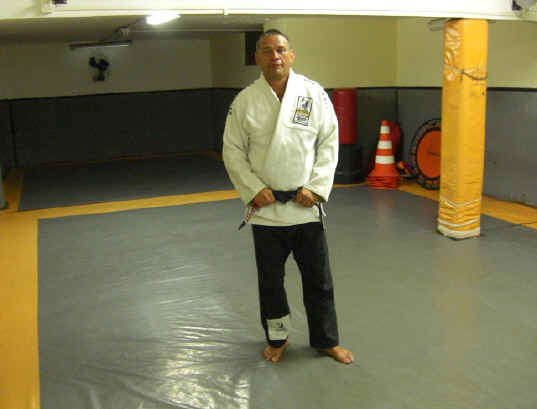 |
| Sergio Bolão de Souza, faixa preta 7 grau. |
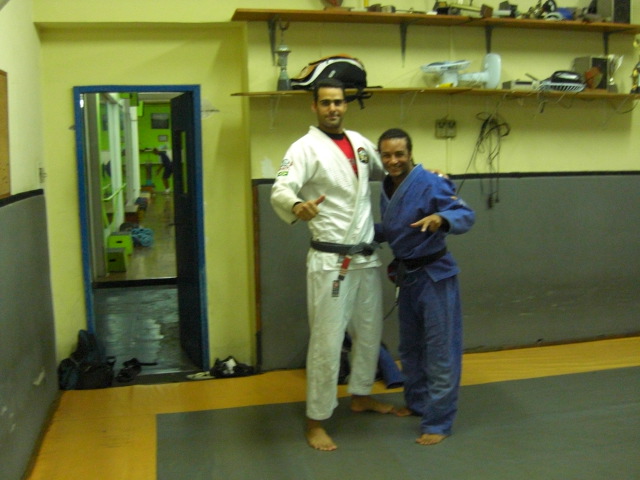 |
| Marcelo Cazuza (left) and Diangelo. Seen through the door, a smooth wooden floor, perfect for Sensei Fred's karate classes. Jiu-Jitsu guys are not arrogant. Every style is cool with them. Do what pushes your personal buttons, they say. Personally, they like jiu-jitsu. |
|
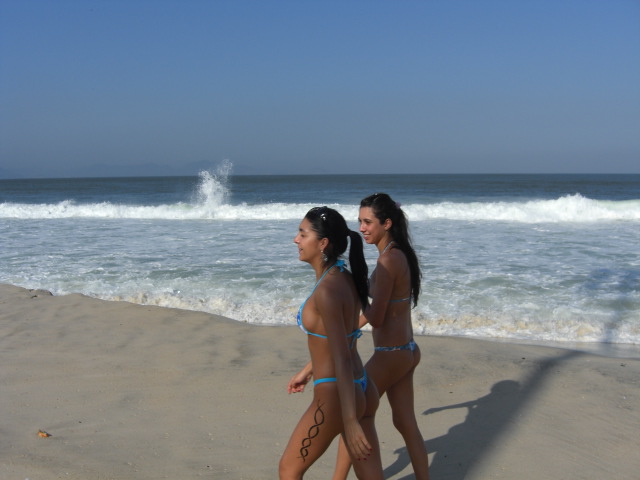
| Garotas na Praia (Copacabana). Surf's up. |
 |
| Pavão-Pavãozinho seen from roof of Corpo Quatro. Compare picture in Zoca. Nothing at all has changed since 1999. |
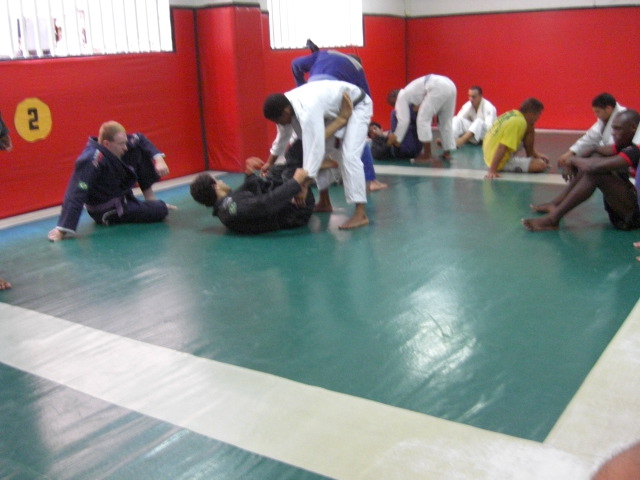 |
| Ricardo Vieira showing spider hook and grip variations. |
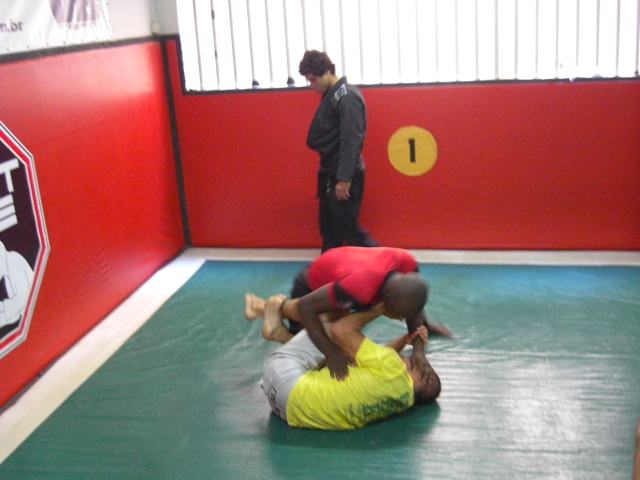 |
| Ricardo Vieira supervising training sem-quimono (Brown belt Alexandre in red on top). Notice how Alexandre controls opponent's face. |
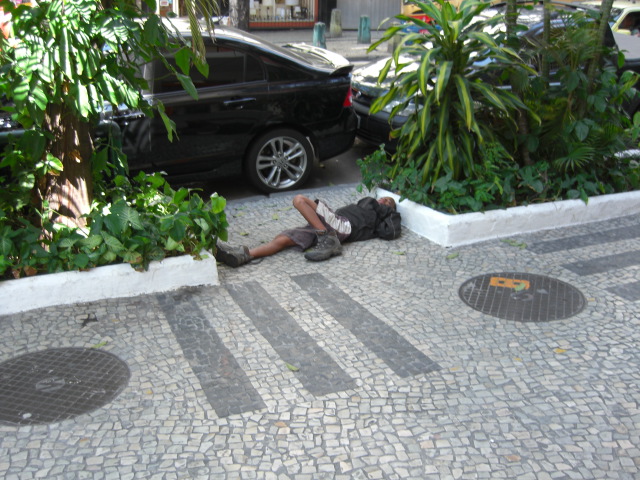 |
| Menino da Rua, sem-teto. Living large on Francisco Sá (except when it looks like the picture below). |
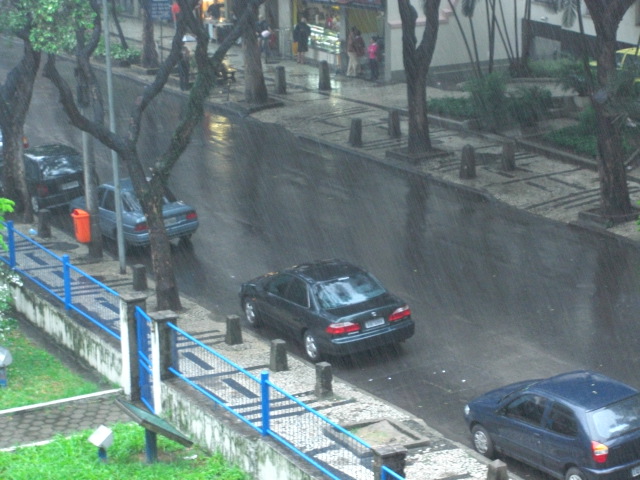 |
| Rainy Day on Francisco Sá.. It isn't all beaches and surfboards. |
Read all of the classic GTR Training in Rio articles from 1997-1999: at A Arte Suave
|
Dedicated to the Memory of Professor Hélio Gracie October 1, 1913-January 29, 2009
Interviews with Prof. Hélio on GTR: |
Global Training Report 2008. (c)2000-2009, Roberto Pedreira. All rights reserved.
|
What you need to know about copyrights before you select and paste copyrighted material to non-authorized destinations: |
Beta Release, December 31, 2008. The Beta version is intentionally a test (pre-publication) version. Within about 30 days the Alpha version (1.0) will be released. This is essentially the final version and typically includes significant revisions and new content.. Subsequent Alpha versions will be released primarily to correct typos or errors.
Alpha Release 1.0, February 3, 2009.
Fifty percent  Content.
Alpha Release 1.1, February 10, 2009. Recommended DVDs deleted.
Update: July 11, 2009. Bolão in Sweden. Minor spelling and punctuation clean up.


|
References 1. Matsumoto, D., & Willingham, B. (2006). The Thrill of Victory and the Agony of Defeat: Spontaneous Expressions of Medal Winners of the 2004 Athens Olympic Games. Journal of Personality & Social Psychology, 91, 568-581. 2. This info comes from six weeks of reports published in O Globo, August-September 2008, and World Health Organization reports.
4. Cohen, J. (1990). Things I have learned (so far). American Psychologist, 45, 1304-1312. 5. Huron, D. (2006). Sweet Anticipation: Music and the Psychology of Expectation.. Cambridge, MA: MIT Press. 6. Madis, E. (2003). The evolution of Taekwondo from Japanese karate. In Martial arts in the modern world (ed. by Thomas A. Green and Joseph R. Svinth. Westport, Conn. : Praeger,
|