


|
This page is a very basic beginning of understanding your goat's body functions. Also a review for those of us who have gotten busy and set aside the basics. We'll start off with the teeth: Goats do not have top front teeth..they have as adults 8 bottom front teeth and a set of molars and incisors- 32 teeth in all. Baby kids are born with teeth although they are sometimes covered with a thin layer of tissue. A goat will loose it's teeth in sets of 2; starting with the middle 2 front bottom teeth at around 1 1/2 yrs old. The nest to go are the next in line at 2 /12 yrs old until all 8 front teeth are replaced with adult teeth. So If you are looking to buy a goat and it is under 5 years of age you should be able to determine the age by which teeth it has.. 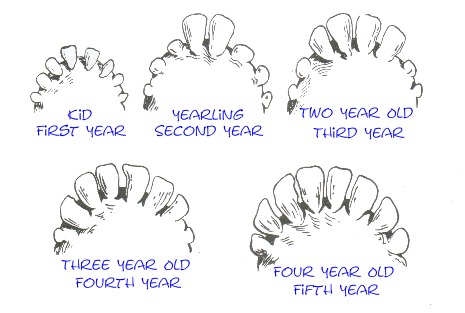 This is a diagram of the entire set of teeth.. goats do NOT like to have their mouths opened so this may be the only chance you get to see this.  Healthy teeth are important to the goat, enabling her to chew properly and digest her food. With older goats you will notice they do start to lose some teeth- it's something that really cannot be stopped. Hoof care is one of the most important parts of caring for and grooming your goats. Poorly taken care of hooves can lead to many health issues: We will get into this a little later. First lets take a look at healthy hooves: 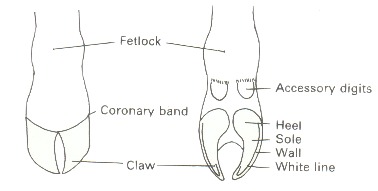 This shows the parts of the hoof and ideally the shape of what a good healthy hoof should look like; take a look at a kid's feet.. they look almost like they are walking on their toes, the hoof is straight and keeps even pressure on all parts of the feet and leg. Ideally all your adult goats hooves should look like a kid's hoof. Regular trimming is the only way to achieve this. There are hoof trimmers on the market that are inexpensive and easy to use. Overgrown hooves can be brought back into normal shape in most cases if they haven't been allowed to get too overgrown. Poor hoof care can lead to hoof rot and other problems, so learning how to trim them is vital in goat care.  Goats are ruminants, meaning they chew cud and have 4 stomachs. They are born a simple stomached animal using only the true stomach-(abomasum); later developing the other three with the introduction of hay and browse. With dairy goats in particular, the sooner they are introduced to hay the more the rumen will develop and the larger capacity they will have for food meaning more milk production. Good quality feed is vital-free from dust and mold. A combination of hay , pasture (if available- I raised goats in dry lot for years before I moved to Missouri and had a pasture-so dry lot can be done successfully)and a pelleted feed or grain mix-free from mold! 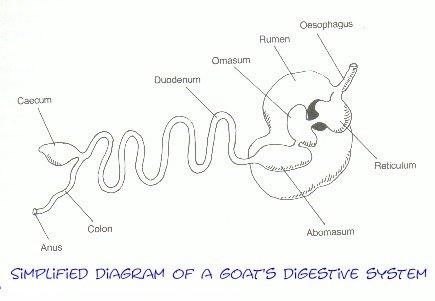 The simple explanation of how a goat's digestion works is this: Goats eat vegetable matter, chewing it slightly before swallowing. The food then goes into the rumen where it will sit until it is brought back up in small plugs called cud, for further chewing. (This BTW is very relaxing for goats- just look into your goatyard a couple hours after feeding time and see how they are all lounging around slowly chewing thier cuds- It's wonderful to watch!) From the rumen after cudding , the food is passed into the abomasum where the enzymes are mixed with the food to further break it down. It is passed into the small intestine where more digestive juices are secreted along with secretions from the liver and pancreas. A good deal of absorbtion of the nutrients occurs here. The large intestine's functions are mainly to resorb the water from the digesting foods. Goat berries are formed in the last part of the large intestine. Have you ever wondered where the rumen goes when doe is pregnant?.. this diagram shows the placement: 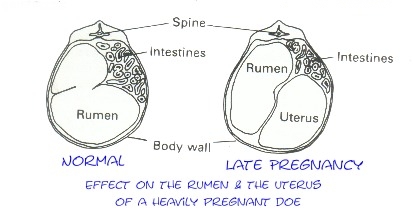 The order in which the food passes through the digestive system is this: 1. rumen, 2. reticulum, 3. omasum, 4. abomasum. A few points about digestion: 1. Goats must in all cases be able to get rid of the gas formed in the rumen, or bloat will occur. 2. The rumen is a large fermentation chamber. 3. the rumen capacity is huge compared to the relative size of the animal- approximately 2 gallons in a medium sized adult goat. 4. Goats do not vomit easily and therefore anything that goes in for the most part.. Stays in. so care must be taken of what your goats eat! Here is a great article written about feeding your goats written by Suzanne Gasparotto of Onion Creek Ranch..Please take a look at " Raising Rumens" A goat's body shape differs from breed to breed and is also individual to a point: I think of it this way... the dairy breeds have somewhat streamlined muscular bodies; the pygmies have the all muscle power-packed bodies in small size; the boers and meat goats are just plain muscle to die for; the nigerians are tiny and delicate; the pygoras are muscular and larger than a pygmy and last but not least.. the angoras are the frumps in the body department.. maybe that's why I love them so much! And there is no goat in the world that looks as royal as an angora in fleece! (of course this is my unbiased opinion..) They all have the same physiological structure:  Here are the basic parts of a diary goat. I hope this helps and I will add more as I have the time.  Questions? Drop me a note... 
 |