by
Gary Parish

|
|
|
|
|
|
|
|
|
|
|
|
|
|
|
|
|
|
|
|
|
|
|
|
|
|||||||||||||||||||||||
|
|||||||||||||||||||||||
|
|||||||||||||||||||||||
|
The Electoral College: Source of Inequality and Social Injustice in America
by Gary Parish |
|||||||||||||||||||||||
|
|||||||||||||||||||||||
THE QUESTION OF STATES' RIGHTS IN ELECTING THE PRESIDENT |
|---|
|
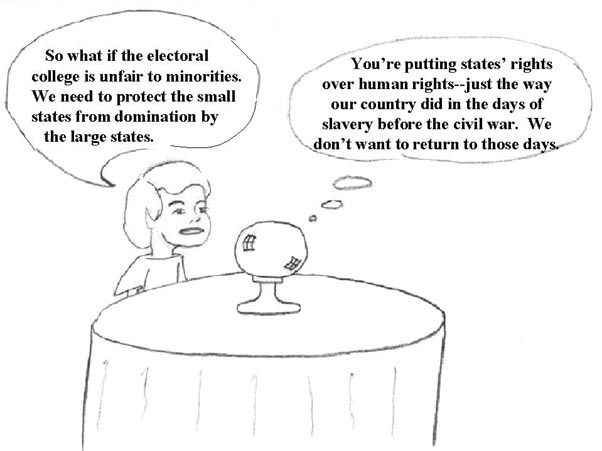
The issue of slavery in the 1800's exposed a fundamental flaw in the Constitution and the principle of federalism by which the states were to provide a counterbalance to the power of the federal government. The Civil war was fought because the power of the states was too powerful relative to the human rights of minority populations. States' rights in Southern states superceded the human rights of slaves.
Out of the carnage of the Civil War came the right to vote for African Americans, the 14th Amendment that limits the power of states to treat minorities differently under the law, and the recognition that the right to secede from the Union is not among the the various powers of the states. However, there was no adjustment of the Constitutional checks and balances between the states, the central government and the people. There was no diminution of the power of the state to check the power of the central government, nor was there an increase in the power of the people to check the power of the state. Instead, we have seen over the past century the continuing struggle for power between the federal government and the states-at the expense of the human rights of the people.
With the incredible advances in technology there has been a corresponding increase in the power of the federal and state governments and a steady erosion of the rights of the people. The absurdity of an presidential election process that is patently unfair, with unequal votes, enforced by the states and the federal government makes it abundantly clear that both the federal government and the states have become too powerful. It is time for a correction. Power must be returned to the people.
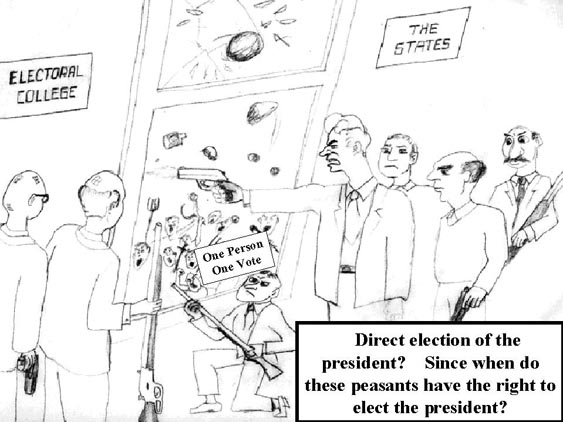
See cartoon showing how easily human rights are suborned to states rights.
A Constitutional arrangement whereby the people, rather than the states, have the right to directly elect the president will eliminate the absurdity of the Electoral College and the associated inequities and inequalities described above. It will provide a much needed correction in the balance of powers among the federal government, the states, and the people, and will strengthen the power of the people to meaningfully participate in government. It will make the President more responsive and accountable to all the people, and not the privileged few who live in the more lightly populated states. It will not destroy the principle of federalism-as some claim--because that principle is well-preserved in the bicameral legislature that insures that both the best interests of the states as individuals (in the House of Representatives) and as a whole(in the Senate) in determining the laws by which our nation is governed. Those who claim that eliminating the Electoral College will destroy the principle of federalism or result in the elimination of the Senate fail to understand the difference between a legislative process and an election process. (See
Under a direct popular vote for the president, the state's proper role as a servant of the people would be to professionally and fairly administer the vote for president within each state and to faithfully carry the vote tally to Washington, D.C. for aggregation with the vote talleys from the other states. The spectre of unending vote counts advanced by the opponents of Electoral College reform for such a system would be no more likely than for our current state electoral apparatus. The Electoral College's proper role would be to provide a staff, a place, and the procedures for faithfully aggregating state vote results by candidate in an open process for all to see. The state electors would have no responsibility other than to convey the vote tally's of it's state for aggregation with that of other states at the national level.
Direct election of the president by the people would firmly establish the people and their human rights as the counterbalance to states' rights and the rights of the central government. It would totally eliminate the problem of the "faithless elector". Because federalism is maintained in the Legislative branch (the Senate), and the states continue to maintain their sovereignty, a republican form of government is continued, and fears about "mob rule" democracy are unfounded. More importantly, the inequities to both white and minority voters of the obviously unfair Electoral College presidential election process would be eliminated. America could truly be the light of the world with its republican form of government, where the key leaders are democratically-and fairly--elected.
The Constitution provides a mechanism by which such a change to our government could be made: an amendment to the Constitution, passed by both houses and ratified by 3/4ths of the states. A grass-roots, nationwide campaign to educate the citizenry about the injustices, inequities and absurdities of the Electoral College is required. This must be accompanied by a nationwide movement to amend the Constitution to provide for direct election of the president by the people. So far, neither major political party has endorsed direct election of the president by the people. The party that does so will rightfully claim the mantle of "defender of human rights" in America for the 21st Century.
|
| PREVIOUS |
HOME|
NEXT
| |