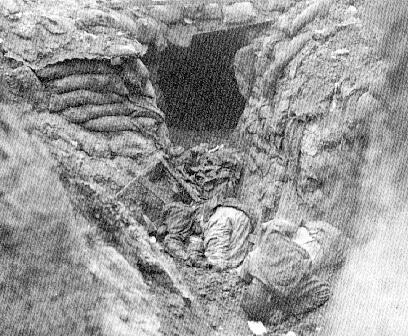
Both sides had to contend with trench warfare. In the first few months in the trenches, there was a spirit of "live and let live" between the two sides. There were acknowledged "quiet" times - you would not shell the enemy at meal times, for instance, and he would do the same for you. Your side would fire the required number of shells but perhaps in places that would not do so much damage, and the other side would do the same. Soldiers would occupy the front-line trenches for a week or so, and then be moved back to the secondary trenches and replaced. The conditions, however, were appalling. The dead would be rotting right beside the soldiers, rats were terrible problems as were lice. If it rained, the trench would fill up with mud. The enemy could not be seen: you could not stand up above the trench or you would be killed by a sniper. Any missions into no-man's-land had to be done at night. The trenches were very close in some places, and the soldiers from both sides could hear each other singing, and would often applaud each other. As time went on, the soldiers, while hating the enemy in principle and the Kaiser or King, began to realize that the men in the other trenches were very much like themselves: doing their duty for King and Country. The quick end to the war, predicted by both sides, would not happen. At Christmas, there was an unofficial truce declared. Exactly where and exactly when is not known, but Allied soldiers started to climb out of the trenches. The Germans yelled that they did not want to fight right now, but it soon became clear that the allies were not attacking. Food and beer were lobbed over into the opposing trenches, and The Germans climbed out and met The Allies in no-man's-land. Basically, they had parties and this spread up and down the trenches. Officers met and shook hands. On New Year's Day, the war resumed.
1914 has been called the end of the nineteenth century. By the beginning of 1915 it was apparent that this was a new kind of war. The technology that had provided so many inventions, had also advanced weapons. Nineteenth Century optimism and the belief in inevitable progress began to vanish as the war continued, and the body count climbed into the millions. Back at home, industry geared up and began producing shells and bullets to continue fighting the war. Since most able-bodied men were in the armed forces, women assumed the roles of factory workers, and proved quite capable. Under the worst possible circumstances, women were allowed to prove that what had been considered "men's work" could be done by women. Unfortunately, millions of the men whose jobs they had occupied, would not return: their fathers, sons and brothers. The conditions in the munnitions factories were less than ideal and many women were blown-up, poisoned or rendered sterile due to the poor safety standards observed.
France would call upon men from her African colonies to enlist as soldiers. Britain would receive troops from all over her empire, including Bermuda, Canada, Newfoundland, Australia and India. Chinese workers worked on the railways behind the lines. A European war was spreading outward, and although the term was not used until 1939, it was becoming the first world war.