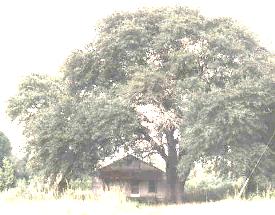
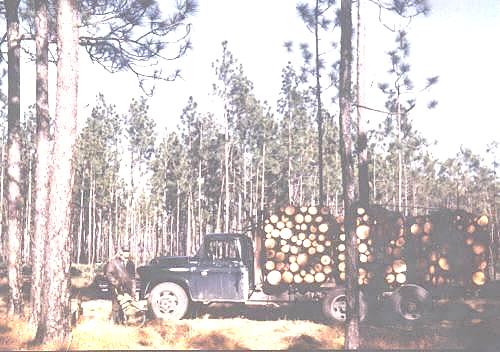
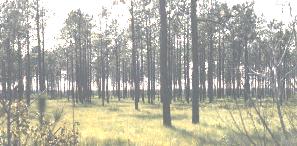
A lot has changed since those days. It is difficult to find houses like those I remember, teetering on stumps or cinder blocks, often unpainted, cold in the winter, hot in the summer. Prosperity has come to Columbus County. It has come to the families of men who made their living in the woods. Innovation in equipment and technique has made it possible to harvest more trees in less time than before. The straight dirt roads, hundreds of which crisscross the pine barrens, trace the path of ever-widening development of the wetlands into pine plantations. Beside each road are the ditches that drain the land so that the logging trucks -- grown twice the size of their predecessors, and equipped with automated devices the like of which my grandfather never even dreamed of -- can get to the trees without sinking in the marsh.
The harsh poverty I remember from my childhood is not the norm today. Life is easier, and people are no longer old at the age of thirty. But poverty is not the only thing that has become rare in the landscape of my childhood. No longer is it possible for a child to marvel at the eerie pods of a Venus flytrap on the way to meet the school bus on Highway 211. The pond where I knelt to come face to face with the pinwheel shape of a pitcherplant flower is long dried. They say that the flytrap, the sundew, and pitcherplant still exist somewhere in what remains of the swamp, but hardly anyone knows where to find them, which may be just as well as they are now so few. Even Lake Waccamaw has lost depth to the point that it has become an oversized pond. I recall when adults dived from the piers into the tea-colored water; now one must walk far out into the lake before the water approaches the shoulders. The water table has lowered, due to the unbridled digging of ditches to drain the marshlands for the harvest of trees. To sacrifice miles of wetlands so that children may sleep in warm beds, so that all people have running water in their homes (not just on the back porch!) and a telephone, is surely a sacrifice with a balanced compensation. Yet there is a point where we must say "enough". It is the point where the balance is thrown, and both the land and the people risk an unrecoverable deficit. How long can the logging company continue to drain the land before the balance is thrown? Already there are reports of ditches draining in the wrong direction from the Lake, of deep fishing holes filling with dirt, of contamination of various kinds. Now we have a proposed landfill. You reach the entrances to the proposed landfill site by one of those logging roads, straight, with a ditch on either side. Other logging roads cross it at frequent intervals. The entrances to the site are blocked by gates. One of the entrances is also crossed by standing water. It has been five days since the most recent rain, yet a large brown puddle remains on the road. The ditches also have water in them. My father says they have had less rain than usual this winter, about four inches below the average. I wonder how much water would be visible here in a normal year. A state-of-the-art landfill, properly constructed and monitored, is a far cry from an old-time dump. From studying drawings and descriptions of the modern landfill, it is apparent that a landfill is the result of much study and effort to dispose of the waste of a large population in the least harmful manner possible (short of recycling). A landfill is a multi-layered sandwich with a compacted clay bottom, layers of thick plastic, gravel, dirt, all of which are permeable or semi-permeable materials. It is a marvel of technology, certainly, in that we've gotten to where we can scientifically "digest" our refuse almost like a new organism created for the purpose. This is really cool, but is it a cool to set one here at Clewis Corner, which, despite what the experts say about it being above the official floodplain, is a site that is at the least prone to puddling, not to mention the flooding that put it underwater during Hurricane Floyd? The landfill will gobble up about a mile of land, five acres of it "protected". The garbage from Columbus County will make up a small percentage (I've heard about 2%) of the total mound which will rise higher than the fire tower on Hwy 211. The plan is to bring in the majority of waste from Somewhere Else to justify this mound. This will bring revenue to Columbus County, which is a main selling point. Revenue is good, it means prosperity for the people. This is your counter-balance, the gain that outweighs the further destruction of the Green Swamp. Free garbage service means a savings of the garbage fee everybody has to pay, right? Well, no -- free garbage service means it is free to the County. No one has heard anything about waiving the garbage fee paid by the people of the County. Nor is anything said very loudly about the 300 or so garbage trucks that will be going up and down the ragged 211 highway, or how much of the revenue is going to sink into building up the tarmac when the shoulders start crumbling off the sides again. Where is the gain to the people of Columbus County? Where is the balanced compensation? These things I wonder as I look around Clewis Corner. No longer a "true wetlands", Clewis Corner is still an easy place to fall into some water. Even five days after a moderate rain. Even with a lower-than-average rainfall. It's enough to make you wonder... |