The tomb entrance to KV 62. Description: KV 62 is a small tomb but it is known to all because of the treasures it held intact for over 3,000 years. It was discovered by Howard Carter in 1922. When King Tutankhamen died suddenly at an early age, the tomb that perhaps was originally planned for him in the Western Valley, at some distance from his grandfather Amenhetep III, was nowhere near completion. It may have been decided that the King would be buried in a tomb that was to be given as a royal favor to a high official (Ay) in the main valley. Ay later took the Western Valley tomb (WV 23) when he succeeded Tutankhamen on the throne. The entrance of the tomb is cut into the Valley
floor (the ground level in antiquity was lower than today). KV 62 lies
directly in front of KV 9, the tomb of Rameses VI. Even before the construction
of KV 9, debris had already been dumped on top of the KV 62 entrance. The
tomb was forgotten and a group of Ramesside workmen's huts were built over
it later in antiquity. Howard Carter, the tomb's modern-day discoverer,
found the tomb through excavation in an area where he had discovered artifacts
bearing the name of Tutankhamen. Sixteen steps led down to a sealed doorway
covered in ancient stamps of ancient Valley guards.
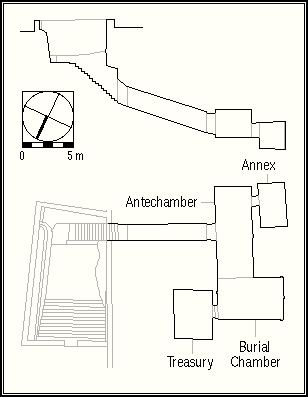
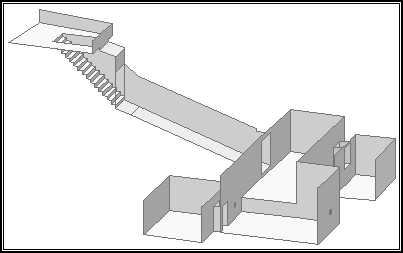
The plan of KV 62. As with all the tombs in the Valley, KV 62 was cut out of the limestone bedrock. Although it is small, the four rooms in KV 62 do, nevertheless, relate directly to certain parts of more traditional plans. The first room reached after the flight of 16 steps and a descending corridor, the Antechamber, is similar to the pillared section of the burial chambers in other tombs. The walls are rough, as are all the other rooms except for the burial chamber. Doorways at the beginning and end of the corridor had to be cut back for funerary equipment to be placed in the Burial Chamber. This room held between 600 and 700 objects. In the west wall of the Antechamber a low doorway leads to the Annex; it is equivalent to the storerooms off the sides of the pillared hall in traditional tombs. This was the last room to be filled before sealing the tomb. The Burial Chamber is sunken and separated from the antechamber by a rubble partition wall, which was dismantled by Carter and his team. Traces of chisel marks on the ceiling, aligned with the west wall of the antechamber run at least halfway into the burial chamber. This suggests that at an earlier stage, the north end of the antechamber went this far before the plan was altered by extending it to the west and lowering the floor to convert it to the burial chamber. At the present north end of the antechamber's west wall, a rough cutting surrounded by black lines may represent the abandoned start for a door. In each wall is a niche that contained "magic bricks." The niches were covered by limestone blocks which were then plastered and painted. The room held 300 objects in addition to the four shrines, sarcophagus, three coffins, burial mask and mummy of the King. Beyond the east wall of the Burial chamber
lay the Treasury. This storeroom for Tutankhamen's canopic shrine held
over 500 objects. It is similar to the storerooms of other burial chambers
in the Valley, and had the only doorway in KV 62 not sealed with plaster
and gravel fill.
Isometric drawing of KV 62. History of Activity in the Tomb: We know that KV 62 was robbed at least twice in antiquity, judging from three different sets of seals on the doorways signifying three different closures of the tomb. Other evidence of theft includes dockets giving the quantities of objects in boxes that did not add up when Carter and his team were taking inventory. The looters do not appear to have penetrated past the Antechamber. Decoration: Only the burial chamber was decorated. The background for the scenes was a golden yellow; the figures are of non-traditional style. Every wall save the south wall utilizes the 20-square grid pattern used during the Amarna Period. The south wall more closely fits the 18-square grid pattern of traditional art.
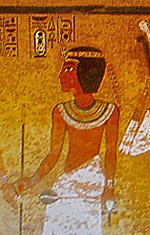
View of North wall of Burial Chamber depicting King Tutankhamen. East Wall: The King's entire burial (the shrines, coffins, sarcophagus, and mummy), covered in garlands, is shown being pulled on a sledge by figures wearing mourning headbands. Hieroglyphic texts announce that the figures are high officials of the palace. North Wall: Three scenes depict the steps the King needed to take on his journey into the Underworld: Ay performs the 'Opening of the Mouth Ceremony' (below); Nut welcomes the King, dressed as he was in life; and the King in royal regalia, followed by his Ka (spiritual double), is embraced by Osiris in the realm of the gods. In each of these scenes, the names of the people or gods shown are written above their heads. South Wall: (damaged, incomplete) The King is welcomed as he enters the Underworld. One scene shows the King with Anubis, god of embalming, and the life giving Hathor, goddess of the West. The other, now destroyed, shows Isis welcoming the King with three minor deities of the underworld behind her. Again, the texts describe the subject of the scenes. West Wall: Excerpts from the Amduat are written
above a representation of the solar barque on which the King will ride
across the sky. Five deities stand in front of the solar barque. Below
this are 12 squatting baboons in three registers that represent the 12
hours of night through which the sun and king travel before being reborn
in the morning.
|