



An
off road exploration
By members of Grupo Fauna y Flora Dulceacuicola del Uruguay*
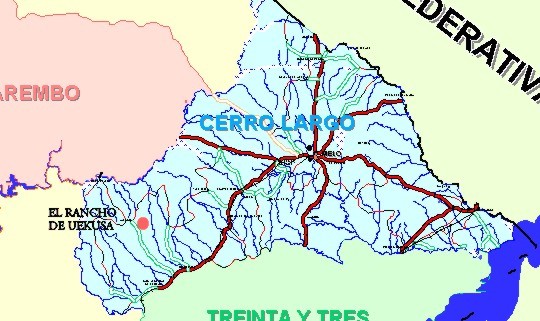
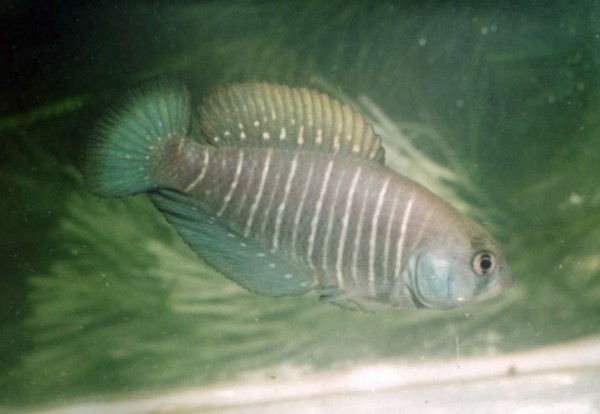
In one occasion last winter, our friend Heber was informed about an extraordinary capture of Austrolebias CXCL 004 (uruguayensis) and Austrolebias vazferreirae, by two fanciers that had been fishing in a farm located in the Cerro Largo Department, Republic of Uruguay. Inmediatelly, a journey was organized to visit that place, with the previous owner’s authorisation. This time. Mr. Daniel Gil provided the vehicle and made us, Enrique, Francisco, Heber and Pablo, possible to access maybe one of the most isolated and less populated points of our country.
We left Montevideo, the capital city, early in the morning, by 4 o’clock, and we pointed to the born of Route 7, northeast direction. This route developes almost all above the heights of the Cuchilla Grande, one of the biggest orographic systems of our mostly plain territory, wich divides the easter basin from the central one. This way was one of the old historic ones to the border with Brazil, due to the absence of great river crossings, making the journeys possible even in bad weather or flood conditions. It’s trace is paralell to the railways to Rio Branco, crossing them in numerous places, producing a sequence of zig zags that makes it dangerous and tedious. The road conditions were even worse, so the kilometers went down slowly, delaying our arrival an hour or so. At nine we arrived to a point three hundred kilometers from the departure; here we had to leave the main road and take a penetration course following a rocky crest, a branch of the main system, from where the valleys could be seen bellow, with rivers flowing to the big Río Negro, arround 50 kilometers ahead. One of them was the “Arroyo Tupambaé”, that crosses the farm where we were supposed to arrive finally. Also we could see the enormous reservoirs of water created in order to generate the necessary amounts of it needed to flood the rice plantations, main production of the area. This kind of production is preciselly considered to be one of the most agressive for the biotopes related to the lowlands near water ways, where our killies do live. So this would be a great opportunity to verify this fact.
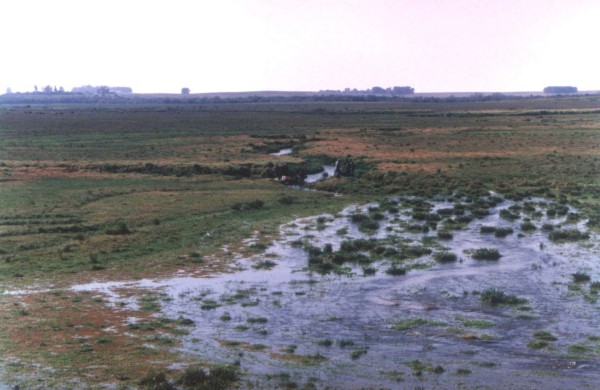
Finally we get to meet Juan, wo had been waiting for hours in the last turn of the road before entering the farm. Inmediatelly, the people get out of their houses to meet us, as well as the numerous dogs that kept barking and barking. At this time, after saying hello to all these kind persons, we where strongly willing to start fishing, to see if we could get any of those specimens that Heber was told about. We started near the dam of the big reservoir that was arround a Kilometer far from the houses. The vehicle was not the ideal one to deal with the wet fields covered of grass, but Daniel managed to reach the point. There, a small creek carried the waters from the dam to the channels that feed the water for the plantation, that was not cultivated at that time.
We surpressivelly could find four species of Gymnogeophagus in there, in spite of not seeming to be possible, as well as an enthusiasming variety of tetras, like Astyanax sp., Hyphessobrycon sp., Bryconamericus sp., etc.
We decided to move directly to the plain, where the impressive fish were caught several days before. The Austrolebias didn’t wait to show. Soon, a bunch of fishes were obtained, certainlly not so much as in the previous time, perhaps explained by the water level went down produced by the lack of rains for the last week. Only one male of “uruguayensis” was obtained, and the big shape of all them told us that the population was probably born last season and survived thanks to the favourable weather conditions the summer before.
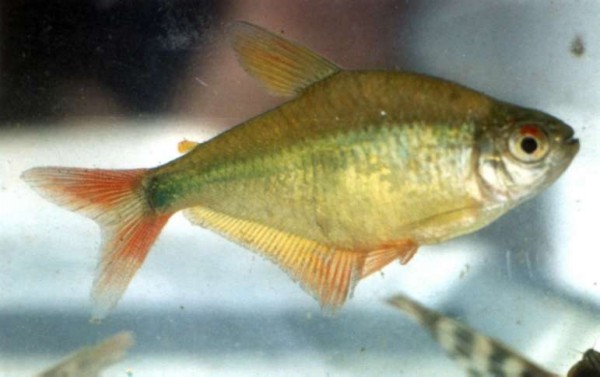
Lots of places were remaining unexplored, so we decided to postpone the traditional “Cordero” (roasted lamb) offered by the house keepers, to continue investigating the area beside the end of the canals, near the big watercourse we’d seen from above, the “Arroyo Tupambaé”. We pointed there with the vehicles, but when we arrived, we saw an inmense marsh of about five hundred meters between the way and the main body of water. Anyway, we tried one of the various lagoons covered with “Camalotes” (Pontederia sp.) Hundreds of amazing tetras with blood red tails (Hyphessobrycon lutkeni) started to glance as soon as we hang the nets, as well as many Brachypopomus brevirostris, an electrical fish of the family Gymnotidae. But what did in fact sorprise all was an outstanding male of Cichlasoma pussilum (“Portalegrensis”) with it’s golden scales marginated of black and big red eyes, making it a very impressive fish. We didn’t expect to find this species here; it is supposed to belong to the northern areas, but this confirm populations to the eastern ones too. This kind of biotope related to the natural floods of the main rivers is tipically inhabited the mentioned combination of species, even the plants are an un doubtly sign that points where tetras, gymnotoids and cichlid of this genera, as well as small catfish are present.
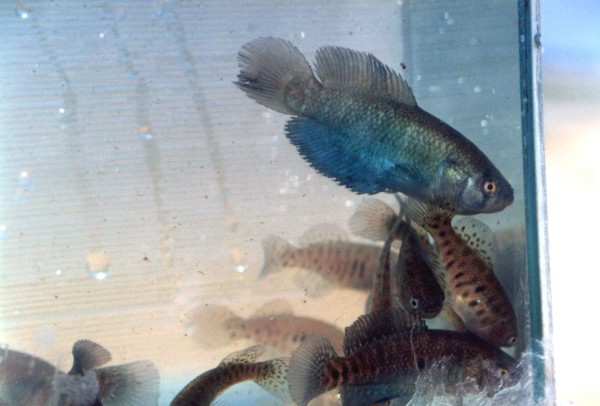
After being satisfied by the capture, we decided to go to a nearby sector, where some remaining ponds could be seen, making us suspect the presence of the still available killies. We walked for arround a couple of hundred meters thru deep mud, to arrive a promising area sorrounded by tall gras. As we had imagined soon a bunch of new Austrolebias vazferreirae, mostly females, started to plenty our nets.
Once again the low level of the waters appeared to be the reason of why a small number of males were captured.
The day was passing quickly, and our bellies were so empty, that, completed our expectations, we decided to accept the invitation to degustate the exquisite roasted lamb, looking forward to recover at least some energy lost in the fishing activities.
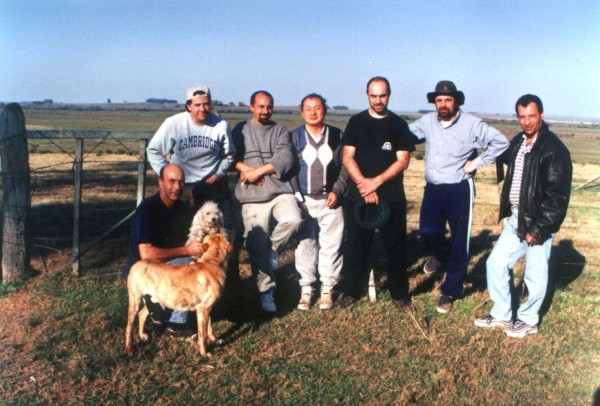
The comments about what we had lived that day were not absent, and we enjoyed a nice moment with this great people who live and work here every day, 50 kilometers far from the nearest town, and with Uekusa, the owner of the farm, a Japanese gentle young men.
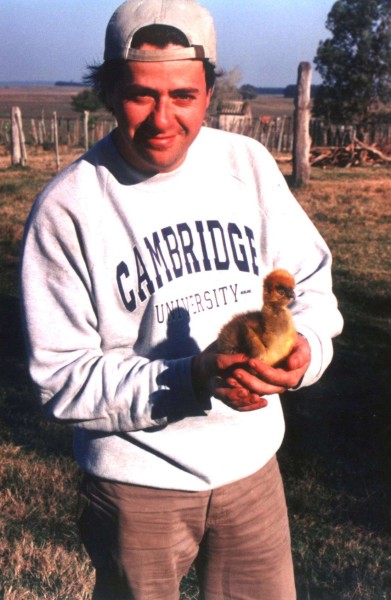
Before departure, we spent a few minutes to repose and take some pictures with them, sorrounded by the giant horizons of the uruguayan lands. Daniel even took himself one with a baby “Chaja”, as he is in fact a big bird fancier.
We returned to Montevideo with the hope of being able to visit again this almost virgin place, despite of it’s enormous future developement opportunities.* The Group Fa Flo Dul is integrated by:
Enrique Perujo
Francisco Prieto Roberto Recuero
Heber Salvia
Pablo Laurino
E-mail: faflodul@adinet.com.uy

Back to collecting trips articles
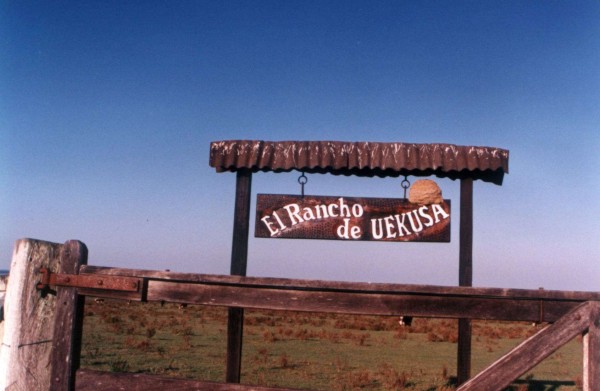
Enlarge The entrance of the farm shows the typical label with a nest of an oven bird on it. (By Pablo Laurino)
Enlarge The waters flow from the reservoir to the main waterway, the Arroyo Tupambae, in the background. (By Pablo Laurino)

Enlarge Daniel is holdig a baby Chaja bird. (By Pablo Laurino)
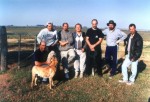
Enlarge The group with Uekusa, the owner of the farm. (By Pablo Laurino)
Enlarge The capture of Austrolebias vazferreirae, showing an outstanding male. (By Pablo Laurino)
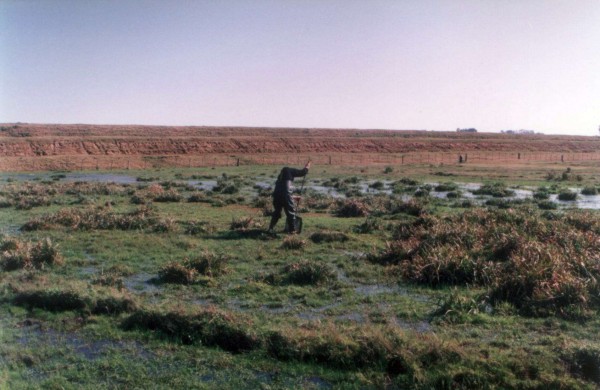
Enlarge Heber is dweeling with the numerous ponds where killies hide; the dam of the big reservoir shows in the background. (By Pablo Laurino)
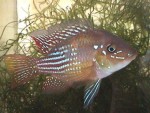
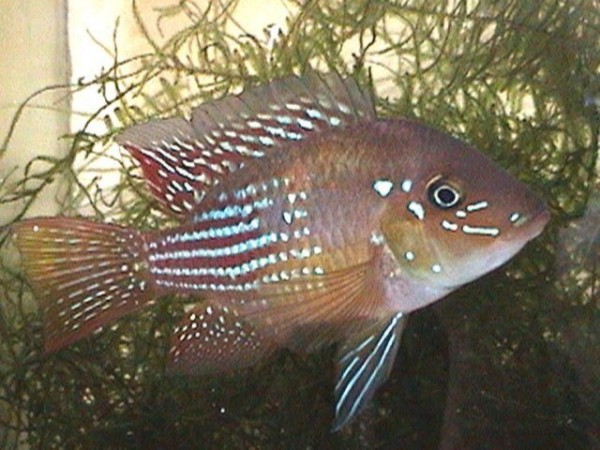
Enlarge One of the four species of Gymnogeophagus that were obtained in the channels. (By Pablo Laurino)
Enlarge These tetras, Hyphessobrycon lutkeni, really show very amazing reds and greens. (By Francisco Prieto)
Enlarge The only male of Austrolebias uruguayensis, a nice trophy for such a big effort. (By Francisco Prieto)