Important Announcement:
GAA, the Guangya Australian Association, is organising a group visit to Taiwan in Octocber 2001. Friends and members of the GAA are encouraged to take advantage of this opportunity to develope people-to-people friendship with friends in Taiwan. To maximize your visiting experience to Taiwan, contact us now to ask questions or submit your ideas in relation to the coming up event. The group will be meeting Guangya Alumni and friends in Taiwan and Dr Henry Hsu OBE, Honourary Member of the International Olympic Committee (IOC) and GAA Honourary President, has extended his personal invitation to the group. -Ed 2001
The Program (Draft)
1007 Meet Futuna Hotel, Taipei.
1008 Reception by Dr Hsu and Taiwan Guangya Alumni, Taipei.
1009 Friendship and Cultural Activities, Taipei.
1010 Friendship and Cultural Activities, Taipei.
1011 Visit Southern Taiwan.
1012 Visit Southern Taiwan.
1014 Free time activities, Thank you dinner by Guangya Australia group.
1015 Conclude the group visit.
Group members must make their own travel arrangement for trips to the Futuna Hotel on 7 October and from Taipei to their desired destinations, eg. Hong Kong, China, or Australia, etc, on 15 October. Please inform hotel staffs that you are a member of the Guangya Australia Association to register yourself for free group activities and discount rate on accommodation. Call or email us for a estimated cost on the trip.
We would like to take this opportunity to thank Dr Henry Hsu and the Taiwan Guangya Alumni for their invitation and supports in making this wonderful program possible.
Geography
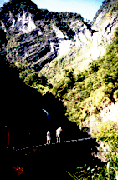 Taiwan was known for almost four centuries in the West as Ilha
Formosa - meaning 'Beautiful Island'. It was named by the Portuguese, who held
control of the island through much of the seventeenth and eighteenth centuries.
However, for the Chinese it has always been known as Taiwan(meaning 'terraced
bay'). It is 384km (240mi.) long by 136km (85mi.) wide. Although created by
tectonic shifts and volcanoes many millions of years ago, there are no longer
any active volcanoes in Taiwan. Taiwan is mountainous and rugged in the interior
of the island with 90% of the people living along the gentler west coast. It is
located 144km (90mi.) off the southeast coast of Mainland China's Fujian
Province. Taipei, Taichung, and Kaohsiung offer easy weekend access to the
mountains for climbing and recreation, and Kaohsiung has Kenting National Park,
known for it's beaches and beautiful scenery.
Taiwan was known for almost four centuries in the West as Ilha
Formosa - meaning 'Beautiful Island'. It was named by the Portuguese, who held
control of the island through much of the seventeenth and eighteenth centuries.
However, for the Chinese it has always been known as Taiwan(meaning 'terraced
bay'). It is 384km (240mi.) long by 136km (85mi.) wide. Although created by
tectonic shifts and volcanoes many millions of years ago, there are no longer
any active volcanoes in Taiwan. Taiwan is mountainous and rugged in the interior
of the island with 90% of the people living along the gentler west coast. It is
located 144km (90mi.) off the southeast coast of Mainland China's Fujian
Province. Taipei, Taichung, and Kaohsiung offer easy weekend access to the
mountains for climbing and recreation, and Kaohsiung has Kenting National Park,
known for it's beaches and beautiful scenery.
Population/Demographics
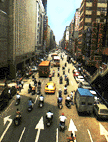 The population currently is a little over 22 million inhabitants. 85% are native Taiwanese; descendants of early
migrants from Mainland China. Most of the remaining 15% is made up of Chinese
people who left the mainland in 1949. Less than 1% of the population is made up
of aboriginal peoples who mainly live in the mountains and small outlying
islands.
The population currently is a little over 22 million inhabitants. 85% are native Taiwanese; descendants of early
migrants from Mainland China. Most of the remaining 15% is made up of Chinese
people who left the mainland in 1949. Less than 1% of the population is made up
of aboriginal peoples who mainly live in the mountains and small outlying
islands.
Pollution
 Like many newly industrialized countries, Taiwan is suffering from the
consequences of rapid economic and industrial growth with too little
environmental controls. As a result, all drinking water is either bottled or
boiled. The air can sometimes be very dirty. People suffering from asthma or
heavy allergies should not consider coming to live in Taiwan. The Taiwanese also
tend to equate noise with life and excitement, and so the noise levels in
metropolitan centers are very high and can be uncomfortable to those unused to
it.
Like many newly industrialized countries, Taiwan is suffering from the
consequences of rapid economic and industrial growth with too little
environmental controls. As a result, all drinking water is either bottled or
boiled. The air can sometimes be very dirty. People suffering from asthma or
heavy allergies should not consider coming to live in Taiwan. The Taiwanese also
tend to equate noise with life and excitement, and so the noise levels in
metropolitan centers are very high and can be uncomfortable to those unused to
it.
On the positive side, collective awareness of environmental pollution is growing and has resulted in stricter pollution controls and higher public responsibility for the environment. Two years ago, Taipei began its mandatory recycling campaign, and now 30% of the residential garbage is recycled. This is not much compared to present standards elsewhere but is an admirable start at addressing the problems of pollution in Taiwan.
Language
Mandarin Chinese is the official language of Taiwan. It is taught in all public schools and is used in all branches of the government and by the majority of the media. However, more than 50% of the population speaks Taiwanese at home. A small percentage speak Hakkanese, and there are also 10 distinct aboriginal languages.
Religion
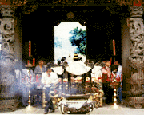 About 90% of the Taiwanese practice a blend of Buddhism and Taoism
with a heavy Confucian influence. Many Taiwanese have an area or room in their
homes where they build elaborate alters for the worship and remembrance of their
ancestors. Between 2 and 5% of the population is
Christian.
About 90% of the Taiwanese practice a blend of Buddhism and Taoism
with a heavy Confucian influence. Many Taiwanese have an area or room in their
homes where they build elaborate alters for the worship and remembrance of their
ancestors. Between 2 and 5% of the population is
Christian.
Visas
Taiwan has recently begun issuing 14-day landing visas to many nationalities. It is best to check with your local Taiwan office in your home country as to whether your country's citizens are eligible as the requirements change often. It is recommended that all foreign nationals, including overseas Chinese holding foreign passports, apply for a tourist visa to enter the ROC before coming to Taiwan. It is best to apply for the visa in your home country. There are several types of tourist visas you might be given: 30-day visas, 2-month extendable visas, or 5-year multiple entry visas. There is no written rule as to how these are distributed. Taiwan does, however, look favorably on those people who are interested in Chinese culture and the Chinese Language. Once an applicant has been hired by ELSI Taiwan, ELSI will sponsor that person for a resident visa. The resident visa allows you to work in Taiwan legally.
Climate
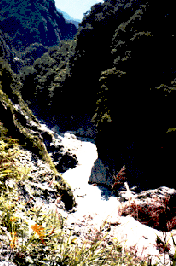
Taiwan lies along the 120th parallel and between 22 and 27 degrees north of the Equatorand is nearly bisected by the Tropic of Cancer. Northern Taiwan has four distinct but mild seasonal changes, and southern Taiwan has two. The humidity is generally high year round.
- Season: SPRING
- Temperature: 17-25C, 65-78F
- Rainfall: "Plum Rains" in May and June
- General Description: Mostly sunny and mild.
- Season: SUMMER
- Temperature: 23-36C, 75-98F
- Rainfall: Afternoon rainshowers often, also the most likely time of the year for typhoons
- General Description: Very hot and humid
- Season: FALL
- Temperature: 20-27C, 68-81F
- Rainfall: Little rain and low humidity.
- General Description:Pleasant temperatures and mostly sunny
- Season: WINTER
- Temperature: 12-24C, 52-75C
- Rainfall: Some heavy rains in the north, often drizzly with gusty winds.
- General Description: Frequent rains and often windy.
